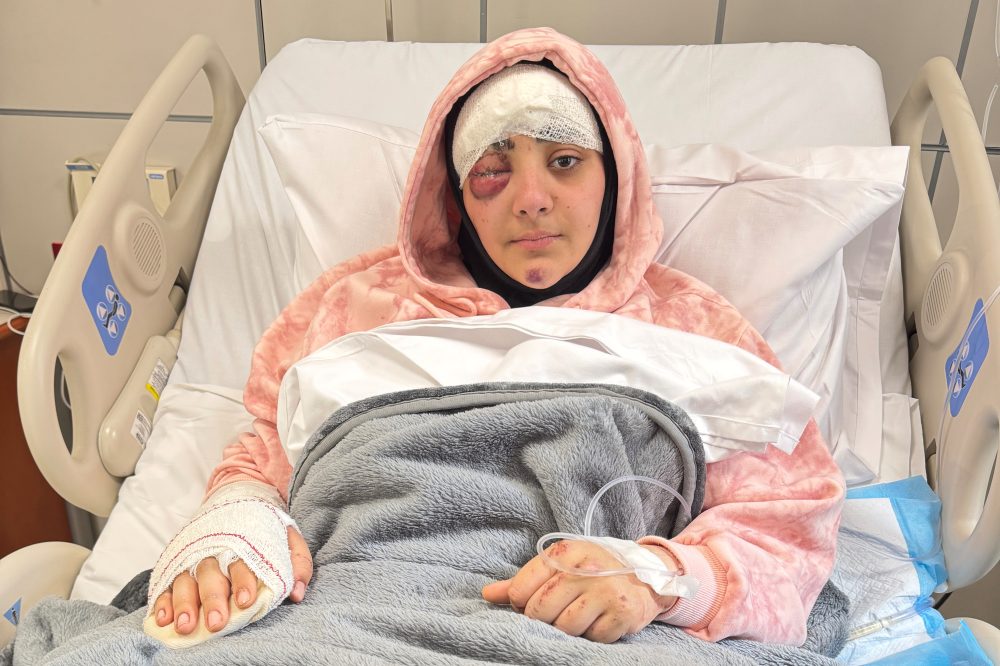

A Lebanese journalist who survived an Israeli airstrike that claimed her colleague’s life has shared her harrowing account of the hours they spent waiting for rescue, speaking to The Associated Press from her hospital bed on Friday.
Zeinab Faraj, a freelance photographer and video journalist, regularly worked alongside Amal Khalil, an experienced correspondent for the Lebanese newspaper Al-Akhbar who covered southern Lebanon.
The pair were traveling behind one of Faraj’s relatives through the village of al-Tiri on Wednesday, approximately 8 kilometers from the Israeli border. They had arrived five days after a delicate ceasefire took effect between Israel and Hezbollah, intending to document conditions in the area following the truce.
While passing through the village with Khalil recording video on her phone through the car window, an Israeli strike targeted the vehicle ahead of them, Faraj explained from her recovery room at a Beirut medical facility.
Both women exited their vehicle and sought cover along the roadside while a drone circled above. Approximately one hour later, a second attack struck Khalil’s car parked nearby.
Faraj managed to force open a shop’s metal security door, and both journalists took shelter inside the building.
“Amal was crawling, she was wounded — her nose and head and shoulder and leg,” Faraj remembered, her words difficult to understand through facial swelling and bruising. She noted that Khalil also sustained burns when the targeted vehicle burst into flames.
The two were able to contact their families and news organizations. According to Faraj, Khalil maintained a positive demeanor and attempted to reassure her loved ones that both were safe.
During this time, urgent communications began between the Lebanese Red Cross, Lebanese military forces, the U.N. peacekeeping mission UNIFIL, and Israeli forces to arrange safe evacuation for the journalists.
As time passed, Faraj began losing consciousness.
“When I said I wanted to go to sleep, Amal came closer and hugged me and told me, ‘Zeinab, don’t leave me alone,’” she recalled. “I realized that Amal was not in good condition. The color of her face had changed and I realized that she had some internal bleeding, too.”
While drifting in and out of consciousness, she heard incoming ordnance. A third strike hit their shelter.
The blast ejected Faraj from the shop while Khalil remained trapped inside.
“I was in and out of consciousness, and then I thought my dad had come to get me and I began calling to him, ‘Baba, I’m here, come and help me,’” Faraj said.
Emergency responders arrived and extracted Faraj from the debris, also recovering the bodies of two people killed in the initial vehicle strike. Lebanon’s health ministry reported that Israeli forces fired upon the Red Cross ambulance attempting to reach Khalil, forcing the crew to retreat.
The Israeli military stated that individuals in the village had breached the ceasefire agreement, putting Israeli soldiers at risk, and rejected claims that it targets media personnel or blocked rescue operations. Officials said the incident remains under investigation.
Faraj had lost consciousness and remained unaware that Khalil hadn’t been evacuated with her until several hours later.
Just before midnight, after Lebanese military, civil defense, and Red Cross teams received authorization to enter the area, Khalil’s body was recovered from the wreckage.
Faraj maintains that “if they had gotten to her a bit sooner, Amal would be here today.”
The current Israel-Hezbollah conflict started on March 2, when the militant organization launched a missile barrage across the border, occurring two days after the United States and Israel began their military action against Iran. Israel countered with extensive bombing campaigns in Lebanon and ground operations.
Following the ceasefire agreement, Israeli forces have maintained control over a border zone extending approximately 10 kilometers into Lebanese territory, characterizing this area as essential for protecting northern Israeli communities from Hezbollah rocket attacks. Despite the truce, both Israel and Hezbollah have continued launching strikes.
Faraj suspects the journalists were intentionally targeted. Khalil had previously disclosed that during her reporting in southern Lebanon during the earlier 2024 Israel-Hezbollah conflict, she received threatening communications from an Israeli phone number.
The origin of these messages — whether from Israeli military sources or private individuals — remains unclear. The Israeli army has not yet responded to requests for comment on this matter.
Prior to Khalil’s death, Avichay Adraee, an Israeli military spokesman, shared on social media platform X a video from Al-Akhbar featuring Khalil rescuing a cat from destroyed building debris. He labeled the publication “terrorist media speaking on behalf of Hezbollah, the devil” due to its pro-Hezbollah editorial stance.
The Committee to Protect Journalists, an international advocacy organization, condemned the post as “incitement” in an official statement.
“Under international humanitarian law, journalists, as civilians, are protected from direct and indiscriminate attack, regardless of the positions or affiliation of their media outlets, provided they do not directly participate in hostilities,” the organization stated. “There is no evidence that Khalil or Faraj were directly participating in hostilities.”
The group has requested an international investigation into Khalil’s death.
Lebanon’s information ministry reports that nine journalists have died in Israeli strikes since March 2. The latest Israel-Hezbollah war has resulted in nearly 2,500 Lebanese deaths, including 277 women, 177 children, and 100 healthcare workers. Fifteen Israeli soldiers and three civilians have also been killed.