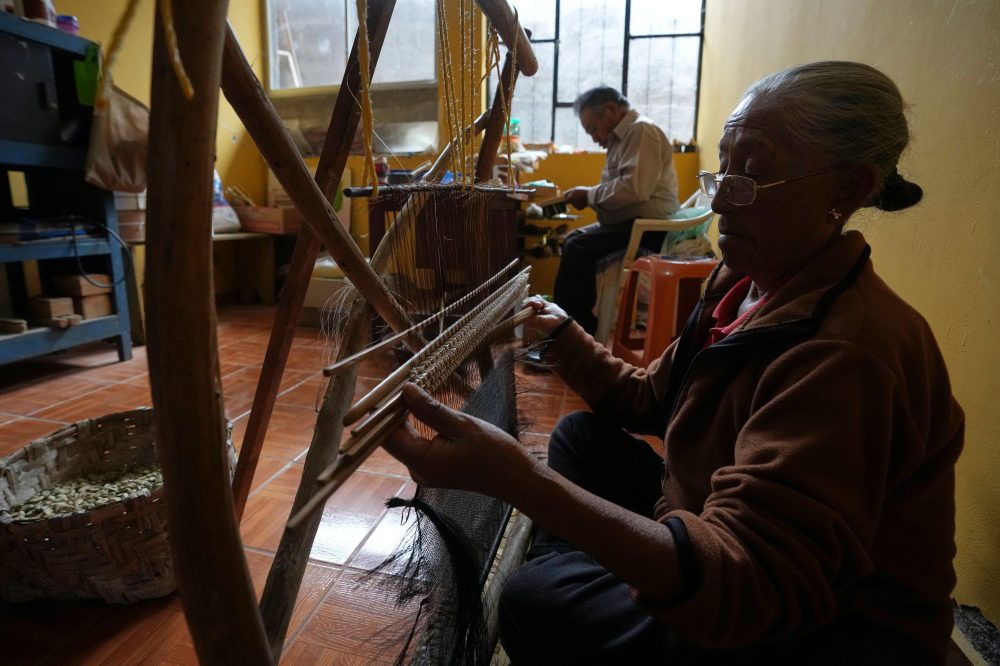

In the small community of Guangopolo, located east of Ecuador’s capital city, 76-year-old Ligia Ipiales sits in her humble dwelling, meticulously pulling apart horsehair strands from a tail. She’s creating a delicate mesh resembling fine cloth for a “cedazo” — a time-honored strainer that’s barely hanging onto existence.
This age-old skill that once brought recognition to the community is slowly disappearing. Just nine “cedacero” craftspeople are left. The group’s youngest member is 51-year-old Guido Paucar, who stands as the sole male practitioner, while Ipiales represents the eldest at 76 years old.
“This is our village’s identity. If it disappears, Guangopolo loses a part of who it is,” said Paucar. “We are the last generation making these sieves.”
Five decades ago, Paucar remembered, approximately 500 Indigenous households earned their livelihood creating and marketing these strainers, distributing as many as 600 pieces monthly at costs between $6 and $30 based on size. However, the introduction of less expensive plastic strainers and man-made materials transformed these sieves into decorative items with no practical household use. “Now we only sell up to 10 each week,” he added.
Community documentation reveals that 1,500 Guangopolo inhabitants have been creating sieves for two centuries. Constructed similar to a percussion instrument, each strainer includes a slender wooden border measuring 15 centimeters (6 inches) in height that holds the customary horsehair material in place. Through the end of the previous century, these implements were essential in Ecuadorian cooking areas, where cooks mainly employed them for filtering flour.
Manufacturing expansion and ecological changes have created growing challenges in obtaining horsehair and timber from the indigenous Pumamaqui tree.
Previously, horses served as essential partners for farm labor throughout the Andean highlands. Currently, though, agricultural workers choose motorcycles and farm machinery instead. This transformation has compelled craftspeople to search other areas, making southern Colombia and central Ecuador the main suppliers of horsehair. Yet the raw material carries a significant cost, with 100 pounds (approximately 45 kilograms) priced at roughly $1,000.
Following cleaning and air-drying, horsehair gets organized by strand length and mounted on a basic wooden structure called a guanga. Sitting with legs folded on the ground, the craftspeople operate with remarkable velocity that makes their hands appear to move in a blur, choosing, extending and tying single strands into a complex pattern.
Creating cedazos previously gave women additional earnings and occasionally covered their children’s schooling costs.
At the El Cedacero workshop facility, where Guangopolo’s surviving weavers gather, attempts to educate younger people through training sessions and instruction have consistently failed to succeed.
“From the age of 6 or 7 our mothers taught us how to weave sieves,” said Leonor Cuje, 57, gesturing toward a table lined with sieves, bracelets and brushes made from horsehair. “Now they are professionals and they don’t want to do this anymore.”