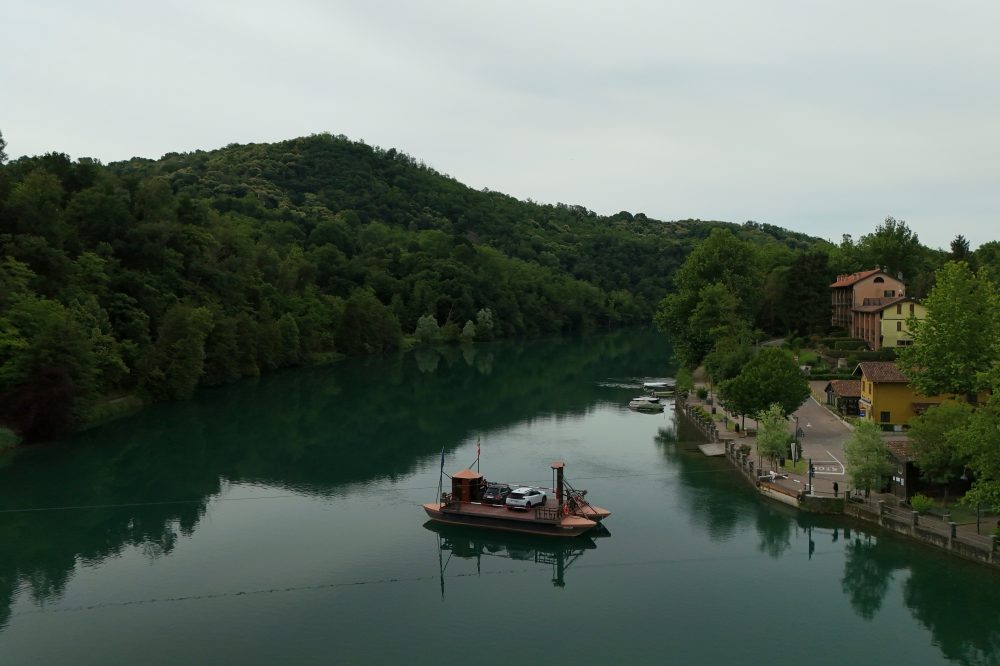

IMBERSAGO, Italy — A unique watercraft drifts smoothly across northern Italy’s Adda River, powered only by flowing water and guided by cables, providing stressed travelers with five peaceful minutes and an alternative path around traffic delays caused by a closed bridge.
Known as “Leonardo’s Ferry,” this reaction ferry system was conceived five hundred years ago and captured forever in a sketch by the Renaissance master, now housed in the Royal Collection at Windsor Castle near London.
This vessel represents the final surviving example of its type operating on the Adda River, which flows from the Alps down to the Po River through the Lombardy region.
“This transportation method has served this location for 500 years, consistently linking both sides of the Adda,” explained Massimo Zoia, a volunteer operator of the watercraft. “Now it has resumed its fundamental function: bringing together communities separated by the river.”
While the ferry bears Leonardo’s name, questions remain about whether the Renaissance genius actually created the design. However, records confirm he documented it in 1513 during his extensive research of waterways, including Milan’s canal network. Leonardo was among history’s most versatile intellectuals, documenting inventions across numerous fields, including aircraft concepts that wouldn’t become reality for hundreds of years.
The vessel operates on a remarkably straightforward yet brilliant concept that produces zero environmental impact.
“The current pushes us downstream. A cable secures us, and through force distribution following the parallelogram principle we learn in secondary school, the energy splits with one portion creating resistance while the other generates sideways motion,” Zoia explained.
“We adjust the rudder to change the ferry’s angle, allowing it to better capture the water flow that strikes us and creates our movement,” he added.
The town of Imbersago operates the ferry service, carrying passengers to Villa d’Adda across the water. The operation nearly ended in 2023 when its previous operator abandoned the contract. Determined to preserve the service, Imbersago Mayor Fabio Vergani earned his own ferryman certification and worked with the local tourism group to recruit volunteer operators.
Starting in 2024, they mainly served weekend tourists traveling between the river’s banks.
However, they expanded to include daily commuter runs this spring when a local bridge closed for repairs, helping reduce road congestion. Current operations run 7 a.m. to 7 p.m. with a two-hour midday break. Foot passengers pay 1.50 euros (approximately $1.75), bicycle riders pay 2 euros ($2.30), motorcycle users pay 2.50 euros ($2.88), and cars cost 3.50 euros (roughly $4).
Gianpaolo Graffagnino resides in Villa d’Adda while working across the river. He now cycles to his job, utilizing the ferry as a convenient route.
“Currently this represents the quickest option, but more importantly the most pleasant since you experience three minutes of tranquility,” he stated.
Mauro Carnati transported his daughter to school by driving his Maserati aboard the ferry, bypassing lengthy alternate routes created by the bridge shutdown.
“We do spend some money, and it’s not feasible daily, but the charm and special quality of the Adda and this ferry are genuinely remarkable. It creates a more pleasant beginning to the day,” he commented.