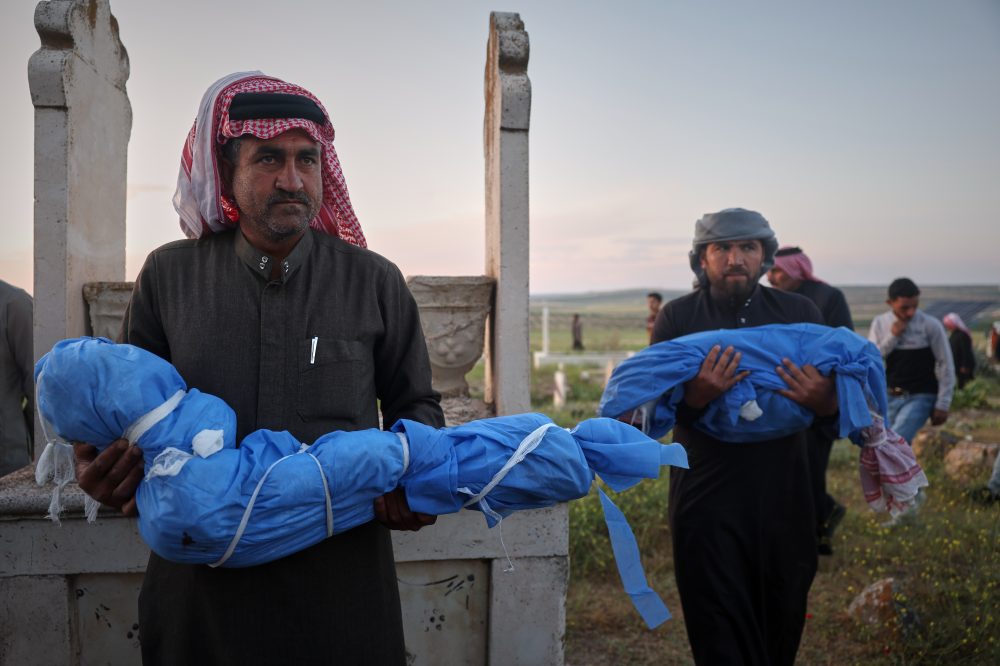

A heartbroken father mourned as he carried his deceased 6-year-old son Amir, covered in a yellow and brown blanket, through northwest Syria.
Idris al-Ridah broke down and fell to the earth as he buried his child, placing the small body in a grave alongside two other young victims who were brother and sister, Aya al-Fankih, 4, and Rayan al-Fankih, 6.
All three youngsters died Thursday in Abu Habbah village, located in the rural areas of northwestern Idlib province, after an abandoned landmine from Syria’s ongoing conflict detonated as they played close to a water well.
These fatalities serve as another tragic example of the ongoing threat from unexploded military devices spread throughout the nation years following the start of the war.
Explosive devices and hidden traps have caused death and serious injuries to hundreds of Syrian citizens since the nation’s civil war started in March 2011, resulting in approximately half a million total deaths.
According to the Syrian Civil Defense, four additional children who were in the vicinity of the well sustained injuries from the explosion.
“We heard a very loud explosion next to our house,” said one resident, Mahmoud al-Aleiwi. He added that “when we got to the location there were a number of children’s bodies thrown around the well.”
He reported that the blast hurled one child 300 meters (984 feet) from the site, and the victim was discovered on a house rooftop.
At a local medical facility, injured children wailed while relatives cared for them. One youngster suffered shrapnel injuries covering his face and torso, with his legs bound in medical wrapping. Another patient remained bedridden with blood seeping through head bandages.
Ten-year-old Ibrahim al-Suwadi suffered injuries in a different incident last month when unexploded military ordnance detonated inside a damaged school building in al-Habit town, located in southern Idlib countryside.
Speaking from his family’s residence while his father sat nearby, al-Suwadi recounted how he and friends were playing at the school when they entered a room and discovered the explosive device.
“Two brothers picked it up and took it to the bathroom,” the boy said. “We thought it was an exploded mine so we started throwing rocks at it. All of a sudden, an older boy grabbed my hand and we ran, the mine exploded and I lost consciousness then I don’t remember anything.”
The boy’s father explained that their family escaped their home village in 2013 during combat operations and lived for years in refugee camps before returning following the collapse of Bashar Assad’s administration in December 2024.
Relief organizations identify unexploded military ordnance as among the most dangerous remnants of Syria’s armed conflict.
“Syria has ranked among the top contaminated countries around the world over the past years,” said Jakub Valenta, head of humanitarian disarmament and peace building for the Danish Refugee Council in Syria. He added that according to the data from the United Nations, around 14.3 million people are in danger of explosive ordnance in the country.
Valenta explained that the explosive threats include anti-personnel mines, anti-tank mines and other unexploded devices left behind in residential and agricultural areas.
“We’re estimating that around 1,200 people and probably more have been affected by explosive ordnance accidents directly,” he said. “Out of those 1,200 people there were around 740 fatal casualties. The vast majority of these people are men and children.”
The Danish Refugee Council reports that approximately 60% of contaminated zones in Syria consist of farming land, creating additional challenges for displaced families attempting to return home and restart their lives.
In the Damascus southern suburb of Kisweh this month, Syrian trainees collaborated with Danish Refugee Council teams to carefully locate and eliminate unexploded ordnance during practice sessions designed to expand local bomb disposal capabilities.
The organization reports it has hired and prepared new Syrian explosive ordnance disposal teams to assist in clearing dangerous areas and teaching communities about the hazards.
“The number of the casualties is among the highest worldwide in terms of explosive accidents and victims,” Valenta said.
“These people suffer lifelong injuries, physical like losing a limb or their vision and suffer mental health problems,” he said. “These people also lose their jobs and livelihoods.”