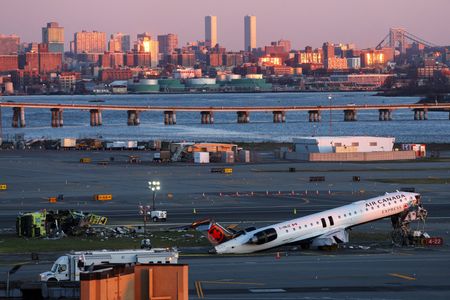

Internal documents suggest that air traffic control operations at LaGuardia Airport may have breached established safety protocols on the evening a deadly collision occurred between an Air Canada aircraft and a fire truck, according to records obtained by Reuters.
The March 22 accident, which happened around 11:37 p.m. Eastern Time and resulted in the deaths of both pilots, has reignited discussions about inadequate staffing levels in America’s air traffic control system and the increasing burden placed on controllers nationwide.
Due to personnel shortages, particularly among supervisory staff, air traffic controllers are increasingly being asked to manage both airborne and ground traffic simultaneously, multiple controllers from various locations have reported.
The National Transportation Safety Board announced last week that investigators are examining the specific responsibilities assigned to each controller as part of their crash investigation.
Should it be determined that the controller managing the incident was handling both aviation and ground operations, this would contradict LaGuardia tower’s established operational guidelines.
A 1997 NTSB final investigation report regarding a similar LaGuardia collision between a private aircraft and ground vehicle noted that new protocols were implemented afterward requiring that “local and ground positions shall not be combined prior to” midnight at the New York facility.
According to a 2023 LaGuardia Tower Standard Operating Procedures document reviewed by Reuters, this regulation remained active as of that year.
“Positions at LaGuardia Tower are not to be consolidated to one position prior to midnight local time or 90 minutes after the start of the shift, whichever is later,” the 2023 document stated. Sources familiar with operations confirmed this policy remained current through 2026.
The Federal Aviation Administration, which oversees American air traffic control operations, has not responded to requests for comment.
UNCLEAR CONTROLLER RESPONSIBILITIES
NTSB Chairwoman Jennifer Homendy informed media last week that two controllers were on duty in the airport’s control tower glass enclosure when the accident occurred.
One local controller was overseeing active runway operations and surrounding airspace, while a controller-in-charge was simultaneously providing departure clearances to pilots, she explained.
“It is not clear who was conducting the duties of the ground controller. We have conflicting information,” Homendy stated, referring to the position responsible for managing aircraft and vehicle movement on taxiways, typically excluding active runways.
Several active and former controllers indicated they believe the local controller overseeing runway operations was simultaneously managing ground traffic, based on audio recordings available through LiveATC.net.
The NTSB has not responded to follow-up inquiries.
Aviation accident investigations typically identify multiple contributing elements rather than pinpointing a single cause.
POSITION CONSOLIDATION
The controller-in-charge began their shift at 10:30 p.m., with the local controller starting at 10:45 p.m., according to Homendy’s statements.
Based on LaGuardia’s standard operating procedures, local and ground controller positions should not have been merged until midnight at the earliest.
The procedural document also specifies that position consolidation should only occur when traffic conditions justify it. When positions are combined and traffic increases, they should be separated again, the guidelines state.
On the evening of the Air Canada incident, weather-related delays led to 70 commercial aircraft departures and arrivals between 10 p.m. and 11:37 p.m., significantly higher than the typical 53 flights during the same timeframe since 2022, based on Cirium aviation data.
Multiple controllers interviewed described that evening’s workload as exceptionally demanding and noted that additional personnel would normally be called in or asked to extend their shifts to handle such increased flight volumes.
Local and ground controller positions should have remained separate until midnight at minimum, according to a current New York-area controller who requested anonymity due to media restrictions.
“And that is not even talking about the traffic, volume and complexity that night,” the controller added.