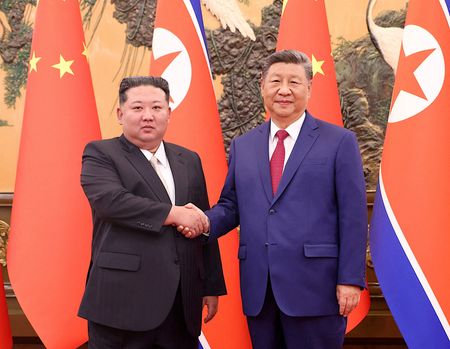

North Korean leader Kim Jong Un is set to host Chinese President Xi Jinping in Pyongyang on Monday, operating from what appears to be a position of enhanced strength backed by solid Russian support, an expanding nuclear weapons program, and minimal interest in diplomatic engagement with Washington.
The Chinese leader, who heads the globe’s second-largest economy, is making his first journey to the neighboring nation in seven years as part of Beijing’s strategy to pull Pyongyang back under Chinese influence during this two-day diplomatic mission.
Last year, Xi welcomed Kim along with other world leaders to an elaborate military display in Beijing, and the two nations have subsequently restored certain passenger railway and aviation connections.
The current diplomatic gathering will likely stand in stark contrast to Xi’s previous state visit in 2019, which occurred just months following the collapse of negotiations between Kim and U.S. President Donald Trump regarding North Korean nuclear disarmament and sanctions removal.
In the years following that failed diplomacy, Kim has strengthened military and economic partnerships with Moscow, enhanced by sending North Korean forces to support Russia’s conflict in Ukraine, expanded his nation’s nuclear weapons program despite U.N. restrictions, and tightened border security to prevent citizen defections.
Ahead of Xi’s diplomatic arrival, North Korea has made several displays of military strength, revealing plans Saturday for a 10,000-ton naval destroyer and reasserting its nuclear weapons status on Sunday.
“Having Xi visit Pyongyang is a big deal and the culmination of a good couple of ‘comeback’ years for Kim,” said Andrew Gilholm, an analyst at consultancy Control Risks.
During Xi’s 2019 visit, Kim organized an extravagant welcome featuring thousands of citizens displaying cards that created Xi’s portrait and the Chinese flag, along with a musical performance of “I Love Thee, China.”
However, the relationship between both leaders has experienced tensions, especially regarding North Korea’s nuclear ambitions. Beijing has openly criticized Pyongyang’s atomic testing and urged the abandonment of its nuclear arsenal.
North Korea has remained wary of excessive dependence on China, with whom it maintains an 1,400-kilometer border. Russian backing appears to offer some strategic balance.
“North Korea is certainly gaining economically from what they’re able to provide militarily to Russia,” said John Delury, a senior fellow of the Asia Society. “That actually puts North Korea in a position where they may feel more confident to increase the volume of trade and investment with China.”
According to a regional diplomat, any meaningful results from the meeting will likely focus on economic collaboration, as North Korea launches a five-year development strategy that includes transforming tourism into a major industry and constructing additional housing.
North Korea closed its borders to international visitors in early 2020 while implementing some of the planet’s most severe COVID-19 restrictions, eliminating a small but crucial source of foreign currency.
Prior to the health crisis, Chinese visitors formed the foundation of North Korea’s tourism sector, representing approximately 90% of international tourists according to some assessments. The initial leisure travelers permitted to return following COVID were roughly 100 visitors from Russia’s Far East in February 2024, as reported by Russian regional officials and a Western tour operator.
Singapore’s foreign minister, following a recent visit, noted that North Korea has achieved economic advancement and indicated Pyongyang shows minimal interest in diplomatic engagement with either the United States or South Korea.
North Korea has abandoned reunification goals with South Korea, despite this being a longtime objective for both countries separated since the 1950-1953 Korean War. South Korean President Lee Jae Myung continues to support dialogue and has requested Xi’s assistance in these diplomatic efforts.
“Improving inter-Korean relations through the mediation of President Xi Jinping, we are hoping that President Xi would play that kind of role,” said Moon Chung-in, a professor at Yonsei University in Seoul who was national security adviser to a previous South Korean president.
Kim has established certain non-negotiable positions, particularly concerning his nuclear weapons program. Beyond Sunday’s declaration, he demanded Thursday an “exponential” growth of the nation’s atomic weapons stockpile.
Yang Moo-jin, president of the University of North Korean Studies in Seoul, predicted Kim would likely continue expanding nuclear material production, increase and position nuclear weapons, and stress the importance of strengthening Pyongyang’s nuclear defense capabilities.
“Kim is emboldened,” said Christopher Green, a Korea specialist at Leiden University in the Netherlands.
“He feels able to publicly pursue a marked expansion of North Korea’s nuclear arsenal with a confidence that comes from knowing that as long as he doesn’t foment outright instability in the region, Beijing will not try to stop him.”