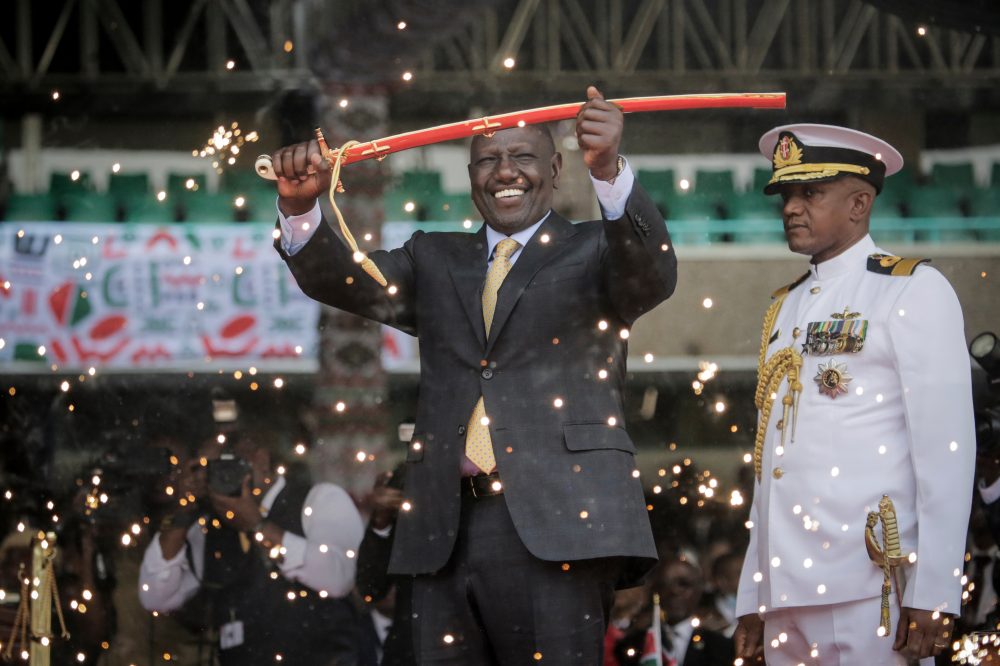

NAIROBI, Kenya — The term ‘goonism’ has become the buzzword dominating Kenya’s political landscape, as leaders across the spectrum use it to describe the intimidation tactics employed by gangs targeting political opponents.
President William Ruto’s supporters invoke the term when discussing political violence they claim authorities will not permit. Meanwhile, opposition leaders use the same word to criticize what they view as Ruto’s harsh and questionable campaign strategies as he pursues a second term in next year’s elections.
The situation has created what appears to be competing accusations of goonism in this East African country, where the battle for political control is intensifying with an increasingly dangerous atmosphere.
Many Kenyans now question whether Ruto remains true to the religious principles he championed before assuming office in 2022.
The president had promised to build a born-again Christian society that would fear God and live in harmony with itself.
However, during his presidency, he seems to have gained from the disorder that has become a nationwide problem, as faith leaders and politicians warn that political violence is undermining democratic progress. His opponents argue that this turmoil stems partly from Ruto’s inflexible leadership approach.
During a recent Sunday service, preacher Wilfred Lai shouted, “Goons, goons, goons,” while expressing dismay about Kenya’s current state. “Everyone who wants to rule this country by that kind of thing, I speak as a prophet of God: You shall fall.”
He continued: “You can’t use goons and you are telling us that you are taking us into a better place. You are a liar and the truth is not in you.”
While Lai, who leads a megachurch in the coastal city of Mombasa, never specifically named Ruto during his sermon, many Kenyans believe the president was his target, especially after portions of the message circulated online.
Lai was among the evangelical ministers who supported Ruto during his time as vice president when he sought to succeed President Uhuru Kenyatta, who had not endorsed him. During that period, Ruto was widely regarded as a devout political figure.
Ruto positioned himself as a champion of the underprivileged and working class people who earned their living through physical labor. The leader, known by the nickname “Nabii” (Kiswahili for “God’s prophet”), claimed his political success came through divine favor, contrasting himself with opponents he characterized as privileged offspring of political dynasties. Ruto secured victory in a closely contested race.
However, many supporters believe Ruto transformed immediately after winning the presidency.
While he maintained his Sunday church attendance, observers noted he stopped carrying his Bible and rarely quoted scripture. His decision to tear down a chapel on the statehouse grounds to build a modern replacement drew criticism from some as self-serving. Others felt betrayed by Ruto’s harsh income tax policies implemented shortly after his inauguration.
Thousands of young demonstrators filled Nairobi’s streets, forcing officials to retract certain tax proposals, though public frustration remained high. Ruto later confronted additional protests following the death of a blogger while in police custody.
While the demonstrations did not succeed in ousting Ruto, they weakened his position and motivated him to display strength. Though his standing remains unstable before next year’s election, some opponents acknowledge his shrewdness and continued difficulty in defeating him.
Following protesters’ breach of the parliamentary building in 2024, Ruto promised such an incident would never recur. Last year, when confronted by demonstrators carrying signs reading “Ruto must go,” the president instructed police to “break” protesters’ limbs and declared he would not step down.
“If we go this route, we will not have a country,” Ruto stated during a televised speech. “The country belongs to all of us. And if there’s no country for William Ruto, there’s no country for you.”
Some interpreted this as an implied threat, and opposition leaders suspect the gangs appearing at their events receive government backing.
Prominent opposition figure Kalonzo Musyoka told a local broadcaster: “We must say no, collectively, to the new specter, the new norm, of goonism. The goons are very well-known. So for anybody to pretend that it is the work of united opposition, he really must be ashamed, even before God, that this is state-sponsored.”
Armed groups carrying machetes and firearms can disrupt or prevent political gatherings from occurring. While opposition leaders blame authorities for encouraging violence, Interior Secretary Kipchumba Murkomen recently cautioned goons that “since the politician won’t be with you when you commit the crime, we’ll come for you.”
Speaker Moses Wetang’ula, an ally of Ruto, declared last month that “the culture of goonism has no place in a democratic society.”
A significant incident occurred last month when an opposition legislator from western Kenya was attacked in a restaurant by men challenging his political beliefs. Senator Godfrey Osotsi sustained injuries requiring hospital treatment. The assault triggered demonstrations in his home region and drew condemnation from religious leaders.
Ruto continues pursuing support from church leaders, whose influence spans social networks, as he works to maintain power. His Sunday worship location choices remain unpredictable. Sometimes religious leaders, ranging from Methodist to Pentecostal ministers, gather around him at the statehouse.
Other faith leaders remain critical, recently angered by insults exchanged between Ruto and his former deputy, Rigathi Gachagua, who broke with the president, faced impeachment, and now heads the Wantam movement aimed at limiting Ruto to one term.
Their verbal battles can be bitter.
In March, after Gachagua labeled Ruto a thief who would steal from a funeral home, the president called Gachagua a “cold-blooded pig” who stole from his brother.
Days afterward, Archbishop Maurice Muhatia, head of the local Catholic bishops’ conference, criticized both Ruto and Gachagua during a bishops’ meeting. “Disagreement is OK, but insulting each other in public is a disgrace,” Muhatia stated. “Give us a break.”
Kenyan elections typically involve considerable conflict. A violent group called Mungiki contributed to deadly violence following the 2007 election.
There is a widespread feeling this time that more is on the line, with a president unwilling to retreat. Some fear Ruto is approaching authoritarianism, unlike his recent predecessors.
Kenyatta, Kenya’s fourth president, was an affable leader who accepted internal opposition from Ruto during their shared service. Mwai Kibaki, whom Kenyatta succeeded, was a gentleman who once held a press conference to deny having a second wife.
Kenya’s current president differs significantly, and goonism represents “a product of gangster theology” with Ruto serving as its chief practitioner, according to Christine Mungai, an independent writer based in Nairobi.
Ruto has perfected “how to perform public piety” while simultaneously working “to make life harder for everyone,” she explained.
The identity of Ruto’s primary election challenger remains unclear. Possibilities include Musyoka or Fred Matiang’i, a former interior cabinet secretary. While Gachagua likely cannot seek the presidency following his impeachment, his support will be vital for the opposition.
If Ruto and opposition figures fail to moderate their language, “the election is going to be very bloody,” warned Karuti Kanyinga, a Kenyan development scholar serving as visiting professor at Stellenbosch Institute for Advanced Study in South Africa. “Everyone will have their own protection gangs.”