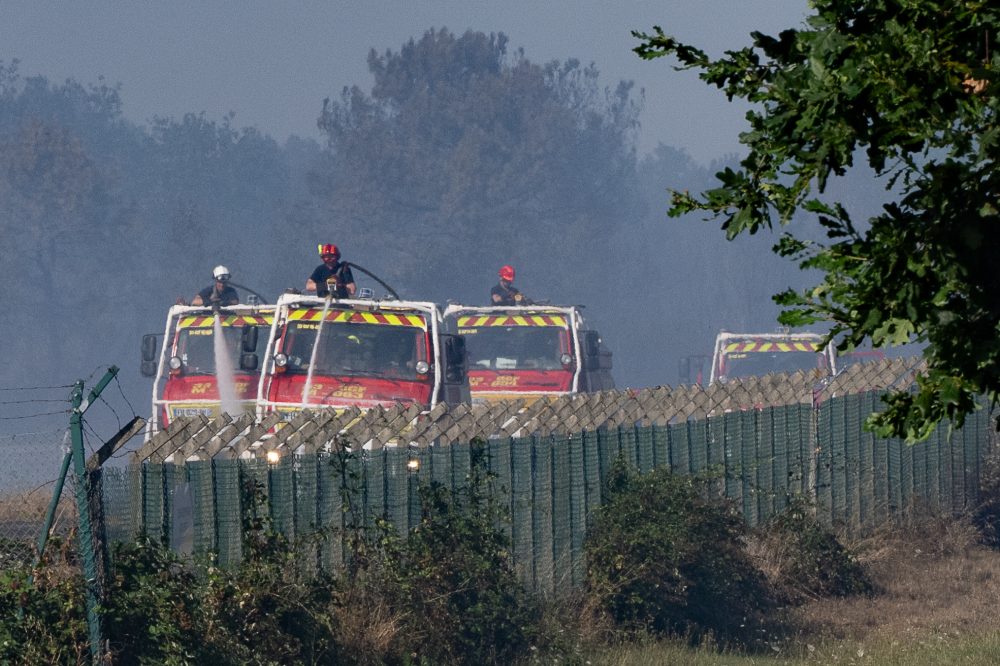

Jordan’s efforts to stay out of regional warfare collapsed Friday morning when missile fragments crashed into central Amman while King Abdullah attended Eid prayers in Aqaba. Emergency crews rushed to secure the debris site in the Wadi Saqra neighborhood, warning residents to avoid handling suspicious objects from what officials believe was Iranian missile interception remnants.
The kingdom that desperately wanted to avoid becoming a battleground now finds itself directly in the crosshairs. As Iran launched fresh ballistic missile strikes toward central Israel and Jerusalem on Eid morning, Jordan discovered that the difference between being targeted and caught in crossfire has essentially vanished.
Jordanian military officials revealed Saturday that Iran has launched 240 missiles and drones at Jordan during three weeks of warfare. The Royal Jordanian Air Force successfully intercepted 222 of these projectiles, but 18 managed to penetrate their defenses.
Ground crews have documented 414 separate debris incidents throughout the country, according to the Public Security Directorate. Missile pieces struck streets in Irbid, home to 800,000 residents in northern Jordan. Air defense systems engaged threats above Aqaba, the nation’s sole port city facing the Israeli resort of Eilat. Twenty-four individuals sustained injuries during these incidents, though all have since made full recoveries.
The conflict’s impact on Jordan has moved beyond theoretical concerns to tangible threats hitting urban areas, challenging the kingdom’s defensive capabilities and highlighting the impossibility of remaining uninvolved while public opinion remains focused on Gaza.
A child suffered wounds Monday when rocket debris hit his family’s residence in Beit Ras, located west of Irbid. Earlier, on March 3, air defense systems neutralized nine separate incoming threats in a single day, including ballistic missiles, cruise missiles, and drones.
Perhaps the most significant damage occurred at Muwaffaq Salti Air Base in Azraq, where Iranian strikes destroyed a U.S. radar installation. The Raytheon-manufactured system, valued at nearly half a billion dollars, detects incoming ballistic missiles and directs interceptor weapons toward them. A U.S. official confirmed the loss to Bloomberg, while CNN satellite imagery revealed two impact craters near the location, with all five trailer components destroyed or severely damaged around March 1 or 2.
More than 50 fighter aircraft had been stationed at that base since mid-February. Ukrainian President Volodymyr Zelenskyy acknowledged that Kyiv deployed drone specialists and equipment to help protect American installations in Jordan. U.S. officials report efforts are underway to replace the damaged radar equipment.
Jordanian analyst Bassam Badareen emphasized that Amman maintains it remains outside the conflict. “Jordan refuses to be a battlefield or a corridor for conflicts,” he stated. However, security analyst Amer Sabaileh argues the military statistics underestimate Jordan’s actual vulnerability, with current missile counts representing a floor rather than a ceiling.
“There are several risks Jordan could face, beyond direct or indirect targeting by missiles or drones if Iran decides to expand the level of chaos in the region,” Sabaileh explained to The Media Line. “Some of these missiles could have consequences that cannot be fully controlled, and they could strike sensitive areas inside Jordan.”
Deputy Prime Minister and Foreign Minister Ayman Safadi denounced the attacks on the conflict’s opening night, stating Iran had struck Jordan without justification despite the kingdom’s efforts to shield Iran by refusing to allow Jordanian territory or airspace for attacks against Iran while advocating for peaceful solutions. He also condemned concurrent Iranian strikes against the UAE, Bahrain, Saudi Arabia, Qatar, and Kuwait. Jordan joined a collective statement with the United States and Gulf nations condemning Iran’s attacks as territorial sovereignty violations endangering civilian populations.
Brig. Gen. Mustafa al-Hayyari, spokesman for Jordan’s armed forces, dismissed claims that Iranian projectiles were simply passing through Jordanian airspace en route to Israel. The missiles and drones specifically targeted Jordanian locations, he stated, including “vital installations inside Jordanian territory.”
Amman had informed all parties before hostilities began that it would not serve as a conflict zone. The strikes occurred regardless. Jordan has since activated defense cooperation agreements with partner nations for additional air protection, al-Hayyari announced during a joint press briefing in Amman, though he declined to identify specific partners. British Prime Minister Keir Starmer later confirmed UK aircraft based in Cyprus had been deployed to help defend Jordanian airspace.
On March 19, the United States approved a $70.5 million support package to maintain Jordan’s existing fleet of F-16 and F-5 fighter jets plus C-130 transport aircraft. The package provides spare parts, maintenance, logistics, and munitions support designed to keep the Jordanian air force operational under current circumstances.
However, the official government position faces domestic pressure. Pro-government newspapers, including Al-Rai and Addustour, have not simply defended Amman’s stance but have criticized both Israel and Iran, characterizing each as promoting extreme religious agendas threatening regional stability.
Jordan shares borders with Israel, Syria, Iraq, and Saudi Arabia while maintaining close security relationships with the United States and a peace agreement with Israel. The kingdom has historically attempted to balance these relationships while insisting its territory would not become a battlefield. This time, that diplomatic balancing act failed to prevent warfare from reaching Jordanian soil, with Iran directly striking Jordanian territory with 240 projectiles during the conflict’s first three weeks.
Even before the initial missile crossed Jordan’s border, domestic political opinion was already strained. On February 20, eight days before warfare erupted, Washington’s ambassador to Israel, Mike Huckabee, told Tucker Carlson it would be “fine” if Israel seized territory between the Nile and Euphrates rivers—land encompassing Jordan. President Donald Trump’s administration claimed the remarks were taken out of context, but Jordan’s parliament rejected that explanation.
Parliament Speaker Mazen Al-Qadi characterized the statements as “a blatant provocation and a serious breach of state sovereignty” violating international law and the UN Charter. Lawmakers urged the government to summon the U.S. ambassador in Amman for clarification. One legislator called for permanently removing the term “Israel” from official Jordanian discourse, replacing it with “the usurping entity.” The chamber voted unanimously to strike the word from that session’s official minutes.
One week later, Iran destroyed the American radar installation Jordan’s government was hosting on its territory. This contrast—parliamentary rhetoric on one side, strategic dependence on the other—has not escaped Jordanian attention.
As the war enters its fourth week, pressure on Jordan extends beyond military concerns. Israel launched a ground invasion of southern Lebanon on March 17. The Strait of Hormuz has effectively closed to commercial shipping. Oil prices have risen more than 40% since warfare began, particularly impacting Jordan, which imports nearly all its energy needs.
The fighting with Iran has not displaced Gaza in Jordanian public consciousness. Gaza’s ceasefire continues unraveling as Israel has closed all border crossings and blocked humanitarian aid, with negotiations on the next phase suspended. For many Jordanians, the new conflict has not replaced Palestinian concerns but has been layered on top of them.
This distinction carries significance. Jordanian public opinion is neither the unified position official statements suggest nor the passive civilian endurance often portrayed in outside reporting.
Political scientist Hassan Barari explained the pressures are reshaping public sentiment in ways the government cannot fully manage. “The escalation between Israel and Iran could affect public sentiment in Jordan in several ways,” he told The Media Line. “It may increase public tension and anxiety because of fears that the war could expand across the region and bring serious security and economic consequences.”
Still, Barari distinguishes between anxiety and alignment. “The escalation could strengthen public mobilization and expressions of solidarity against what many see as aggression toward Iran, especially as the war in Gaza continues,” he said. “Jordan finds itself in a sensitive position between its regional and international commitments and a public mood that strongly sympathizes with the Palestinian cause.”
That sentiment is not uniformly pro-Iran but rather anti-war, hostile to Israel’s military campaign, and deeply suspicious of being drafted into someone else’s conflict.
“Many Jordanians believe the war between Israel and Iran is part of a broader geopolitical struggle involving the United States and other powers,” Mohammed Abu Sharife, a writer and political researcher specializing in Israeli affairs, told The Media Line. “But they insist Jordan should not become a battlefield for those rivalries.”
Abu Sharife noted public perceptions remain influenced by Gaza rather than sympathy for Iran’s government. “For many people here, Iran is not seen as the main threat. The conflict with Israel and what is happening in Gaza remains the issue that shapes how people see the region.”
Meanwhile, these tensions are manifesting online. Former Jordanian Information Minister Samih Al-Maaytah called for legal action against individuals publicly celebrating Iranian missile attacks, warning that praising projectiles passing through Jordanian airspace toward Israel crosses legal boundaries. Jordan’s Cybercrime Unit reported detecting social media accounts spreading rumors, questioning state positions, or posting content that could inflame tensions. The unit warned it is monitoring online platforms and could pursue legal measures against anyone publishing material threatening national security or inciting unrest. The crackdown itself indicates government awareness that the official narrative is not resonating at the popular level.
On the street, calculations are more immediate. “We live in the middle of this region,” said Mohammad Al-Hussein, a 30-year-old day laborer from Mafraq. “When missiles start flying between Israel and Iran, people here feel that Jordan could become the next place affected. I don’t follow politics closely, but I know one thing: If this war expands, families like mine will pay the price first.”
The warfare erupted on Ramadan’s 10th day. Eid al-Fitr began Friday, March 20. Jordanians who expected to spend the holy month’s final nights at iftar tables with family, in Amman’s illuminated downtown markets, or traveling to visit relatives across the country are instead calculating whether air raid sirens will sound before or after children go to sleep.
Prime Minister Jafar Hassan announced the Eid holiday would run from March 20 to March 23. The Amman Chamber of Commerce reported clothing and shoe prices remained stable. The government is attempting to project normalcy into a holiday that does not feel normal. Eid began with the established pattern already in place—missiles at night, interceptions overhead, debris in the morning. What comes next remains uncertain in Amman.
The government briefly closed the country’s airspace when fighting started, then reopened it following a security review. Schools remained open, though the Cabinet considered shifting to remote learning based on security conditions.
Another area drawing attention is Central Badia on civil defense debris maps. The sparsely populated desert territory along the Iraqi border is widely viewed as a vulnerable corridor into Jordan. Iranian-backed Iraqi militias have threatened to expand attacks to regional countries hosting U.S. troops, specifically naming Jordan.
“This could move to other levels, not just chaos caused by military strikes, but also through the activation of sleeper cells operating inside the country,” Sabaileh warned. “There is also the possibility of militias being pushed toward Jordan’s borders or attempts to target vital areas inside the country. All of these scenarios are now possible.”
King Abdullah has incorporated these same pressures into his diplomacy. In conversations with regional leaders, he emphasized the need to protect worshippers’ access to Al-Aqsa Mosque during Ramadan, connecting the war, Gaza, and the holy month in a unified message directed at the Arab and Islamic world. Border crossings between Jordan and Israel have remained operational since warfare began, indicating Amman has not used the conflict as justification to suspend infrastructure supporting its peace treaty.
“Jordan does not want any of this,” Sabaileh concluded. “But the country has little choice but to strengthen its ability to intercept missiles and Iranian drones, maintain a high level of readiness along its borders, and increase internal awareness among citizens. What they must do now is take all necessary defensive measures and be prepared to respond if attacks occur.”