
KASHIWAZAKI, Japan (AP) — The world’s biggest nuclear facility has returned to operation in Japan as the nation grapples with massive electricity needs during a worldwide oil crisis, but the restart exposes a critical issue: the country is approaching maximum capacity for storing used nuclear fuel with no workable strategy for permanent radioactive waste disposal.
The return to service of the No. 6 reactor at Kashiwazaki-Kariwa Nuclear Power Station this year was intended to encourage additional nuclear facilities to come back online. According to the Federation of Electric Power Companies of Japan, Kashiwazaki-Kariwa represents one of three facilities where cooling pools will reach maximum capacity within five years.
“Without solid (fuel management) plans, our power generation will stall sooner or later,” said Kashiwazaki-Kariwa General Manager Takeyuki Inagaki.
Following decades of searching for permanent storage solutions for highly radioactive used fuel, officials are examining Minamitorishima, an isolated Pacific island located south of Tokyo. However, this choice has encountered doubt and opposition due to Japan’s inconsistent approach to used fuel and radioactive waste handling.
Just 15 of Japan’s 54 reactors have returned to operation following the March 2011 Fukushima catastrophe, when a 9.0 earthquake near Japan’s northeastern shore and resulting tsunami triggered meltdowns at three reactors managed by Tokyo Electric Power Company Holdings, or TEPCO. Approximately 160,000 residents evacuated from Fukushima, with certain regions still uninhabitable.
Kashiazaki-Kariwa, which TEPCO also operates, was closed following the Fukushima catastrophe during a countrywide nuclear power shutdown.
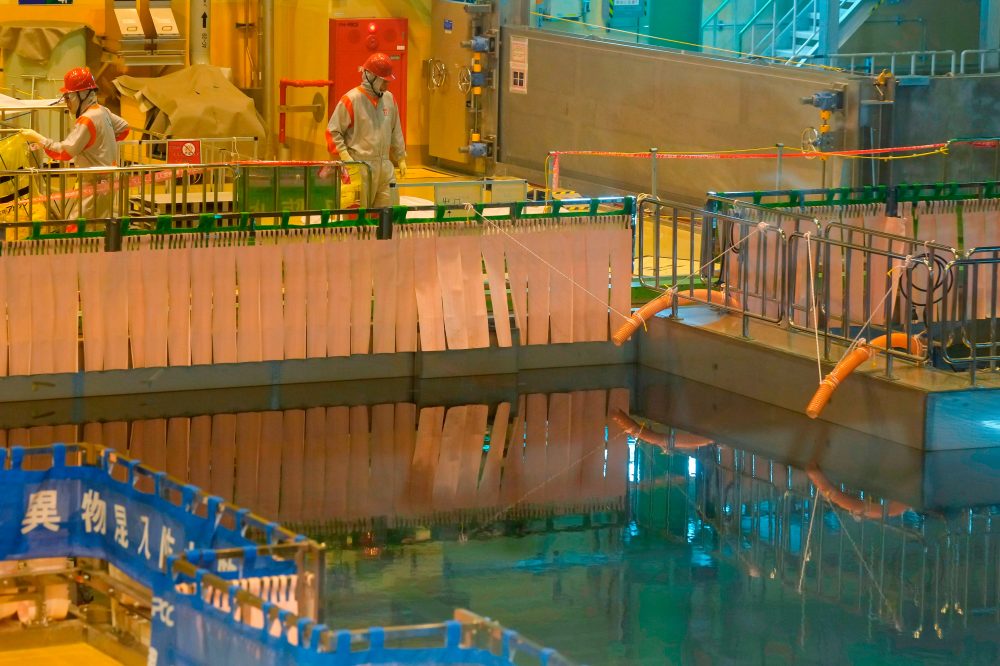
The used fuel stored in a cooling pool at Kashiwazaki-Kariwa No. 6 reactor, currently 88% full, is visible from an upper-floor viewing area. TEPCO has added filtered venting systems and equipment to prevent hydrogen explosions as part of enhanced safety measures developed from Fukushima experiences.
Prime Minister Sanae Takaichi advocates for activating additional nuclear facilities, which will generate more used fuel. Without a practical permanent storage solution, concerns exist that reactors may need to shut down once storage capacity is exhausted.
Two approaches exist for managing used nuclear fuel: immediate disposal as waste or recycling to recover plutonium and uranium for future use.
Japan maintains its commitment to recycling, claiming this approach will support the resource-scarce country’s energy requirements while decreasing radioactive waste toxicity and volume. However, a reactor built for plutonium reuse, essential to the recycling process, has malfunctioned. Reprocessing cannot manage all used fuel, contributing to a plutonium inventory already sufficient for thousands of nuclear weapons.
Specialists suggest Japan should examine the immediate disposal alternative as well.
By December 2025, cooling pools at 17 Japanese nuclear facilities contained over 17,000 tons (15,422 metric tons) of used fuel, occupying almost 80% of available storage space, according to the Ministry of Economy, Trade and Industry.
Besides the substantial radioactive waste from standard reactors, Japan must also “deal with massive and largely unknown high-level nuclear waste from the Fukushima disaster,” stated Lila Okamura, a Senshu University professor specializing in environmental politics and nuclear waste management.
Selecting a permanent disposal location for used fuel and constructing a facility would require 100 years plus tens of thousands of years for monitoring the deep underground storage. For such a multi-generational undertaking, Japan should proceed cautiously rather than rushing the current plan filled with uncertainties, Okamura explained.
Following Kashiwazaki-Kariwa’s No. 6 reactor returning to service for the first time in 14 years since the Fukushima disaster, Industry Minister Ryosei Akazawa contacted Ogasawara village requesting a feasibility study for a high-level radioactive waste facility on Minamitorishima, an island under Ogasawara’s administration, which belongs to Tokyo.
“With a lot of spent fuel accumulating at nuclear power plants across the country, a final disposal of radioactive waste is a crucial challenge that must be resolved,” Akazawa wrote to Ogasawara Mayor Masaaki Shibuya.
The government-controlled Minamitorishima, approximately 2,000 kilometers (1,242 miles) south of Tokyo, has no permanent inhabitants. The Japanese army is building a firing range for long-range, surface-to-ship missiles as a deterrent to China. The island also contains deep sea deposits abundant with rare earth minerals.
“The move seems political,” commented Satoshi Takano, a participant on a government panel examining permanent disposal of used fuel. “There will be little opposition from a government-owned remote island.”
Several specialists believe the island, positioned on a geologically stable tectonic plate, might be appropriate. Many inhabitants on Ogasawara and two neighboring islands expressed concerns regarding safety and tourism.
“I was baffled when I heard about the plan,” Ogasawara assembly member Yusuke Hirano stated during an assembly meeting. “I think nuclear waste is incompatible with islands that are a UNESCO Natural World Heritage site.”
Locating a community willing to accommodate a highly radioactive disposal facility has proven challenging, despite substantial financial incentives. Minamitorishima marks the fourth location for a feasibility study since the government began searching in the early 2000s.
The complete review process will require approximately two decades. Municipalities joining the initial phase can receive up to 2 billion yen ($12.8 million) in government subsidies. The subsequent phase would provide up to 7 billion yen ($44.7 million). Funding specifics for a final study remain undisclosed.
The world’s first permanent disposal facility for used nuclear fuel is scheduled to open in Finland this year. Britain, Germany and the United States have discontinued reprocessing primarily due to high costs and technical difficulties, while various other nations are discussing plans for direct disposal facilities.
Inagaki, the Kashiwazaki-Kariwa general manager, explained that TEPCO is moving used fuel from No. 6 reactor to other reactors at the facility with additional space, but the utility hopes to restart shipments to dry cask storage in northern Japan as a short-term solution. Other utilities with nearly full pools have announced intentions to construct dry-cask storage at their facilities.
Many inhabitants are concerned about Japan’s increasing stockpile because high-density storage of used fuel could also elevate overheating dangers.
Mie Kuwabara, a civil activist in Niigata, questioned “where will it go next?”
“It’s irresponsible to accelerate restarts and produce more spent fuel without deciding its final destination,” said Kuwabara, who also doubts using Minamitorishima.
“It’s like saying that it’s OK to put a facility there because nobody is around to complain if there is a problem,” Kuwabara said. “It’s scary.”