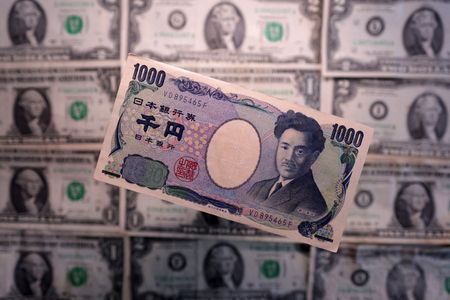

Japan’s currency has slipped back to concerning levels that triggered official market intervention just one month ago, raising questions about Tokyo’s remaining financial resources and determination to support its struggling yen.
Japanese authorities deployed approximately $63 billion in suspected currency-buying operations during late April and early May, representing just a small portion of the nation’s $1 trillion reserve fund. However, market participants believe using all or even a significant portion of these reserves would be impractical. As speculative positions against the yen begin building again, government officials are working to maintain market uncertainty.
“The more foreign reserves shrink, the more vulnerable Japan looks to speculators,” said Daisaku Ueno, chief foreign exchange strategist at Mitsubishi UFJ Morgan Stanley Securities. With pressure to sell the yen showing no signs of diminishing, “the war of nerves between the authorities and the market looks set to continue.”
Currency-buying intervention requires selling foreign assets, of which Japan possessed approximately $1 trillion at April’s end. After subtracting roughly 10 trillion yen ($62.78 billion) used in the April and May operations, based on Bank of Japan money market calculations, approximately 150 trillion yen remains, providing enough resources for “around 30 rounds” of intervention, according to Goldman Sachs economist Yuriko Tanaka.
‘CRUCIAL’ UNDERSTANDING
However, depleting Japan’s entire foreign asset portfolio wouldn’t be practical, especially since it would harm U.S. Treasury values at a time when American cooperation remains essential. The U.S. Treasury conducted “rate checks” that helped push the dollar-yen rate lower in January.
“U.S. understanding is crucial” to maintaining intervention effectiveness, said Takeshi Ueno, a senior economist at NLI Research Institute. If Washington opposed such activities, it “could invite speculative yen selling.”
FREE-FLOAT RULES
Another potential limitation on intervention involves International Monetary Fund standards where countries that intervene too frequently risk losing their “free-floating” exchange rate designation. However, chief currency diplomat Atsushi Mimura has stated the IMF rules don’t constrain how frequently the government can intervene.
“The thinking is that curbing excessive volatility takes priority,” said Akira Moroga, the chief market strategist at Aozora Bank. Even if Japan lost its free-floating currency classification, “I don’t think they care at all,” he added.
The yen weakened to 159.65 on Thursday, its lowest point since April 30 when Japan allegedly conducted its first intervention in nearly two years. The Ministry of Finance plans to announce at 1000 GMT on Friday the total spending on foreign exchange intervention since April 28.
Japanese Finance Minister Satsuki Katayama on Friday once again refused to comment on whether her agency had intervened, reiterating that officials were prepared to take “decisive action.”
CAUTIOUS BOJ
The yen has been weakened by the three-month Middle East crisis, with rising energy costs creating a trade shock for Japan, which imports nearly all its oil. This worsened an existing decline amid the BOJ’s careful approach to interest rate increases and expectations of expanded fiscal stimulus under Prime Minister Sanae Takaichi.
While previous Japanese governments focused on the pace of change when deciding to intervene, the current administration appears more focused on protecting the 160 per dollar threshold. Rather than avoiding intervention, some market participants are now positioning for it.
A dealer at a domestic bank reported buy orders for dollars are concentrating in the 155-157 yen per dollar range, reflecting genuine dollar demand from importers and speculative positions. On the upside, market expectations suggest the next intervention will occur before the 162 level.
“The government will want to defend that level at all costs,” said a dealer at a domestic bank.
($1 = 159.2800 yen)