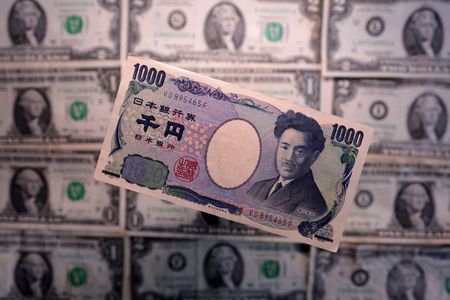

The Japanese yen remained under heavy pressure Friday, trading close to a 40-year low and heading toward a weekly decline, as traders kept a close watch for any potential move by Japanese officials to prop up the struggling currency.
Overnight, investors appeared to shrug off escalating tensions between the U.S. and Iran, with oil prices falling and stock markets climbing. However, the collapse of a fragile ceasefire between the two nations has once again raised concerns about energy prices and global inflation going forward.
“The specter of war still hangs over sentiment,” said Thierry Wizman, global FX and rates strategist at Macquarie Group.
“The question confronting traders is whether Iran is willing to return to large-scale kinetic war with the U.S. and its allies if necessary to strengthen its claim of control over the Strait of Hormuz,” Wizman added.
The U.S. dollar slipped slightly on Friday but was on track to close the week with little overall movement, as fresh safe-haven demand was counterbalanced by fading expectations of a Federal Reserve rate increase.
The dollar was trading at 162.36 yen — not far off a peak reached last week that marked the highest level in four decades — and was set to gain more than 0.5% against the yen for the week.
Currency traders have been watching closely for weeks as the yen has continued to weaken beyond 160 per dollar. A possible shift in how Japanese officials might intervene has made it more difficult to predict when action could come.
Analysts at Goldman Sachs weighed in on the situation, noting: “While intervention risks remain top-of-mind as a tactical consideration, we have argued that without a change in the fundamental macro backdrop — higher-for-longer U.S. yields, low recession risk, and lingering fiscal concerns in Japan — the yen will likely continue to steadily weaken in the months ahead.”
“This helps place the yen as a top funding candidate over longer horizons,” the Goldman Sachs analysts added.
The British pound was hovering near its strongest point against the yen since 2007 during early Asian trading Friday, after reaching a peak of 218.00 yen overnight. The euro was last buying 185.64 yen, up 0.6% on the week.
Japan’s Economy Minister Minoru Kiuchi stated Friday that the government would never reveal in advance its preferences regarding how the Bank of Japan should set interest rates.
Elsewhere in currency markets, the euro edged up 0.02% to $1.1433, while the British pound rose 0.03% to $1.3413 and was on pace for a weekly gain of 0.45%.
The Australian dollar was trading at $0.6939, and the New Zealand dollar climbed 0.08% to $0.5759.
The New Zealand dollar was headed for a weekly gain of more than 0.9%, following a rate hike by the Reserve Bank of New Zealand this week along with signals of further tightening to come.
Westpac is forecasting the Reserve Bank of New Zealand will raise rates by 25 basis points in both September and December, with the cash rate expected to peak at 4% in September 2027.
“The exact timing of the tightening profile is highly uncertain and even the tightening we forecast at the September 2026 meeting should not be regarded as a done deal,” said Kelly Eckhold, Westpac’s chief economist.