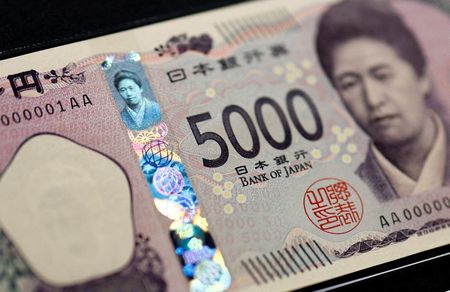

The Japanese yen tumbled to its lowest point in four decades on Tuesday, reaching 162.27 per dollar — a level the currency hasn’t seen since 1986 — fueling growing expectations that Japanese authorities may be forced to step in and support it.
The currency is on pace for a nearly 2% decline against the dollar for the second quarter, marking its fourth consecutive quarter of losses. The last time the yen fell for so many quarters in a row was in 2022, when it dropped for seven straight quarters. Analysts point to a wide gap in interest rates between Japan and the United States as a key driver of the yen’s weakness.
“It’s a question of when, not if, the Ministry of Finance intervenes again to support the yen,” said Carol Kong, a currency strategist at Commonwealth Bank of Australia. She added, however, that any such action is unlikely to turn the tide. “We forecast USD/JPY to keep rising to 164 by early 2027,” Kong said.
Japan’s government has already spent roughly 11.7 trillion yen — about $72.25 billion — on interventions in recent months, and the Bank of Japan has raised interest rates, but neither move has been enough to stop the yen’s slide. Concerns about inflation tied to the ongoing Iran war have complicated the global interest rate picture, further weighing on the yen.
Speculators have grown increasingly bold, rebuilding their bets against the yen. The most recent weekly data from a U.S. regulator shows short positions totaling approximately $11.3 billion — near the highest level seen in two years.
A previous round of intervention in late April and early May gave the yen a temporary boost, but the currency came under renewed pressure as traders began expecting the U.S. Federal Reserve to raise interest rates later this year.
That puts Thursday’s U.S. jobs report for June in the spotlight. Three straight months of stronger-than-expected hiring figures have reinforced the Fed’s more aggressive stance on rates, and traders currently see a 63% probability of a rate hike by September.
Matt Simpson, a senior market analyst at StoneX, said Japan’s Ministry of Finance faces a difficult position. “MOF will intervene if they can, but they can’t, as they know they’re currently swimming against the tide of a hawkish Fed,” he said. However, he noted that officials did act swiftly following a softer-than-expected U.S. inflation report in July 2024. “So if U.S. data throws a surprise gift for Fed doves this week, the MOF could burst into action with momentum of a weaker U.S. dollar on their side,” Simpson said. “Until then, it’s likely just talk.”
The U.S. dollar index, which tracks the greenback against six other major currencies, stood at 101.6 after slipping 0.26% in the prior session. Still, the dollar is on track for a 1.3% gain for the second quarter.
Other currencies showed modest moves: the euro traded at $1.14165, the British pound fetched $1.3251, the Australian dollar dipped 0.15% to $0.6876, and the New Zealand dollar was at $0.5647.
Thursday’s U.S. payrolls report is expected to show employers added 110,000 jobs in June, with the unemployment rate holding steady at 4.3%, according to a Reuters poll.
Investors were also watching a series of U.S. Supreme Court rulings, including a decision to block President Donald Trump from removing Fed Governor Lisa Cook — a development seen as easing some concerns about the Federal Reserve’s independence under the current administration.
On the geopolitical front, Iranian and U.S. negotiating teams were expected to meet in Doha this week, but Iran stated no meeting had been confirmed. Weekend missile exchanges between both sides tested a fragile interim ceasefire in the four-month-old conflict, keeping market sentiment on edge.