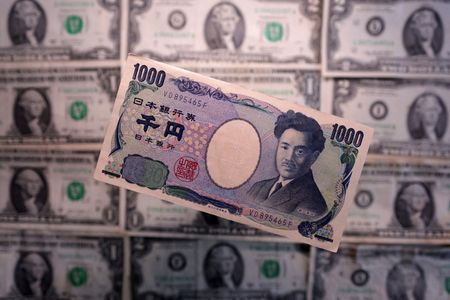

The Japanese yen is hovering dangerously close to a 40-year low against the U.S. dollar, as currency traders scaled back their bets on Federal Reserve rate hikes following U.S. inflation figures that matched expectations and conflicting signals from central bank policymakers.
Early Friday in Asia, the yen was holding steady at 161.82 against the dollar, retreating slightly from Thursday’s two-year low of 161.95. Should the yen slip past 161.96, it would mark its weakest position since 1986. The currency showed little reaction after data released Friday revealed that core inflation in Tokyo picked up in June, meeting forecasts.
The dollar index, which tracks the greenback’s performance against six other major currencies, broke a three-day winning streak on Thursday, pulling back from its strongest point since May 2025. Despite the dip, the dollar remains on pace for its first consecutive weekly gain since the onset of the Middle East conflict in late February.
Analysts from Capital Economics noted the dollar’s recent fluctuation in a research report. “After a sharp rise in the wake of last week’s FOMC meeting, the dollar has dropped back a little today and may be due a pause in the very near term,” they wrote, referring to the Federal Open Market Committee.
The analysts added: “But we think that the emerging monetary policy divergence between the U.S. and Europe means that further gains for the greenback is on the cards for the second half of 2026.”
Thursday’s U.S. inflation report showed living costs continued to climb in May. The Personal Consumption Expenditures price index — the Federal Reserve’s go-to inflation gauge — rose 4.1% compared to a year ago, driven in part by higher energy prices tied to the Middle East conflict. The figure aligned with what economists had anticipated.
Federal Reserve officials offered differing takes on what the numbers mean for future policy. Chicago Federal Reserve President Austan Goolsbee acknowledged a “glimmer of hope” on services inflation on Thursday, while cautioning that underlying price pressures remain too elevated and are moving in the wrong direction.
Federal Reserve Bank of New York President John Williams echoed a cautious tone, saying inflation pressures are likely to ease this year but are still too high for comfort.
The comments nudged markets toward expecting the Fed to hold rates steady. According to the CME Group’s FedWatch tool, futures markets are now pricing in a 69% chance the central bank will keep rates unchanged at its next two-day meeting concluding July 29 — up from a 65.8% probability the day before.
In other currency moves, the euro slipped 0.1% to $1.1361, while the British pound held steady at $1.3187. The Australian dollar fell 0.2% to $0.6899, and the New Zealand dollar edged down 0.1% to $0.5646.
In cryptocurrency markets, Bitcoin gained 0.7% to reach $59,801.31, while ether climbed 0.7% to $1,569.09.