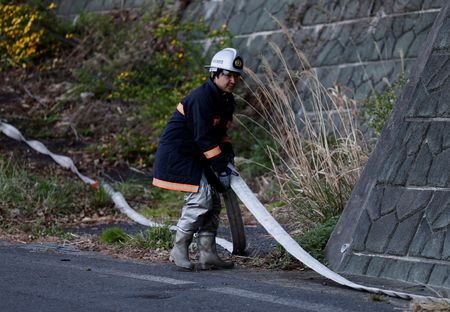

A volunteer firefighter whose family home was destroyed in Japan’s catastrophic 2011 tsunami now finds himself defending that same community against a raging wildfire that has burned for six consecutive days.
Ryota Haga, currently 31 years old with a wife and young child, was a high school student when Japan’s most powerful earthquake on record generated a devastating tsunami that demolished his family’s residence in the peaceful northeastern community of Otsuchi in March 2011.
The massive wildfire has consumed more than 1,600 hectares of forestland as of Monday morning, prompting deployment of approximately 1,400 firefighters and multiple Self-Defense Force units to combat the flames.
“It’s been 15 years since the (Great East Japan) Earthquake, and our lives were finally beginning to settle down,” Haga said at the end of another draining day battling the blaze on Sunday.
“We can’t let people lose what is precious to them all over again. The fire is spreading and our exhaustion is at a limit, but it’s our hometown. We will protect it at all costs, even if it feels like we’re running on empty.”
The coastal community of Otsuchi suffered among the worst devastation during the 2011 disaster, when tsunami waves reaching approximately 10 meters in height crashed through the small fishing village. The catastrophe claimed nearly 1,300 local residents—roughly one-tenth of the town’s entire population—including the mayor.
According to Haga, the current fire represents the largest blaze he has ever encountered. Despite scattered rainfall predicted for Monday, officials have not yet gained control over the wildfire.
Although Japan experiences fewer major wildfires compared to other global regions, climate change has led to more frequent blazes, particularly during early spring months preceding the humid rainy season when conditions remain hot, dry, and windy. On Sunday, another wildfire ignited in Fukushima, also located in Japan’s northeastern territory.
Beyond the immediate crisis, Haga expresses concern about the severe shortage of firefighters as Japan’s population continues declining and aging. His fire brigade currently operates below official staffing requirements established by authorities.
“If a forest fire breaks out when I’m in my 50s or 60s, and I’m the one gasping for breath while trying to fight it, I don’t think we’ll be able to stop it,” he said.
Despite these challenges, Haga maintains optimism that the firefighters’ unwavering commitment to protecting their community will inspire others.
“The next generation might be inspired to join the volunteer fire brigade.”