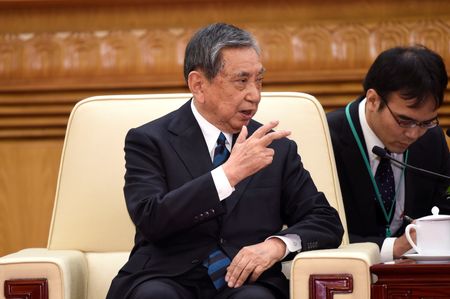

TOKYO – Yohei Kono, the Japanese political figure responsible for a historic 1993 government statement acknowledging women who were coerced into working at military brothels during wartime, has passed away at the age of 89.
According to local reports, he died Monday, though no cause of death was provided.
Kono stood as a firm critic of former Prime Minister Shinzo Abe’s efforts to strengthen Japan’s military capabilities and amend the nation’s pacifist constitution. Even following his retirement from political life, he remained an uncommon moderate voice within the conservative ruling Liberal Democratic Party.
His most significant accomplishment within a political system reluctant to confront Japan’s World War Two actions was delivering what became known as the Kono Statement in August 1993. This marked the initial instance when the government admitted that the Japanese Imperial Army had compelled women, primarily Korean, into service at military brothels.
The situation of these so-called “comfort women” damaged relations between Japan and South Korea for many years.
“The then-Japanese military was, directly or indirectly, involved in the establishment and management of the comfort stations,” the statement said, adding that in many cases the women were recruited against their will and that administrative and military personnel took part in their recruitment.
“They lived in misery at comfort stations under a coercive atmosphere,” it added.
In 1995, Kono held the position of deputy premier in a coalition administration when Socialist Prime Minister Tomiichi Murayama delivered a “heartfelt apology” for wartime harm and suffering caused by Japan.
Various prominent political figures opposed such expressions of remorse. Abe, who passed away in 2022, voiced concerns about both Murayama’s and Kono’s apologies. Conservative critics have also attacked these statements over the years as cold relations between Japan and South Korea persisted regarding Japan’s early 20th-century colonization of the Korean peninsula.
In 2014, a Japanese committee assigned to examine the Kono statement reported that South Korea had assisted with the delicate language of the original document.
South Korea voiced strong disappointment about the review, claiming the findings minimized the facts and challenged the conclusion that Seoul was directly involved in crafting the formal 1993 apology.
Prime Minister Sanae Takaichi offered condolences for Kono’s passing on social media Wednesday evening. “In diplomacy, (Kono) endeavoured to build a relationship of trust with neighbouring countries,” Takaichi wrote on X.
“In particular, he faced historical issues sincerely. His emphasis on dialogue and understanding should be remembered as one of the cornerstones of our country’s peace diplomacy.”
Born to a family of lawmakers, Kono came from Kanagawa prefecture near Tokyo and completed his education at Tokyo’s Waseda University. He entered politics in 1967 following his father’s death.
During the 1990s and early 2000s, he held positions including deputy prime minister and foreign minister. He led the Liberal Democratic Party from 1993 to 1995, but because other parties controlled coalition governments, he became one of just two LDP leaders who never served as premier.
Kono’s son Taro is also in politics. The father and son gained attention in 2002 when Taro, then 39, provided part of his liver to his father, whose liver was deteriorating from a long-term hepatitis infection. The operation succeeded.
“Japan made a fresh start 70 years ago based on remorse for that tragic war, the many lives lost and the troubles caused to neighbouring countries,” Kono told Reuters in 2015.
“Now Japanese people worry in their hearts that we will somehow set aside that remorse and those memories, and walk the same path as in the past.”