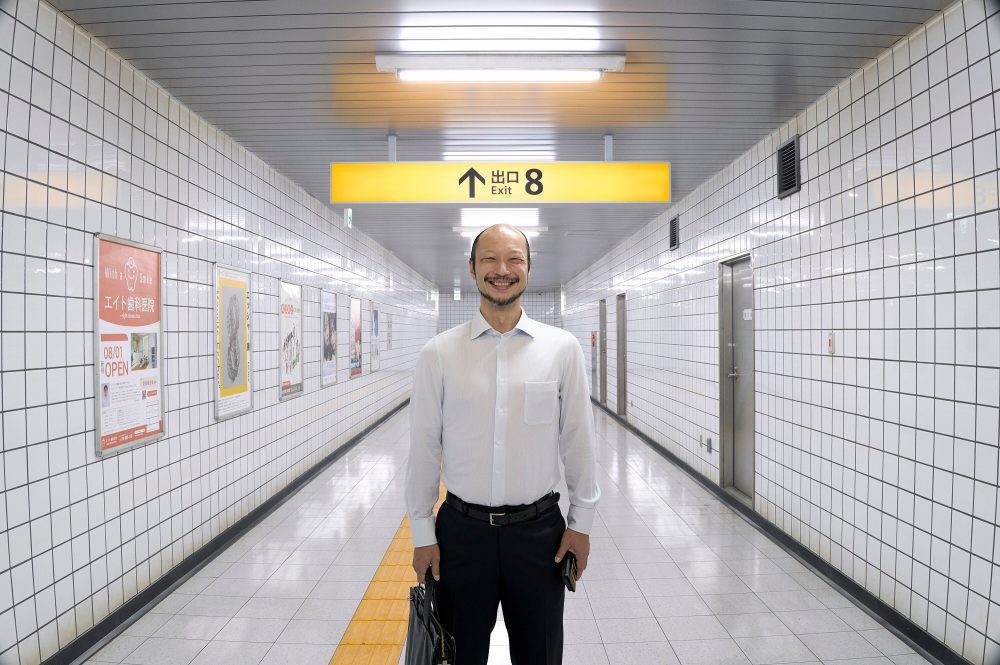

In cinema, corridors typically spell trouble for characters. Whether it’s blood spilling from elevator doors or serving as battlegrounds for intense fight sequences, these narrow spaces usually amplify danger and drama.
However, Japanese filmmaker Genki Kawamura breaks this convention with ‘Exit 8,’ a unique production that begins in a corridor and never leaves it. The story follows a nameless protagonist navigating Tokyo’s crowded subway system, absorbed in his smartphone like fellow commuters.
Struggling with asthma, the man climbs subway stairs while adjusting his earbuds playing an unusual Ravel composition with a military rhythm. During a phone conversation with a hospitalized woman discussing an urgent decision, the call disconnects as he promises to arrive soon.
Seeking Exit 8 through the complex underground network, he discovers something unsettling: each time he walks down the designated corridor, he mysteriously returns to his starting point. Initially attributing this to a navigation error, he repeatedly attempts the same route with identical results.
This nightmarish puzzle forms the foundation of Kawamura’s adaptation of the popular indie video game ‘The Exit 8.’ The original game challenges players to navigate a tiled metro passage in first-person view, escaping the endless cycle only by understanding the mechanics and advancing through levels.
This places the film alongside other video game adaptations currently in theaters, though audiences might unknowingly choose this Kafkaesque maze over more mainstream gaming movies like Nintendo productions.
Such a choice would prove worthwhile. Despite its minimal and repetitive nature, ‘Exit 8’ represents one of the most successful mergers between cinema and gaming mediums in recent memory. The film achieved tremendous popularity in Japan.
While maintaining the game’s core concept and central mechanics, Kawamura enriches the sparse source material with sufficient background narrative to enhance its depth. His previous work, ‘A Hundred Flowers,’ explored the perspective of a dementia patient, demonstrating his skill with seemingly limiting viewpoints. In ‘Exit 8,’ he elevates basic gaming elements with human emotion.
The protagonist remains unnamed throughout, credited simply as The Lost Man and portrayed by Kazunari Ninomiya, a recording artist who delivered a memorable performance in Clint Eastwood’s ‘Letters From Iwo Jima.’ Viewers only see him directly once the corridor begins its repetitive cycle and the camera perspective changes.
After multiple failed attempts, he discovers wall instructions: retreat upon spotting any irregularity, continue forward if none appear. The Lost Man begins cataloging every ventilation grate, doorway, and advertisement (notably including an appropriate Escher poster) during his journeys.
Part of the challenge involves identifying what qualifies as an irregularity versus normal elements. A mechanical-seeming commuter called The Walking Man (Yamato Kôchi) appears during each cycle, and at certain stages, a child (Naru Asanuma) stands in the corridor’s center. While reaching Exit 8 resembles gameplay, success ultimately requires truly observing fellow human beings.
The film’s most memorable scene likely won’t be the clinical subway corridor where most action occurs. In this loop-like narrative, the opening subway moments prove most impactful: smartphone-illuminated faces deliberately ignoring an irregularity—a man berating a mother with a crying infant. Though built on a minimal premise, translating ‘Exit 8’ to cinema creates opportunities for compassion. The military-style music in The Lost Man’s headphones might represent a rallying cry for action.
‘Exit 8,’ distributed by Neon and opening in theaters Friday, receives a PG-13 rating from the Motion Picture Association for some violent imagery and frightening content. The Japanese-language film includes English subtitles and runs 95 minutes.