
JAKARTA, Indonesia (AP) — Celebration erupted across Indonesia’s capital Friday as community members, municipal employees, and environmental activists pulled massive nets filled with invasive suckermouth catfish from a city reservoir during a major crackdown on the destructive species.
Officials aim to extract a minimum of 10 tons of these unwanted fish from Jakarta’s water systems, hoping the initiative will help restore ecological balance to the Ciliwung River while drawing public focus to water quality issues.
Throughout the contaminated waterway and along concrete barriers near downtown’s towering buildings, dark silhouettes of these fish attach themselves firmly to river walls. Upon closer inspection, they look almost ancient, featuring armored frames that shine a muted brown color under the cloudy water.
These suckermouth catfish, scientifically called Pterygoplichthys and known locally as ‘sapu-sapu,’ originated outside Indonesia. Brought in years ago for home aquariums due to their algae-eating capabilities, they eventually escaped into Jakarta’s heavily contaminated rivers where they flourished. These creatures can reach lengths of 50 centimeters (nearly 20 inches) and survive 10-15 years.
Scientists have repeatedly cautioned that uncontrolled invasive species populations can upset freshwater environments, especially in crowded metropolitan regions like Jakarta.
Dian Rosleine, an environmental scientist from the Bandung Institute of Technology, explained that these fish demonstrate remarkable adaptability, thriving in polluted environments where native species cannot survive.
‘So, these fish are biological indicators that the water is in poor condition,’ she said.
The Ciliwung previously transported pristine water from West Java’s mountains into Jakarta. Currently, it winds through crowded residential areas, collecting untreated domestic sewage and factory discharge. Concrete barriers have replaced natural riverbanks. When dry seasons arrive, warmer and slower water creates ideal conditions for janitor fish while harming native species, according to Rosleine.
Jakarta officials have launched widespread removal efforts, focusing on these invasive fish throughout municipal waterways. The initiative started last week.
The removal campaign, directed by Jakarta Governor Pramono Anung, occurred simultaneously across all five administrative districts of the capital, involving hundreds of workers including firefighters, emergency personnel, and local volunteers. Teams have captured and disposed of more than seven tons of janitor fish citywide within one week.
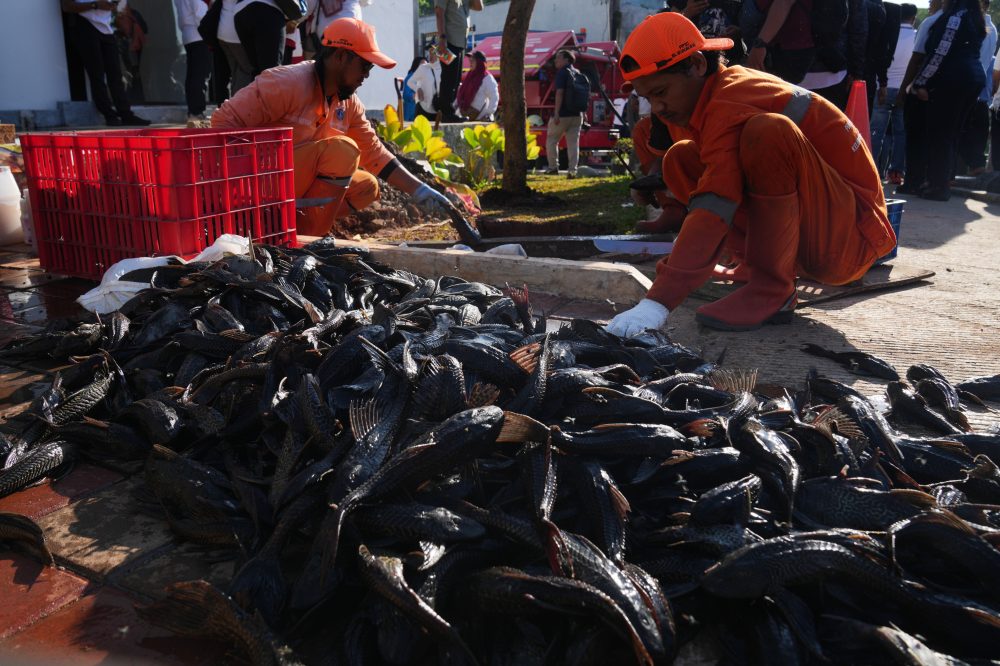
Friday’s cleanup at a 6-meter-deep (19-foot-deep) water reservoir in East Jakarta’s Ciracas district attracted interested onlookers as municipal crews gathered approximately 320 kilograms (705 pounds) of the invasive species.
Stacks of squirming janitor fish filled red containers beside the reservoir — concrete evidence that meaningful action was finally underway.
‘The janitor fish populations have reproduced at a notable level while also feeding on native species,’ East Jakarta’s mayor, Munjirin, told reporters during Friday’s cleanup visit. ‘The impact extends beyond ecosystem destruction, contributing to structural damage to riverbank and embankment walls.’
Munjirin, who follows the Indonesian custom of using one name, stated that this coordinated effort begins a long-term strategy to manage the species, with regular surveillance and removal scheduled to prevent additional environmental harm.
Nevertheless, he promised to reassess the program’s approach after the Indonesian Ulema Council, or MUI, expressed concerns about apparent cruelty, guaranteeing that all fish will be deceased before disposal.
While supporting the cleanup, MUI’s religious ruling commission cautioned that burying living janitor fish constitutes a breach of animal welfare principles established in Islamic teachings.
Officials remain careful about future steps. Although janitor fish provide food in certain nations, worries about heavy metal pollution mean they cannot be immediately cleared for human consumption in Jakarta. Instead, authorities are investigating options including converting the fish into livestock feed or soil enhancement products.
Anung stated that the disposal process will mandate killing the fish before burial at approved locations, with sanitary protocols implemented to prevent their return to waterways or commercial markets.
The Jakarta governor observed that buried janitor fish can function as organic fertilizer and recommended following Brazil’s approach, where the fish become charcoal to create greater economic value.
However, scientists warn that removal represents just the beginning. Without enhancing sewage treatment and decreasing contamination, the river may rapidly return to previous conditions.
‘The Ciliwung River requires rehabilitation, our major challenge that must be addressed,’ Rosleine said. ‘Addressing the symptoms without tackling the root causes will not provide a lasting solution.’