
SANTA CLARA, California — A World Cup featuring 104 matches, 48 teams, and 39 days of action spread across three nations is a grueling test for players — but the broadcasters keeping audiences informed are dealing with their own extraordinary challenge.
The North American World Cup has shattered previous records in both revenue and reach. More than 100 networks are delivering coverage to 223 territories around the world, and FIFA is projecting over six billion media engagements — a full billion more than the 2022 tournament generated.
The sheer scale of the expanded format has placed enormous demands on everyone involved in coverage, from production crews to the commentators calling the action live.
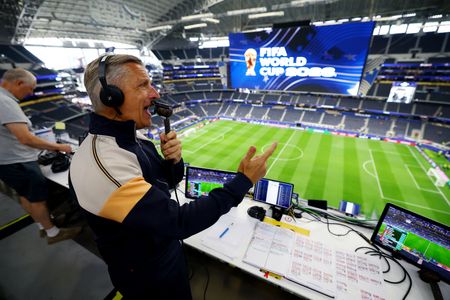
BBC commentator Steve Bower has spent three decades in broadcasting, but says nothing has prepared him for the scope of this tournament. After covering nine matches across six cities and two countries, he put it simply.
“This tournament is crazy,” Bower said. “The number of teams, the volume of matches, the travel, the different nations … this competition has tested our skills in new ways.”
New Challenges at Every Turn
One unexpected hurdle has been identifying players on the field. Commentary positions are located high up in large NFL-style stadiums, and many players are wearing identical fluorescent pink boots, making it harder to tell them apart from a distance.
Bower said staying focused during simultaneous matches and rapidly shifting group-stage standings is especially demanding, made even more complicated by the new format’s rule allowing the best third-place finishers to advance.
“Experience helps you handle those situations better but the responsibility remains,” Bower said. “The adrenaline gets you through the broadcast, but there’s always a degree of nervous energy.”
With four time zones, 16 additional teams, and 40 more matches than previous tournaments, host-nation broadcasters have had to expand their operations significantly.
U.S. Spanish-language broadcaster Telemundo has set up World Cup studios in Mexico City, Miami, and New York, deploying 80 on-air personalities, 1,400 production staff, reporters, and dozens of cameras spread across all 16 host cities.
Canada’s Bell Media, which operates TSN, began preparing for the tournament back in 2023. The network has studios in Vancouver, Toronto, and Montreal, a team stationed at FIFA’s broadcast headquarters in Dallas, and multiple crews working in rotation to sustain coverage across the 39-day event.
Shawn Redmond, Bell Media’s VP of sports, described the production as likely the largest media undertaking in Canadian history.
“It’s a tremendously logistics-heavy operation,” he said. “There’s a responsibility and an obligation that we take seriously to get it right and do right by Canada.”
‘Best Seats in the House’
On the U.S. side, Fox Sports has broken its own World Cup viewership records, averaging five million American viewers per group-stage match — a 92% increase compared to the Qatar World Cup. The network has deployed 12 former top-level players as studio analysts and nine commentary teams to cover all 104 games.
Among those commentators are Darren Fletcher and former England player Owen Hargreaves, a pairing known for their lively on-air chemistry. Working out of a Dallas base, the two have been flying back and forth to cities including Toronto, Guadalajara, New York, Houston, and Atlanta.
Fletcher, who also works with Britain’s TNT Sports, adjusts his commentary approach depending on his audience and focuses heavily on preparation. He watches replays of every match he calls, reviewing each line of commentary to find ways to improve.
“I try to concentrate, know all the eventualities as the big games start. I’m a fan like anyone and I’m likely to cock it up as much as anyone else is,” Fletcher told Reuters. “You’ve got to be across it. There’s nothing genius about it.”
Correctly pronouncing players’ names is another ongoing challenge. Fletcher addresses this by writing out phonetic spellings in his pre-match notes, which he prints and laminates to protect them — a lesson learned the hard way.
“Someone once spilled a drink all over my notes — they were unreadable,” he said. “So now I’m prepared for that.”
Despite all the demands, both Bower and Fletcher say they wouldn’t trade their roles for anything, especially as soaring ticket prices have put attending matches out of reach for many fans.
“I genuinely believe it’s the best job in the world,” Bower said. “I never complain.”
Fletcher echoed that sentiment: “We’ve got the best seats in the house, watching the World Cup next to my mate — it’s more than you could ever ask for. When you cover games, you’re being invited all the time into strangers’ living rooms. That’s an honour for us. We’re privileged and it’s such a buzz.”