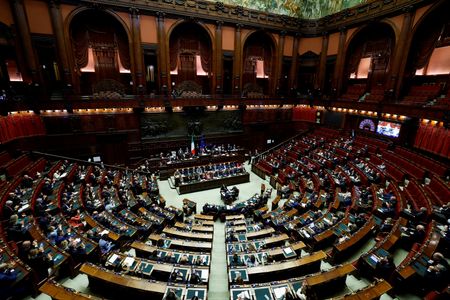

Italy’s lower house of parliament gave the green light Thursday to a deeply divisive government plan to reshape the nation’s electoral system — a move that opposition lawmakers blasted as a calculated effort to keep Prime Minister Giorgia Meloni in power when Italians head to the polls in 2027.
The proposal comes from Meloni’s ruling right-wing coalition, which includes her Brothers of Italy party along with the League and Forza Italia. Under the plan, Italy would move to a fully proportional voting system. Any political bloc that earns more than 42% of the vote would receive a bonus allocation of seats — 70 additional seats in the 400-member lower house and 35 extra seats in the 200-member Senate. To prevent any one group from dominating too heavily, total representation would be capped at 220 seats in the lower chamber and 113 in the Senate.
The road to passage was not without friction. On Tuesday, coalition lawmakers themselves helped sink a related proposal that would have allowed voters to express preferences for individual candidates on party lists, revealing cracks within the ruling alliance.
The legislation still requires Senate approval before it becomes law. The government is targeting the period after the summer recess to push it through that chamber.
Italy’s current voting system elects most lawmakers through proportional representation, but roughly one-third of seats are filled through first-past-the-post contests — a format that analysts say tends to benefit opposition parties. The reform would eliminate those first-past-the-post seats entirely, including in southern Italy where a centre-left alliance led by the Democratic Party and the 5-Star Movement has historically performed well.
Supporters of the reform argue it would produce more stable governing majorities following elections. Meloni is on track to become Italy’s longest-serving postwar prime minister in early September, having overseen an unusually steady period of governance.
Meanwhile, a new political force is complicating the picture for Meloni’s coalition. A far-right movement called Futuro Nazionale, headed by former army general Roberto Vannacci, has been drawing support away from the ruling bloc. The party is now polling at just above 6% and has surpassed the League in some surveys. Whether Vannacci would ultimately align with Meloni remains an open question.
Polling firm YouTrend ran simulations showing that a right-wing alliance that includes Futuro Nazionale could still achieve a parliamentary majority — but that the centre-left could come out on top if Vannacci’s party runs independently.
“The outcome of the next election will depend not only on the electoral law, but crucially on where Futuro Nazionale positions itself,” YouTrend said.