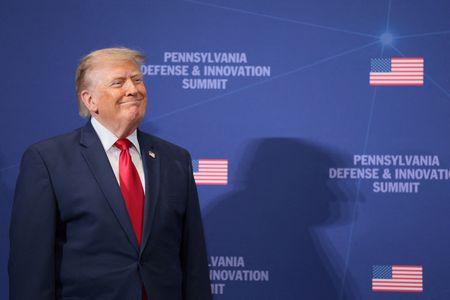

President Donald Trump is planning to address the nation in a primetime speech Thursday evening, with election security as the central topic — a move that puts his long-standing grievances about voting systems back in the spotlight as Republicans brace for a difficult midterm election this November.
According to four sources cited by Reuters on Wednesday, the White House was weighing whether Trump’s remarks would include the release of classified intelligence regarding China’s intentions or capabilities to interfere in the 2020 U.S. election. Several Trump administration officials reportedly expressed concern that sharing the information could be misleading.
Trump has spent years casting doubt on election results, repeatedly and falsely claiming that his 2020 defeat to Democrat Joe Biden was the result of a rigged process. He has also pushed other debunked claims — that mail-in voting is riddled with fraud, that voting machines can be easily compromised, and that non-citizens are casting ballots in large numbers. Multiple courts and vote recounts have found no evidence of widespread fraud in the 2020 election.
The intelligence related to China was gathered during Trump’s first term, which ran from 2017 to 2021. Sources told Reuters that the information did not indicate Beijing had actually altered or manipulated any votes.
A White House task force headed by conservative journalist John Solomon reportedly requested documents from the intelligence community outlining that information. According to one source with knowledge of the group’s activities, the task force has spent several weeks reviewing those materials ahead of Thursday’s speech.
White House spokeswoman Karoline Leavitt pushed back on reports about the speech’s content. “As usual, anonymous sources are speculating about what President Trump will say during his speech on Thursday evening,” she said. “The truth is, nobody knows yet what President Trump will ultimately say.”
The Office of the Director of National Intelligence did not respond to requests for comment, and the CIA declined to comment.
Since taking office again in January 2025, Trump has moved to expand federal authority over election administration — a responsibility that under the U.S. Constitution belongs to state governments. He has also pushed Senate Republicans to pass the SAVE America Act, a bill that would require photo identification to vote and proof of U.S. citizenship to register, while also compelling states to share voter registration data with the federal government. Democrats and voting rights groups argue that voter fraud is extremely uncommon and that the legislation would end up blocking legitimate voters from participating.
Some Republican leaders have privately urged Trump to redirect his attention toward kitchen-table issues like the high cost of living rather than relitigating the 2020 election.
Senate Majority Leader John Thune offered a measured response when reporters asked Wednesday whether he would counsel Trump against bringing up the 2020 election. “I don’t know what he’s going to say,” Thune said. “The only thing I can tell you is, we are focused on the 2026 election, at least I am, and I think most of my colleagues are.”
Republicans are facing political headwinds heading into the midterms, with Trump’s approval rating below water and voters expressing deep frustration over the Iran war and the high energy prices that have come with it.
Democrats need to flip just three Republican-held seats to take control of the U.S. House of Representatives. Winning back the Senate, however, presents a steeper challenge, with key races playing out in states that lean Republican.
Senate Democratic leader Chuck Schumer told reporters Wednesday that Democrats are bracing for the White House to attempt to manipulate the November election. “They know they can’t win the election fair and square,” Schumer said. “So we don’t put it past them to try whatever they can.”
It remains unclear whether television networks will provide airtime for Trump’s speech. That practice is generally reserved for major presidential addresses on matters of significant national concern. Some Democrats, including U.S. Representative Alexandria Ocasio-Cortez, have called on networks to decline, arguing Trump is likely to repeat claims about elections that have already been thoroughly debunked.