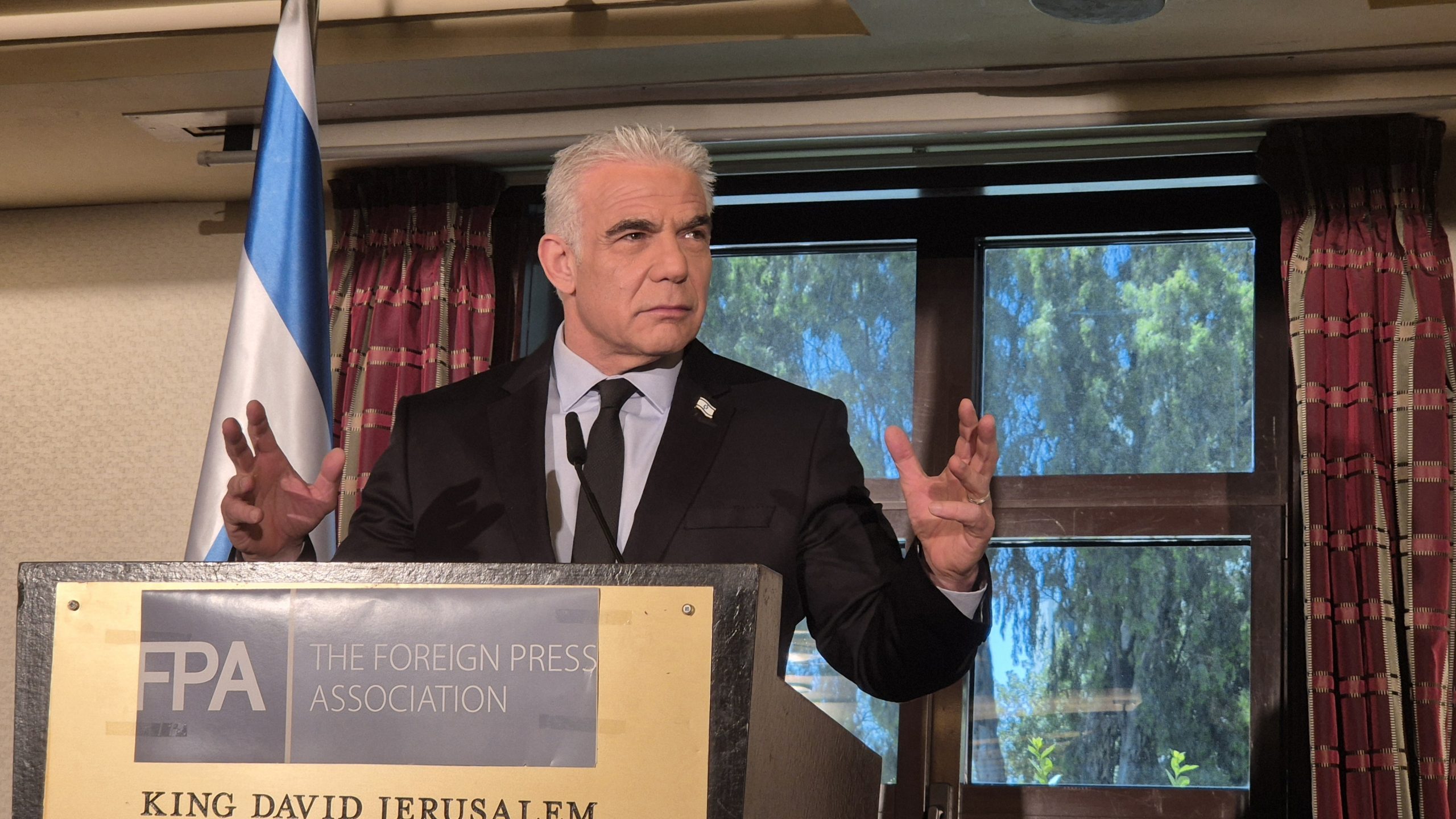

Israeli opposition leader Yair Lapid delivered sharp criticism of settler violence during a Foreign Press Association briefing, declaring without hesitation that “Settler terror is terror” when questioned about extremist actions in the West Bank.
During the press conference, Lapid addressed foreign policy matters involving Iran, Gaza and the West Bank, but made headlines when he outlined potential leadership arrangements for a future government headed by Naftali Bennett.
“I assume that the ideal government for most Israelis will be Naftali Bennett as prime minister, and former IDF chief Gadi Eisenkot as defense minister, and former finance minister Avigdor Lieberman as finance minister, and myself as foreign minister,” Lapid stated. “Again, this will be subject, I assume, to political results, but this is what we’re trying to do.”
Lapid characterized this potential partnership as “a union between the center and the liberal right” while indicating that additional political groups might still join the coalition. He expressed hope that Eisenkot would formally participate, saying “he will eventually.”
When pressed about whether settler violence constitutes terrorism, Lapid responded immediately and forcefully. “I never thought that in my lifetime we would talk about Jewish terrorism,” he declared. “But this is Jewish terror.”
The opposition leader argued that radical settler actions in the West Bank create both security risks and diplomatic problems for Israel. “These people are the greatest gift anti-Semites around the world could ask for,” Lapid explained. “It allows anti-Semites on both the right and the left to claim that this is Zionism and these are the values of the State of Israel. It is not.”
Lapid also targeted National Security Minister Itamar Ben-Gvir regarding treatment of Gaza flotilla activists, describing the situation as “a national disgrace” and emphasizing that “democracy comes with a price,” which includes “upholding international law.”
International relations emerged as a major focus when The Media Line questioned what Israel’s Foreign Ministry had accomplished recently and what changes he would implement. “You’re asking what the Foreign Ministry has done right in the last three and a half years?” Lapid responded. “Nothing.”
He blamed the current administration for damaging Israel’s bipartisan support in the United States, mismanaging European relationships, and choosing public confrontation over diplomatic engagement. “Part of foreign relations is dealing with these issues, not calling everybody an anti-Semite,” Lapid stated. “There are enough anti-Semites. We don’t have to create new ones.”
To illustrate his point, he referenced Israel’s decision to withdraw its ambassador from Ireland during a diplomatic disagreement, while Ireland kept its diplomatic presence in Israel. “So now if you’re an Israeli in Ireland, you have no one to talk to if you lost your passport,” Lapid observed. “But if you’re an Irish man or woman in Israel who lost his passport, you have an ambassador to talk to. This doesn’t make any sense.”
Lapid also expressed concern that Israel’s Washington influence had declined substantially despite the close ties between Netanyahu and US President Donald Trump. “In Washington, the Israeli government is actually at an all-time low in its ability to influence decisions in Washington,” Lapid warned. “Israel is not a vassal state and we are not a protectorate.”
Despite his harsh assessment of current diplomatic efforts, Lapid maintained tough positions on Iran and security matters. He supported Israel’s right to take military action against Iran when needed and expressed concerns about developing agreements between Washington and Tehran that could threaten Israeli interests.
“There will be no two-state solution in the coming years,” Lapid declared later during the session, explaining that Israelis have lost confidence that a Palestinian state could avoid becoming “another failing terror state on our border.”
However, he indicated that a Bennett-led administration would pursue a cautious approach in the West Bank, avoiding major policy shifts. The government would implement neither annexation nor significant diplomatic efforts toward Palestinian statehood in the immediate future. “We will make sure that nothing will happen that is irreversible,” Lapid promised.