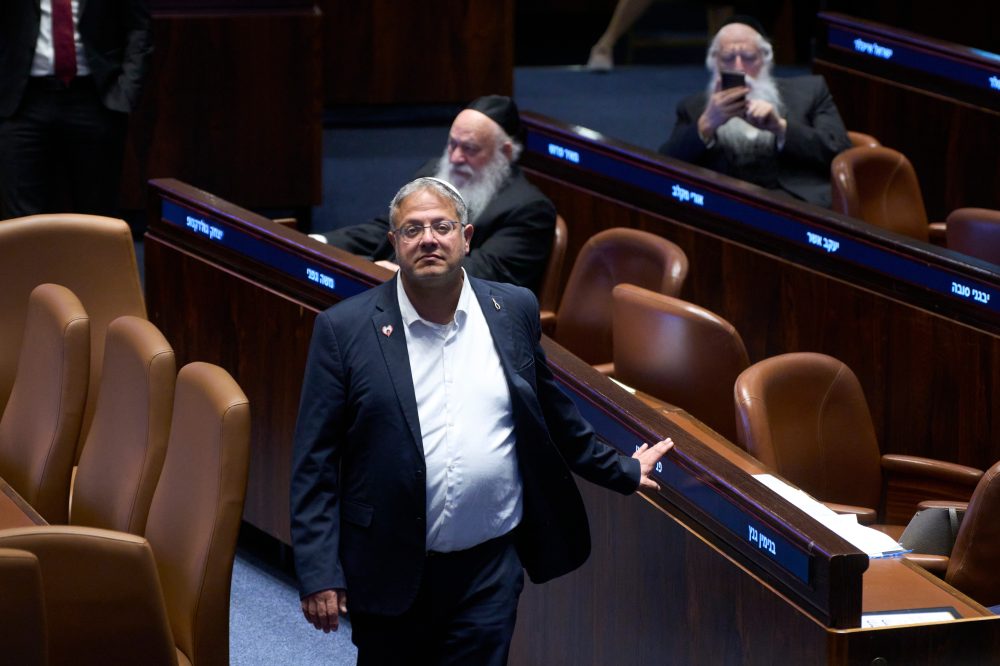

Approximately 430 protesters who were captured while attempting to breach Israel’s naval blockade around Gaza were brought to the Israeli port city of Ashdod on Wednesday aboard military vessels, where National Security Minister Itamar Ben-Gvir confronted them and demanded they be imprisoned for an extended period.
Footage distributed by Ben-Gvir depicted the minister moving through groups of the captured protesters while surrounded by law enforcement and military personnel, carrying a large Israeli flag and declaring “Welcome to Israel, we are the landlords.” The video captured one restrained protester yelling “Free Palestine” as Ben-Gvir passed by, prompting security forces to immediately force the individual to the ground.
The recording revealed protesters with their hands restrained behind them, kneeling with their faces to the floor in what appeared to be a temporary holding facility at Ashdod port and on a ship’s deck.
In additional footage, Ben-Gvir remarked that the protesters “came here all full of pride like big heroes. Look at them now,” while requesting Israeli Prime Minister Benjamin Netanyahu to authorize their extended detention.
“I say to Prime Minister Netanyahu, give them to me for a long, long time, give them to us for the terrorist prisons, that’s what it should look like,” Ben-Gvir said.
The Legal Center for Arab Minority Rights in Israel, known as Adalah, condemned Israeli officials for “employing a criminal policy of abuse and humiliation against activists.”
Adalah released a statement claiming this mirrored previous patterns of mistreatment by Israeli officials toward protesters in earlier flotilla operations “for which Israel faced zero accountability.” The organization reported that its attorneys and other volunteers were offering legal assistance to protesters at Ashdod while demanding their immediate freedom.
“The international community must take urgent measures to protect the flotilla members against this brutal and illegal conduct by Israeli officials,” the group said.
Italian Foreign Minister Antonio Tajani contacted Israeli counterpart Gideon Saar during overnight hours, pressing for the swift release of Italian nationals — including a lawmaker and a journalist — and requesting protection of their safety and rights.
Israeli military forces on Tuesday intercepted the final vessels from the flotilla that attempted to challenge the blockade — the most recent initiative to draw attention to the dire circumstances facing nearly 2 million Palestinians in Gaza.
Flotilla coordinators alleged Israeli troops opened fire on five vessels during the seizures, resulting in some damage. Israel’s Foreign Ministry stated that no live rounds were discharged and that “nonlethal means” were directed at the ships as a warning, without targeting or harming demonstrators.
Israeli forces had started intercepting the flotilla approximately 167 miles (268 kilometers) from Gaza’s shoreline, based on the flotilla’s website. The ships had left Turkey the previous week.
Israel has characterized the flotilla as “a PR stunt at the service of Hamas” without genuine intentions to provide aid to Gaza. The vessels transported a token amount of humanitarian supplies.
On Monday, the Israeli navy intercepted 41 vessels from the flotilla in international waters near Cyprus and detained everyone aboard.
More than a dozen Irish citizens participated in the flotilla, including the sister of Irish President Catherine Connolly. Irish Prime Minister Micheál Martin has denounced Israel’s seizure of the boats in international waters as “absolutely unacceptable.”
Turkey and the Palestinian militant group Hamas have characterized the seizures as “piracy.” Italy, Spain and Indonesia urged Israel to free the protesters and guarantee their safety.
The U.S. Treasury, however, imposed sanctions against several European activists aboard the flotilla, which U.S. Treasury Secretary Scott Bessent called “pro-terror.”
Israel has enforced a maritime blockade of Gaza since Hamas assumed control of the region in 2007. Israeli officials tightened it following the Hamas-led militant attacks on southern Israel that resulted in approximately 1,200 deaths and saw more than 250 people taken hostage on Oct. 7, 2023.
Opponents argue the blockade constitutes collective punishment. Israel has maintained that the blockade aims to prevent Hamas from obtaining weapons. Egypt, which controls the sole border crossing with Gaza not under Israeli authority, has also severely limited movement in and out.
Gaza’s Health Ministry reports that Israel’s retaliatory campaign following the Oct. 7 attacks has resulted in more than 72,700 deaths. The ministry, operating under Gaza’s Hamas-run government, does not provide a breakdown between civilians and combatants. The ministry consists of medical professionals who maintain and publish detailed records considered generally reliable by the international community.