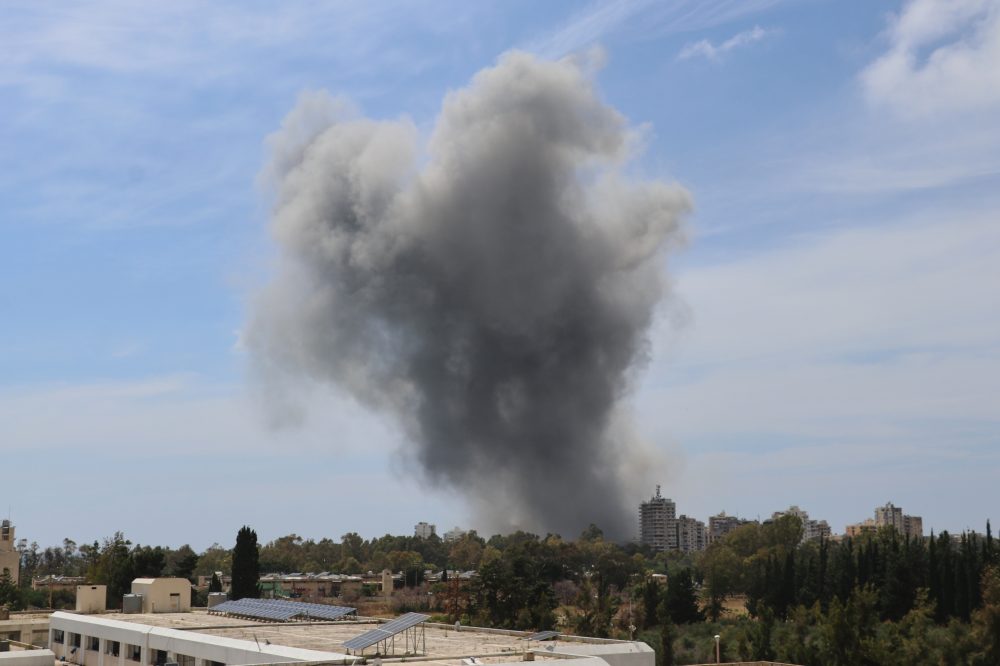

Israeli military forces have captured a strategically important fortress in southern Lebanon, advancing deeper into the country than they have in more than 25 years, even as diplomatic efforts continue to broker peace between the neighboring nations.
The Israeli army took control of Beaufort castle on Sunday, a historic stronghold positioned more than 700 meters above sea level that provides sweeping views of both Lebanon and northern Israel. The fortress has served military purposes for nearly 1,000 years.
Israeli officials state they are conducting operations against Hezbollah, the Iranian-supported militant organization that maintains significant political influence in southern Lebanon and has fired thousands of rockets and drones at Israeli forces and communities in northern Israel.
Israeli authorities have urged Lebanese residents throughout the southern region to leave their homes or face potential danger from military operations. Lebanese Prime Minister Nawaf Salam criticized Israel on Saturday, claiming the nation is “implementing a policy of total destruction of cities and towns.”
More than 3,300 individuals, including numerous children, have lost their lives in Lebanon since hostilities resumed on March 2, just two days following the start of the Iran conflict. Approximately 1 million people have been forced from their homes. Israeli casualties include at least 25 soldiers and one defense contractor killed in Lebanon or northern Israel, plus two civilians in northern Israel.
The captured fortress, alternatively known as Al-Shaqif, originated as a Crusader stronghold during the 12th century. Throughout history, it has been occupied by Saladin’s forces, Mamluks, Ottomans, French mandate authorities, the Palestinian Liberation Organization, and Israeli forces until 2000, when it underwent partial restoration and welcomed tourists.
Israeli Prime Minister Benjamin Netanyahu observed on Sunday that Beaufort represents “a symbol of a heroic battle for our fighters, but was also a symbol of deep division between us.”
The military’s return to the site creates a sense of repetition, according to Orna Mizrahi, who previously served as deputy director in the government’s National Security Council. “There’s a feeling of, ‘For what?’” she stated.
Mizrahi, currently a senior researcher at the Institute for National Security Studies, explained that “Beaufort” evokes both triumph for the Israeli forces who captured it in 1982 and the costly efforts to defend it before its transfer in 2000.
She anticipates Israel will ultimately surrender control of the fortress, despite Defense Minister Israel Katz’s pledge to incorporate it into Israel’s permanent security zone in southern Lebanon.
Maintaining a military presence there will not resolve the Hezbollah situation, Mizrahi noted: “Yes, we are damaging them in the operations, but in parallel we need to pursue a political and diplomatic solution.”
Israel has consistently viewed Hezbollah as a security threat. The Shiite Muslim armed organization formed in 1982 following an Israeli occupation of southern Lebanon. Hezbollah has attacked northern Israeli communities and entered the Gaza conflict in 2023 to support Palestinians.
Israeli operations significantly weakened Hezbollah during months of warfare. Combat ceased with a U.S.-mediated ceasefire in late 2024 following indirect negotiations, and Israeli troops pulled back except from five strategic elevated positions near the border.
Lebanon’s new administration assumed power promising to disarm organizations like Hezbollah, but the militants refused. Israel subsequently alleged that Hezbollah was rearming and rebuilding its capabilities.
Hezbollah resumed attacks on Israel on March 2, leading Israel to launch an invasion of southern Lebanon. Recently, Israel has reported efforts to prevent Hezbollah from harming its personnel and civilians using an advanced fiber-optic drone technology that has seen extensive use in the Ukraine conflict.
A U.S.-mediated ceasefire took effect in mid-April. However, unlike the agreement in the Iran conflict, this truce has failed to maintain stability.
Hundreds of thousands of residents have evacuated southern Lebanon as Israeli forces conducted aerial bombardments and ground troops advanced into the territory. Many displaced people have sought refuge in Beirut, the capital, where hundreds have died, including during an intensive bombardment lasting several minutes in April.
Israeli forces currently occupy substantial portions of southern Lebanon and have destroyed residential buildings and historical landmarks. Lebanon’s prime minister, Salam, stated Saturday that Israel is attempting to “uproot Lebanon’s memory and erase the people’s history.”
Groundbreaking discussions between high-ranking Israeli and Lebanese officials commenced in April in Washington, representing the first such meetings in over three decades between the nations that lack formal diplomatic ties.
The first direct military discussions in decades took place on Friday.
Outstanding matters include Israeli withdrawal from southern Lebanon, positioning of Lebanese forces in the region, and Hezbollah’s disarmament, which the group has rejected while Israeli forces remain in the country.
Negotiations will resume this week. Hezbollah is not participating and has declared it will not recognize any outcomes. The organization favors discussions that utilize Iran’s influence and considers the Lebanese government ineffective, a view echoed by some others in the country.
Lebanese citizens remain divided regarding the talks, which sparked protests when announced. Many Lebanese express anger toward Hezbollah for the devastation it has brought to their country, while also maintaining suspicion of Israel.
Lebanon’s prime minister described the direct negotiations on Saturday as “currently the least costly option,” emphasizing they do not constitute surrender and acknowledging no guarantee of success.