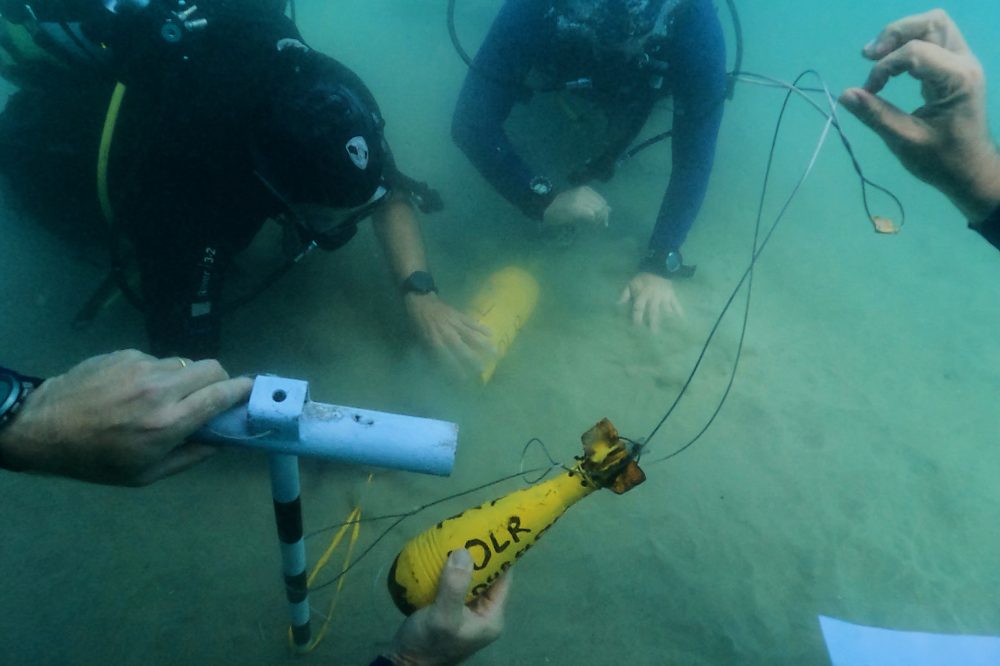

RISHON LEZION, Israel — With GPS coordinates marked and an anchor tossed overboard, an orange buoy bobbed to the surface as a team of Israeli divers geared up on the bow of a research vessel. They pulled on wet suits, ran checks on their oxygen tanks, and slipped beneath the Mediterranean waves.
After spending hours searching the seafloor for yellow-painted practice mortar shells, however, the team came up with nothing.
It was the fifth dive in a multi-year research effort designed to help Israel figure out how to safely remove unexploded grenades and other munitions from the sea — and eventually return a stretch of beach to local residents. But that day in June, the dummy shells the team had placed months earlier were nowhere to be found, offering a preview of the enormous challenges that lie ahead.
“It’s really hard to find things in the sea,” said Roy Jaijel, a researcher in the marine geology and geophysics department at Israel’s National Institute of Oceanography, after surfacing from the dive.
Jaijel is co-leading a project focused on reclaiming roughly 2 kilometers, or about 1.2 miles, of shoreline in the central Israeli city of Rishon LeZion — a stretch that has functioned as a military firing range for decades. The initiative is the first of its kind in Israel and aligns with a worldwide effort to better safeguard oceans and seas as global demand grows for their use in shipping, energy production, and recreation.
According to experts, the issue of underwater munitions has drawn increasing attention in part because of the rapid expansion of artificial intelligence, which depends on millions of kilometers of fiber-optic cables running along the ocean floor to keep the world connected.
Munitions end up underwater in a variety of ways — dumped after wars, lost during active conflict, or, as in Rishon LeZion’s case, left behind from years of military training exercises. Over time, seawater erodes the shells, causing toxic chemicals, explosive compounds, and heavy metals to leak out and contaminate the surrounding environment. There is also the danger of an accidental detonation if someone steps on one — or if a child picks one up, mistaking it for a toy.
Two years ago, Europe launched a program to better detect and remove non-military unexploded ordnance from industrial and commercial sites. In a separate effort in 2024, Germany began a pilot program to collect and dispose of military debris in the North and Baltic Seas, where the German government estimates some 1.6 million tonnes of unexploded munitions from two world wars still rest on the seafloor.
Despite these efforts, there has been comparatively little focus on clearing munitions from Middle Eastern waters, including the Mediterranean, which has historically seen fewer large-scale dumping events than European seas.
Project leaders in Israel say their work is among the first to specifically address the challenge of clearing smaller munitions in complex underwater environments — a task that many countries have steered clear of entirely.
“It’s like looking for a needle in a haystack,” said Israel Faintuch, head of the Maritime Division at Israel’s Ministry of Defense National Mine Action Authority, as he checked his oxygen tank and prepared to dive.
The Israeli government says that nearly half of the country’s 194-kilometer, or 120-mile, coastline is closed to the public, taken up by commercial ports, power stations, desalination plants, military installations, and firing zones.
Since Israel’s founding nearly 80 years ago, 7 kilometers — roughly 4.3 miles and nearly the entire length of Rishon LeZion’s shoreline — has been used as a military firing range. Grenades and both small and large mortars have been launched there over the years, leaving hundreds of thousands of residents squeezed onto a narrow band of accessible beach.
The joint research project, which launched last year, is funded by the Rishon LeZion municipality and is being led by Israel’s National Mine Action Authority alongside researchers from the National Institute of Oceanography. The goal is to identify the most heavily affected areas, map where the munitions are concentrated, and determine how far out to sea and how deep the clearance effort will need to go.
To collect data, divers place fake munitions of varying sizes — some fitted with motion sensors — at depths of 5, 10, and 15 meters (16, 33, and 59 feet) and at distances up to 1.2 kilometers, or about 0.75 miles, from shore. After several months, the team retrieves the devices, studies the data, and then deploys a new set.
In June, Associated Press journalists joined the team underwater as divers placed a fresh round of test munitions and attempted to recover ones left behind in January. The divers used a string or measuring tape to navigate along the seafloor, tapping each other and pointing in different directions as they swept their hands across the sandy bottom in search of the hidden objects.
“You have limited air supply when you go with the divers and you have limited time in the water,” said Dafna Eliahu, a graduate student working on the project. “So with actual live munition I expect it to be very difficult, very hard to locate and to actually be able to find them.”
Eliahu noted that while the data from the sensors is still being analyzed, early results suggest the munitions moved less than anticipated — a potentially encouraging sign that the area requiring clearance may be smaller than originally feared.
Israel’s Defense Ministry is aiming to collect enough data to begin actual clearance operations by the end of next year, with an initial goal of opening up 150 meters, or about 492 feet, of shoreline within a few months after that. Completing the full project will take years and is expected to cost tens of millions of dollars. Progress has already been set back by Israel’s multiple military conflicts — including wars with Hamas in Gaza, Hezbollah in Lebanon, and Iran — since divers cannot work when missiles are being fired and may land in the sea.
During the current war that the U.S. and Israel launched against Iran, as well as a 12-day conflict last June between Israel and Iran, the military acknowledged that missiles aimed at larger cities including Rishon LeZion fell into the sea, though officials declined to say how many.
Israeli authorities say no one has been killed or injured by unexploded sea ordnance, but roughly a dozen sightings of suspicious devices over the past 20 years have prompted responses from police and military units. Most of those objects were found on or near the shoreline.
Beyond expanding beach access for local residents, Israel also hopes the research will generate new knowledge about munitions clearance in this part of the world, where threats exist but relatively little data has been gathered.
According to the Geneva International Centre for Humanitarian Demining, more than half of all global incidents involving unexploded ordnance — including sightings and drifting mines — were recorded in the Middle East between 2014 and 2023. The majority occurred in the Red Sea off the coast of Yemen and in the Bab-el-Mandeb Strait, largely as a result of Yemen’s civil war.
Pedro Basto, research and innovation program manager with the organization, stressed the importance of keeping attention focused on the removal of underwater explosives given how much modern society depends on the seas.
“Both renewable energies based on the sea (wind turbines and harnessing water currents) and the global connectivity that most of the world relies on every minute of every day, depend massively on underwater cable laying,” he said.
As the project moves forward, residents of Rishon LeZion say they are eager for the day when more of their coastline becomes accessible.
Moria Malka, head spokesperson for the city’s municipality, said the clearance effort will triple the amount of available coastline in the area, with much of it set to become a nature reserve as well as residential space near the water. For beachgoers like Mark Kostman, that prospect is welcome news.
“Holidays and Saturdays, all of this place is completely crowded and too dense to even have fun,” Kostman said while playing volleyball with his children near the firing zone. “Having it as public space for leisure and sport … it’s wonderful.”