
BEIRUT – The conflict between Israel and the Iran-backed Lebanese militant organization Hezbollah has rapidly intensified in recent days.
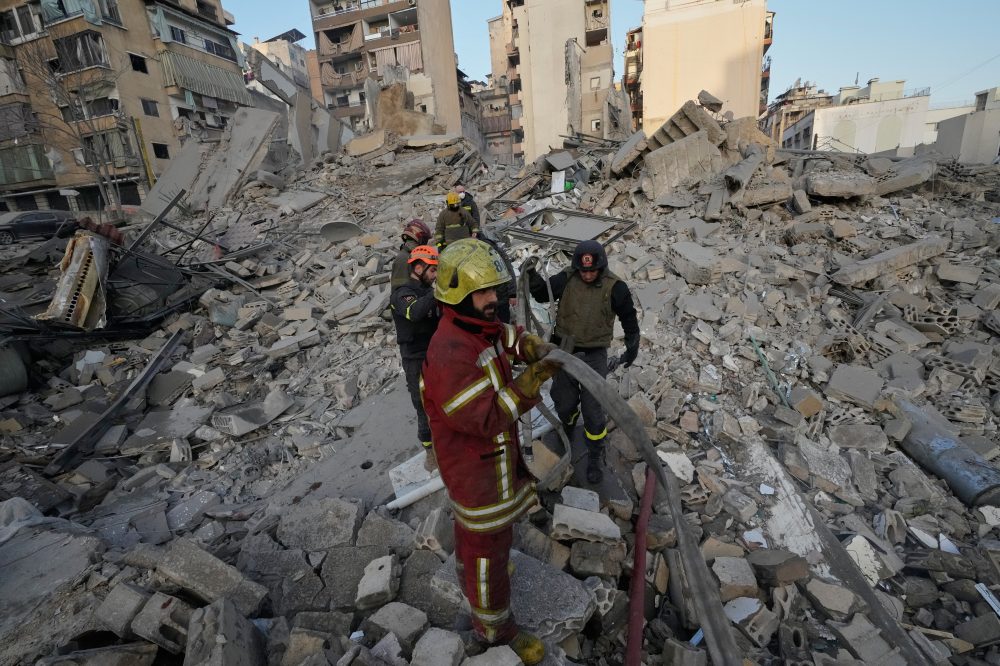
On Wednesday, Israeli airstrikes targeted several neighborhoods in central Beirut, causing a multi-story residential building to collapse along a major street and damaging walls of surrounding structures. These attacks followed Hezbollah’s launch of dozens of missiles into Israeli territory the night before.
Along Lebanon’s southern border, Israeli military forces are gathering for what could become a large-scale ground offensive, with fighting already taking place in certain border regions.
Efforts by Lebanese government representatives to begin direct peace talks with Israel have failed to gain traction. Both Hezbollah and Israel appear unwilling to pursue an immediate end to hostilities.
Israel aims to eliminate the security threat along its northern frontier through this military campaign. Hezbollah views the conflict as a fight for survival. Regardless of how it concludes, the war is expected to have significant impacts across Lebanon and the broader Middle East.
The two adversaries have engaged in several conflicts since Hezbollah emerged in the 1980s as a guerrilla organization opposing Israel’s occupation of southern Lebanon during that period.
Fighting resumed on March 2, just two days after joint Israeli-American strikes against Iran that contributed to expanding regional warfare. Hezbollah fired missiles at Israel, stating the attack was revenge for the death of Iranian Supreme Leader Ayatollah Ali Khamenei and in response to “repeated Israeli aggressions” in Lebanon.
This renewed hostility between the long-standing enemies began 15 months after a ceasefire agreement brokered by the United States ended their last war. During the ceasefire period, Israel maintained almost daily air operations in Lebanon, claiming these were necessary to prevent Hezbollah from rebuilding its capabilities. Israeli forces also maintained control of five strategic hilltops within Lebanese territory along the border.
During this time, Hezbollah faced both domestic and international demands to give up its remaining weapons stockpile. The organization remained relatively inactive and did not participate in last year’s Israel-Iran conflict. Many observers believed the group had been significantly weakened following substantial casualties in the 2024 fighting.
Hezbollah’s choice to rejoin the conflict surprised and angered many Lebanese citizens, including some within the group’s Shiite supporter base, who criticized the organization for providing Israel with justification to escalate military action.
However, Mohanad Hage Ali, a senior fellow at the Malcolm H. Kerr Carnegie Middle East Center in Beirut, explained that from Hezbollah’s viewpoint, joining the regional conflict made strategic sense.
Iran was confronting an existential danger, and Hezbollah “is backed and funded and trained by the Iranian regime,” he explained. The fall of the Islamic Republic would “basically mean the death of Hezbollah as a project.”
Additionally, Hage Ali noted that even if Hezbollah had remained neutral, the militant organization anticipated that Israel would eventually launch an attack against it regardless.
From Hezbollah’s strategic perspective, he explained, “There’s no point in continuing to be a sitting duck until Israel finishes off your main ally and comes for you. It makes more sense that you join your ally in the war and try to achieve a ceasefire as part of a package.”
Lebanese health ministry statistics show that as of Wednesday, Israeli strikes have killed 968 people in Lebanon since March 2, including 77 women and 116 children, with over 2,400 people injured.
More than one million Lebanese residents have been forced from their homes after Israel issued widespread evacuation orders throughout the country. Many displaced families are living in vehicles, on streets, or in overcrowded schools converted to emergency shelters.
Israeli Foreign Minister Gideon Saar stated Wednesday that “since March 2nd, Israel has been attacked from Lebanese territory more than 2,000 times with missiles and drones.” Most projectiles were intercepted by defense systems or landed in unpopulated areas. The Israeli military has confirmed two soldier deaths during combat operations in southern Lebanon, though casualty numbers for wounded personnel have not been released.
While no major civilian casualties have occurred in Israel from Lebanese attacks, the continuous barrage of missiles and drones has created anxiety among residents in northern Israel. Many citizens are frustrated that the government has not offered evacuation assistance payments as it provided during the previous war when tens of thousands were displaced.
United Nations peacekeeping forces deployed in southern Lebanon have observed a clear increase in Israeli military presence along the border, according to Kandice Ardiel, spokesperson for the peacekeeping mission known as UNIFIL.
“Peacekeepers are seeing concentrations of IDF (Israel Defense Forces) troops in at least half a dozen locations near the Blue Line in Lebanese territory,” she stated, referring to the international border between the nations.
UNIFIL personnel have monitored combat activity near the villages of Odaisseh and Khiam and “have seen IDF ground incursions in some cases at least 5 kilometers (3 miles) into Lebanese territory,” Ardiel reported.
However, she noted that Israeli forces have subsequently pulled back rather than establishing permanent positions.
An Israeli military official confirmed that several thousand troops are operating inside Lebanon, primarily concentrated near the border area in what he characterized as a defensive mission to protect nearby Israeli communities. He indicated that the operation remains in early phases of a gradual process that might develop into a full-scale invasion with deeper territorial penetration. The official provided information anonymously according to military briefing protocols.
Lebanon’s national army has not actively participated in the fighting, though three Lebanese soldiers were killed in Israeli strikes on Tuesday. The Israeli military stated it is investigating the incident.
Tensions have also increased along Lebanon’s eastern border with Syria.
Last week, Syria’s military claimed that Hezbollah fired artillery rounds across the border at Syrian army positions, which Hezbollah has denied.
Subsequent reports suggested that the United States had proposed that Syria – whose government maintains hostile relations with Iran – deploy forces across the border to combat Hezbollah. U.S. envoy to Syria Tom Barrack denied these reports on Tuesday.
A senior Syrian official also rejected claims that such a proposal had been made, stating that discussions focused solely on preventing cross-border smuggling and Hezbollah’s use of Syrian territory. The official, speaking anonymously due to lack of authorization for public comment, said Syria had notified the Lebanese government that it would not intervene in Lebanon.
Turkish Foreign Minister Hakan Fidan told The Associated Press on Saturday that Turkey had “been approached by the Lebanese officials” regarding efforts to reduce tensions “and we talked with our Syrian counterparts” to help facilitate dialogue. Fidan noted that Turkey has not communicated directly with Hezbollah since the conflict began.