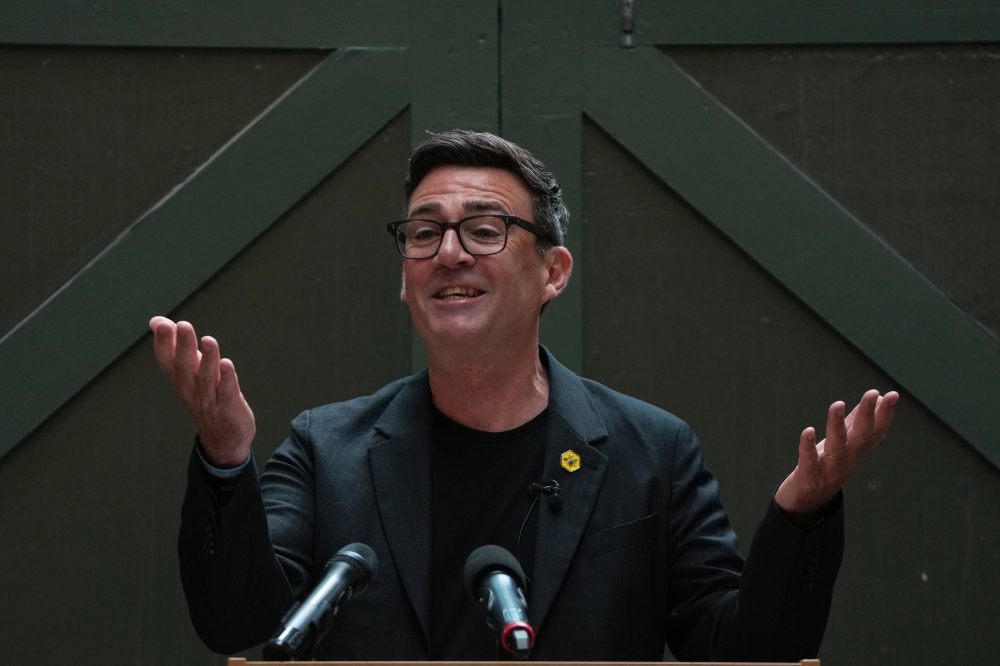

LONDON (AP) — Veteran Labour Party politician and former Greater Manchester mayor Andy Burnham is poised to take the reins as Britain’s next prime minister on Monday, formally assuming power from Keir Starmer, who stepped down as Labour leader last month.
Burnham ran unopposed in the Labour leadership race, becoming the only candidate to gather sufficient backing from fellow party lawmakers to succeed Starmer. Since Labour currently controls a majority in Parliament, whoever leads the party also holds the office of prime minister.
Of the 401 Labour lawmakers eligible to vote, 349 threw their support behind Burnham. He was officially declared the new Labour leader at a special party conference held Friday. However, he does not formally take office until Monday, when he travels to Buckingham Palace for a meeting with King Charles III — the ceremonial step that completes the transition. Until that meeting takes place, Starmer continues to serve as caretaker prime minister.
Here’s a closer look at how and why Britain is welcoming a new prime minister just two years after Starmer’s party swept to a landslide election victory:
Under Britain’s parliamentary system of government, a ruling party has the ability to swap out its leader in the middle of a term. When that happens, the new party leader steps into the role of prime minister without any need for a nationwide general election. This can occur when a prime minister voluntarily resigns as party leader or is pushed out through a formal leadership challenge.
The next scheduled general election does not need to occur until 2029 — five years after the last one, which was held in 2024.
Starmer announced on June 22 that he was stepping down as Labour leader after less than two years in power. His time in office was plagued by a string of political stumbles, most notably his decision to appoint someone with close ties to the late convicted sex offender Jeffrey Epstein as Britain’s ambassador to the United States.
Labour’s significant losses in a round of local elections held in May put enormous pressure on Starmer, with many of his own lawmakers calling for him to quit. The tipping point came when Burnham — widely seen as a favored figure within the party — won a special election for a parliamentary seat. That victory gave Burnham the platform he needed, and Starmer ultimately yielded to the growing calls to resign.
Starmer’s departure automatically set off a Labour leadership contest. Party rules state that a lawmaker can enter a leadership race if at least one-fifth of Labour’s House of Commons members back their candidacy. Burnham easily cleared that bar, and with no other candidates stepping forward, the outcome was never in doubt.
It is worth noting that this kind of leadership transition is far from unusual in British politics. In fact, four of the six prime ministers Britain has had over the past decade came to power through internal party contests rather than direct public votes.
During the 2010s, both Theresa May and Boris Johnson rose to the position of prime minister after winning Conservative Party leadership races that were triggered by their predecessors’ mid-term resignations. When Johnson himself announced he was stepping down in 2022, the Conservative Party held another leadership contest, and party members chose Liz Truss as his replacement. Truss lasted just 49 days before she too resigned, and was succeeded by Rishi Sunak through the same internal process.
With Burnham’s ascension, Britain will have its seventh prime minister in a decade — a turbulent stretch in which a rapid parade of leaders each struggled, to varying degrees, to navigate the complicated and divisive fallout from Britain’s decision to leave the European Union.
After so many leadership changes in recent years, the ceremonial transfer of power has become a familiar sequence for many British citizens.
On Monday, Starmer will deliver a farewell address to the public before heading to Buckingham Palace, where he will hold a brief audience with the king and formally submit his resignation.
Once Starmer departs, Burnham will arrive at the palace, where King Charles will formally invite him to establish a new government. The private ceremony is historically referred to as the “Kissing of Hands” — though in practice, no hands are actually kissed, and the exchange is more likely to involve a handshake.
After leaving the palace, Burnham will officially hold the title of the 59th person ever to serve as British prime minister. He will then travel by car to his official residence at 10 Downing Street, where he is expected to deliver his first public remarks as the country’s new leader.
The entire process is typically aired live on television and is expected to be completed within a matter of hours.