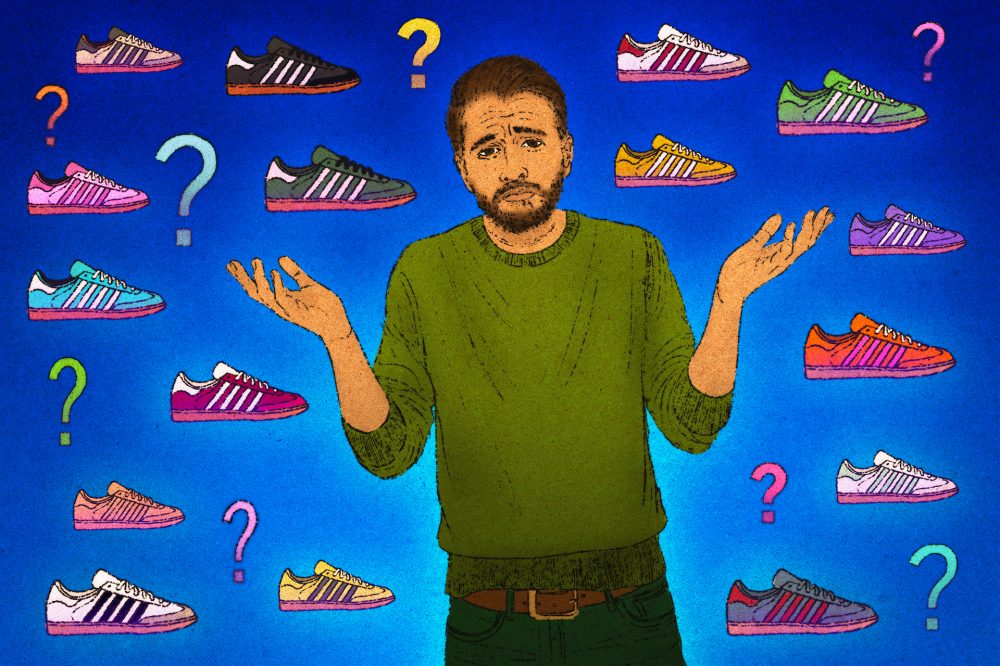

Perfect-fitting jeans. The right show to stream on a weeknight. Your one true partner. Modern life tells us that with enough options available, we can find the absolute best of everything.
But researchers who study human behavior say the endless wave of choices we face — from shopping decisions to social situations to personal relationships — is actually working against us.
The belief that more options equal better outcomes is deeply embedded in Western culture. However, research tells a different story. Having more choices can leave people feeling anxious, unable to decide, and — surprisingly — less satisfied with whatever they ultimately pick, according to Barry Schwartz, an emeritus psychology professor at Swarthmore University and author of “The Paradox of Choice.”
“There have been hundreds of studies showing that there can be too much of a good thing,” Schwartz said.
His advice: cut down on the number of decisions you make each day, and your mind will be better for it.
Schwartz pointed to several real-world examples where having more options actually left people worse off. When it came to Medicare Part D prescription drug plans, people living in states with a greater number of plan options were actually less likely to select any plan at all. The same pattern showed up with workplace retirement accounts — the more investment options a company offered in its 401(k) plan, the less likely employees were to enroll, even when the employer was offering to match contributions.
Even lower-stakes decisions follow this pattern. Schwartz referenced a widely cited study in which shoppers at a gourmet grocery store purchased more jars of specialty jam when they saw six varieties compared to when they were shown 24. A follow-up study found that students were more likely to complete an optional extra-credit assignment when offered six topic choices rather than 30.
Schwartz’s own research explored the emotional side of this pattern.
“Instead of being liberated by all this choice, you’re paralyzed,” he said. “You can do anything, and you can’t figure out which of those many things to do.”
More options also tend to produce worse decisions, he explained, because a larger pool of possibilities means more chances for a bad outcome. And even after someone finally makes a choice, they may feel less content with it — even if it was a good one — because they worry a better option was left behind.
This dissatisfaction is especially pronounced among people who always aim for the absolute best outcome. Psychologists call these individuals maximizers.
“People who are maximizers especially suffer from the proliferation of options,” Schwartz said. “Only the best will do.”
That said, Schwartz acknowledged the pattern doesn’t apply to everyone in every situation. Someone who loves cars, for instance, might genuinely enjoy sorting through a vast number of options when purchasing a new vehicle.
“But you don’t feel that way when it comes to buying jam,” he said.
Daniel Willingham, a psychology professor and neuroscience researcher at the University of Virginia, explained that this all comes down to how the brain operates. The brain is fundamentally wired to conserve energy and spare us from having to think too hard.
Willingham said that solving problems takes more mental energy than drawing on memory — a tendency rooted in how humans evolved to survive. When facing a goal, whether an urgent one like responding to danger or a longer-term one like finding shelter, the brain first looks for solutions that have worked in the past. Only when memory comes up short does the problem-solving part of the brain engage.
“Another way to put it is that if you’re thinking, things are not going well,” he said.
This is also why people often move through parts of their daily routine without much conscious thought, Willingham noted. We encounter hundreds of moments throughout the day where we could do something differently, yet we almost always take the same route to work.
Schwartz added that the explosion of choices has become even more complicated in the age of social media, where people constantly compare their decisions to those of others.
“When all you’ve got to choose from is Lee’s and Levi’s, nobody expects the jeans they buy to fit perfectly,” he said. “When there are 2,000 options, well, now, dammit, you do expect your jeans to fit perfectly.”
David Epstein, after completing research for his book “Inside the Box: How Constraints Make Us Better,” said he began pulling back from his own habit of always seeking the best possible option. He now actively limits his chances to make choices — for example, he bought 10 of the same well-fitting T-shirt in different colors.
Epstein was inspired by Herbert Simon, a psychologist and 1978 Nobel laureate in economics, who owned just three sets of clothing and ate nearly the same meals every day. Simon coined the term “satisficing” — a blend of “satisfying” and “sufficing” — which means setting a “good enough” standard for a decision and then moving forward without second-guessing.
Epstein applies this approach when shopping online by first identifying exactly what he needs the item to do.
“When I find one that does that, I’m buying it, instead of reading all the reviews and getting sucked into, ‘Well, this one has all these other features,’” he said.
Both Willingham and Schwartz suggested another strategy: hand off some decisions to someone else. If you need a new phone, find a friend who is happy with theirs and simply get the same one.
For bigger decisions — like managing finances — Willingham said people are generally better off trusting a professional rather than trying to figure it out themselves.
“If you’re thinking, ‘Well, I’m a clever guy, I can figure that out,’ I think 9 times out of 10, you’re fooling yourself,” he said.
Schwartz acknowledged that for those who already struggle with making decisions, breaking the habit is not easy. But he said the payoff is real.
“What happens over time is you find it easier to make decisions, you end up more satisfied with the decisions you make, and all of a sudden, you’ve got an extra two hours in every day,” he said.