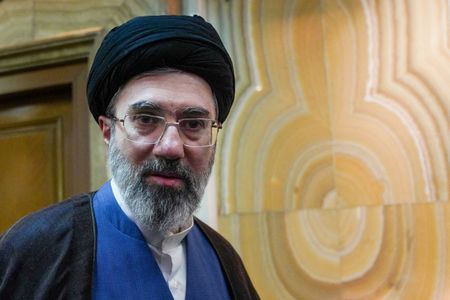

Iran’s newly appointed Supreme Leader Mojtaba Khamenei continues his recovery from serious facial disfigurement and leg injuries he sustained during the February airstrike that claimed his father’s life, according to three individuals with close ties to his administration who spoke with Reuters.
The 56-year-old leader suffered significant facial wounds and injuries to one or both legs during the attack on the supreme leader’s compound in central Tehran, all three sources confirmed.
Despite his injuries, those close to Khamenei say his mental faculties remain intact and he actively participates in high-level government meetings through audio conferencing. Two sources indicated he continues making critical decisions regarding the ongoing conflict and diplomatic negotiations with Washington.
These revelations about Khamenei’s medical condition come at a crucial time for Iran, as the nation faces what many consider its most serious crisis in decades. High-stakes peace negotiations with the United States are scheduled to begin Saturday in Islamabad, Pakistan.
The detailed accounts from Khamenei’s inner circle represent the most comprehensive information about the leader’s health status released in weeks. Reuters was unable to independently confirm these reports.
Since the air attack and his appointment as his father’s successor on March 8, Khamenei’s location, medical status, and governing capacity have remained largely unknown to the public. No photographs, videos, or audio recordings of him have been made available.
Iran’s United Nations mission has not responded to Reuters’ inquiries regarding the severity of Khamenei’s injuries or explanations for his absence from public view.
The injuries occurred on February 28, the opening day of the conflict initiated by the United States and Israel, during the strike that killed his father and predecessor Ayatollah Ali Khamenei, who had governed since 1989. The attack also claimed the lives of Mojtaba Khamenei’s spouse, brother-in-law, and sister-in-law.
Iranian officials have not issued any formal statements about the extent of Khamenei’s injuries. However, a state television news anchor referred to him as a “janbaz” – a designation reserved for those severely wounded in combat – following his appointment as supreme leader.
These injury reports align with comments made by U.S. Secretary of Defense Pete Hegseth on March 13, when he stated that Khamenei was “wounded and likely disfigured.”
An individual familiar with U.S. intelligence evaluations informed Reuters that Khamenei was believed to have lost a leg.
The CIA refused to provide comments on Khamenei’s medical status. The Israeli prime minister’s office did not respond to inquiries.
Alex Vatanka, a senior fellow at the Middle East Institute, explained that regardless of his injury severity, the new and inexperienced leader would likely struggle to wield the comprehensive authority his father once commanded. While he represents institutional continuity, Vatanka noted it could require years for him to establish the same level of unquestioned leadership.
“Mojtaba will be one voice but it will not be the decisive one,” he said. “He needs to prove himself as the credible, powerful, overriding voice. The regime as a whole has to make a decision in terms of where they are going to go.”
One person close to Khamenei’s administration suggested that images of the supreme leader might be released within the next one to two months, with a possible public appearance around that time. However, all three sources emphasized he would only emerge when his health and security circumstances permit.
Under Iran’s theocratic governance structure, supreme authority is intended to rest with the supreme leader, a respected Shi’ite Muslim cleric chosen by an assembly of 88 ayatollahs. The leader supervises the elected president while maintaining direct control over parallel institutions, including the Revolutionary Guards, a influential political and military organization.
Iran’s founding supreme leader, Ayatollah Ruhollah Khomeini, possessed undisputed authority as the charismatic revolutionary leader and the most scholarly cleric of his era.
His replacement, Ali Khamenei, held less religious prestige but had previously served as Iran’s president. He dedicated decades to consolidating his power after his 1989 appointment, partly by enhancing the Revolutionary Guards’ influence.
His son Mojtaba lacks the same absolute authority, according to senior Iranian sources who previously spoke with Reuters. The Revolutionary Guards, who facilitated his rise to leadership following his father’s assassination, have become the primary voice on strategic wartime decisions. Iran’s U.N. mission has not responded to questions about the distribution of power between the Guards and the new supreme leader.
As an influential member of his father’s administration, Khamenei had spent years participating in top-level Islamic Republic power structures, building relationships with senior Guards officials, according to government officials and insiders.
While he is expected to maintain his father’s hardline policies due to his Guards connections, Vatanka from the Middle East Institute noted that “we don’t know much about his world view.”
Khamenei’s initial communication with Iranians as supreme leader occurred on March 12, when he issued a written statement read by a television news presenter, declaring that the Strait of Hormuz should remain closed and warning regional nations to shut down U.S. military bases.
His office has subsequently released several other brief written statements, including a March 20 Persian New Year message, which he designated the “year of resistance.” Other senior officials have made public statements regarding Iran’s war position, diplomatic approach, regional relationships, ceasefire negotiations, and domestic unrest.
Khamenei’s absence has become a frequent topic of discussion on Iranian social media and messaging applications when the country’s unreliable internet service allows. Conspiracy theories about his condition and questions about who is governing the nation are widespread.
A popular internet meme features an empty chair under a spotlight with the caption “Where is Mojtaba?”
Some government supporters, including a senior Basij militia member – a volunteer paramilitary organization operated by the Revolutionary Guards – argued that maintaining a low profile is crucial for Khamenei, given the danger from continued U.S. and Israeli airstrikes that have already eliminated much of the country’s leadership.
A lower-ranking Basij member expressed agreement.
“Why should he appear in public? To become a target for these criminals?” Mohammad Hosseini from the city of Qom wrote in a text message.