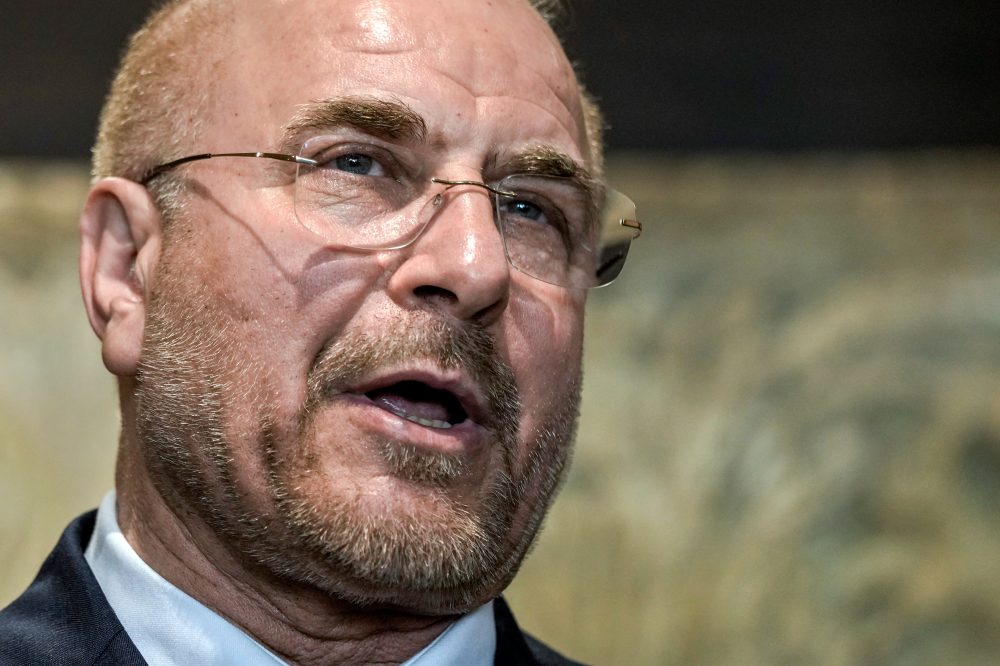

DUBAI, United Arab Emirates — For nearly twenty years before assuming his role as Iran’s parliament speaker, Mohammad Bagher Qalibaf conducted an extensive diplomatic campaign, presenting himself as a hardline leader with whom Western nations could negotiate within the Islamic Republic.
“I would like the West to change its attitude to Iran and trust Iran, and rest assured that there’s an attitude in Iran to advance issues through dialogue,” he stated to The Times of London in 2008.
As the conflict between the United States, Israel, and Iran enters its fourth week, the 64-year-old former pilot and Revolutionary Guard commander has rejected claims of ongoing discussions with Washington, despite media reports suggesting he was proposed as a potential negotiating counterpart for the U.S.
Uncertainty surrounds Qalibaf’s actual influence within Iran’s religious government structure, which was severely disrupted following the February 28 Israeli air attack that resulted in the death of 86-year-old Supreme Leader Ayatollah Ali Khamenei.
The late leader’s son, Mojtaba, who now serves as Iran’s supreme leader, has supported Qalibaf throughout his numerous unsuccessful presidential bids. Nevertheless, various power centers within Iran’s theocratic system are likely competing for control of the Islamic Republic, with ongoing questions about Mojtaba Khamenei’s condition after reports he sustained injuries and has not been publicly seen.
During his tenure, Qalibaf has been connected to government crackdowns on protesters demanding political reform and has faced various corruption accusations.
President Donald Trump may be seeking an Iranian equivalent to Venezuela’s acting President Delcy Rodríguez, who assumed power after U.S. forces captured former Venezuelan leader Nicolás Maduro in January.
“Many Iranians despise Ghalibaf; diplomats see him as pragmatic,” analyst Michael Rubin wrote, using an alternative spelling of the politician’s surname. “Those diplomats confuse pragmatism with opportunism. Ghalibaf is a survivor. He sees in Trump someone who can help him achieve what late Supreme Leader Ali Khamenei denied him: the presidency or some equivalent interim leadership role.”
Iran’s semi-official Tasnim news agency, which maintains close ties to the Guard, characterized Western media reports on Tuesday as a “political bomb” designed to destabilize the country’s leadership.
“Qalibaf was introduced as a negotiating party in order to present a contradictory and non-unified image of Iran,” Tasnim reported. “The mention of Qalibaf’s name was clearly intended to create internal divisions within Iran and to provoke conflict among political forces.”
Born in Torqabeh city within Iran’s northeastern Razavi Khorasan province, Qalibaf’s father worked as a shopkeeper rather than belonging to the Shiite religious leadership that gained control during the 1979 Islamic Revolution.
Following the pattern of many young men from his generation, he enlisted with the paramilitary Guard during Iran’s devastating 1980s conflict with Iraq, advancing rapidly through military ranks. Following the war’s conclusion, he directed the Guard’s construction division, Khatam al-Anbia, for multiple years while leading reconstruction efforts.
As a trained aviator, he subsequently commanded the Guard’s air force. In 1999, he co-authored a letter to reformist President Mohammad Khatami during student demonstrations in Tehran sparked by the government’s closure of a reformist publication and subsequent security force response. The letter warned Khatami that the Guard would act independently unless he agreed to suppress the protests.
The violent confrontations during these demonstrations, marking the beginning of a series of expanding protests over recent decades, resulted in multiple deaths, hundreds of injuries, and thousands of arrests.
Qalibaf later assumed leadership of Iran’s police force, modernizing operations and establishing the nation’s 110 emergency telephone system. However, leaked audio from a subsequent meeting between Qalibaf and members of the Guard’s volunteer Basij force revealed him claiming responsibility for ordering gunfire against protesters in 2003 and commending the violence employed during Iran’s 2009 Green Movement demonstrations.
Then-President Hassan Rouhani referenced the 2003 incident during their confrontation in a 2017 presidential election debate.
“There was an argument that you were saying that the students should come then we can pincer attack to them and finish the job,” Rouhani stated at the time.
While serving as Tehran’s mayor from 2005 to 2017, Qalibaf encountered corruption charges, including concerns over approximately $3.5 million donated to a foundation operated by his wife.
Despite this, he leveraged his position to attend the World Economic Forum and even complimented New York City during a Financial Times interview, likely surprising fellow hardliners. Political rivals compared Qalibaf to Reza Pahlavi, an ambitious military leader who became shah in 1925 and aggressively pursued Persia’s westernization while renaming it Iran before transferring power to his son Shah Mohammad Reza Pahlavi.
Qalibaf did not completely dismiss this comparison.
“If authoritarianism means when collective sense reaches a plan and decision, I’m very determined and firm in carrying it out,” Qalibaf explained to The Financial Times in 2008, positioning himself as an alternative to hardline President Mahmoud Ahmadinejad. “When the expediency of the society is in carrying a project, then I’m very firm and show little flexibility and don’t let that collective sense be marred or disarrayed.”
Despite unsuccessful presidential campaigns in 2005, 2013, 2017, and 2024, U.S. diplomatic sources indicated he maintained Mojtaba Khamenei’s backing, according to diplomatic communications released by WikiLeaks.
“Mojtaba reportedly has long maintained a very close relationship with Tehran Mayor and presidential hopeful Mohammad Baqr Qalibaf; Mojtaba was reportedly the ‘backbone’ of Qalibaf’s past and continuing election campaigns,” stated an August 2008 cable. “Mojtaba is said to help Qalibaf as an advisor, financier, and provider of senior-level political support. His support for and closeness to Qalibaf reportedly remains undiminished.”
With Khamenei now serving as Iran’s supreme leader, Qalibaf’s standing may receive substantial enhancement.
Following Trump’s decision to extend a 48-hour ultimatum for Iran to reopen the Strait of Hormuz, media outlets reported Qalibaf as a potential Iranian liaison for the U.S. administration. Qalibaf has personally refuted claims of active negotiations.
“No negotiations have been held with the US, and fakenews is used to manipulate the financial and oil markets and escape the quagmire in which the US and Israel are trapped,” he posted Monday on X.
Notably, unlike numerous Iranian government officials, Qalibaf’s name does not appear on any U.S. bounty list.
Whether Israeli forces consider Qalibaf a target remains unknown. In his role as parliament speaker, Qalibaf endorsed the October 7, 2023, Hamas assault on Israel, declaring it demonstrated the “Zionist regime will never have peace until the day it is annihilated.”
Trump also expressed concern Monday that revealing his unnamed negotiating partner could endanger potential discussions.
When asked about his reluctance to identify the Iranian negotiator, Trump responded to reporters: “Because I don’t want them to be killed, OK? I don’t want them to be killed.”