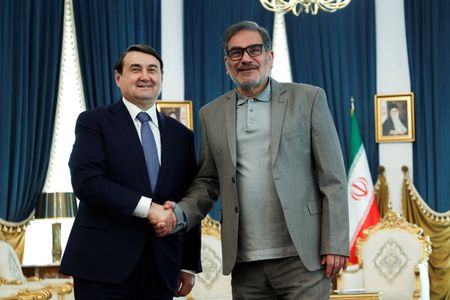

A senior Iranian official who narrowly escaped death when Israeli forces struck his Tehran residence has returned to a pivotal position in the country’s defense leadership during one of its most challenging periods.
Ali Shamkhani, 70, was pulled from the debris of his destroyed home following the June 2025 attack and has now been named to head Iran’s newly formed Defense Council by Supreme Leader Ayatollah Ali Khamenei.
“Bastards, I am alive,” Shamkhani declared in an October interview with Iranian filmmaker Javad Mogouei, describing his close call with death and referencing the classic 1973 prison break movie Papillon.
The appointment places Shamkhani back at the heart of Iran’s military decision-making as the nation faces mounting pressure from the United States. His new role involves coordinating Iran’s wartime strategy while American warships in nearby waters threaten fresh airstrikes if diplomatic talks fail to reach a nuclear agreement.
During his State of the Union address Tuesday, President Donald Trump outlined his rationale for potential military action against Iran, declaring he would not permit what he called the world’s leading terrorism sponsor to obtain nuclear weapons.
Iranian officials reject terrorism allegations and maintain their nuclear program serves peaceful purposes, though Western nations and Israel suspect weapons development.
In a January 2026 social media post, Shamkhani warned that any American military action would trigger immediate and massive retaliation. “A ‘limited strike’ is an illusion. Any military action by U.S. – from any origin and any level – will be considered the start of war, and its response will be immediate, all out, and unprecedented, targeting heart of Tel Aviv and all those supporting the aggressor,” he wrote.
The veteran military leader earned his credentials during the brutal 1980-1988 conflict with Iraq, when Iran’s newly established Islamic Republic fought for its survival. Since leaving the Supreme National Security Council in 2023, he has served as a political counselor to Khamenei.
For ten years, Shamkhani directed the security council through major events including Iran’s 2015 nuclear agreement with world powers and America’s 2018 withdrawal from that deal, experiences that deepened his distrust of such arrangements.
Born in 1955 to an Arab family in Khuzestan province’s oil region, Shamkhani advanced through Revolutionary Guard leadership during the Iran-Iraq conflict, initially commanding forces in his home province where the heaviest fighting occurred.
By 1982, he served as second-in-command to Revolutionary Guard chief Mohsen Rezaei, a fellow Khuzestan native and former anti-shah activist from the 1970s. Before the war concluded, he led the Guards’ ground troops while simultaneously holding a cabinet position.
Supreme Leader Khamenei transferred him to the conventional navy in 1989 after U.S. forces had severely damaged that branch. Within twelve months, he commanded both regular and Revolutionary Guard naval forces, implementing unconventional maritime strategies to counter technologically superior opponents.
Shamkhani’s career has included significant diplomatic assignments alongside his security duties.
Serving as defense minister under reformist President Mohammad Khatami from 1997 to 2005, he conducted the first visit to Saudi Arabia by an Iranian defense official since the 1979 revolution, helping reduce tensions between the regional competitors.
More recently, he spearheaded Chinese-mediated negotiations that restored diplomatic relations with Saudi Arabia in 2023, ending an eight-year break that began when Iranian demonstrators attacked the Saudi embassy in Tehran.
His appointments typically occur when Tehran seeks engagement with opponents while maintaining a strong stance.
This approach was evident during nuclear negotiations under President Hassan Rouhani, when Shamkhani helped implement the 2015 agreement and managed its collapse after American withdrawal.
Rouhani eventually regretted selecting Shamkhani, believing he backed legislative measures that strengthened Iran’s negotiating stance by requiring increased uranium enrichment.
In his October 2025 interview, Shamkhani suggested Iran should have pursued nuclear weapons in the 1990s, comments reflecting his focus on deterrence following major air attacks by Israel and the U.S. during last year’s 12-day conflict.
The official has faced sanctions and corruption allegations regarding his family’s business activities. The U.S. Treasury sanctioned him in 2020 and targeted his son Mohammad Hossein in 2025 for operating ships that transport banned oil from Iran and Russia to international customers.
Treasury officials describe the Shamkhani family’s “shipping empire” as generating enormous wealth while helping Iran evade U.S. sanctions.
Shamkhani has not publicly addressed corruption claims.
His daughter Fatemeh sparked controversy in 2025 when video of her wearing a revealing dress at an expensive wedding circulated widely, prompting criticism about elite privilege and highlighting conflicts between the government’s conservative values and the lifestyles of those in power.