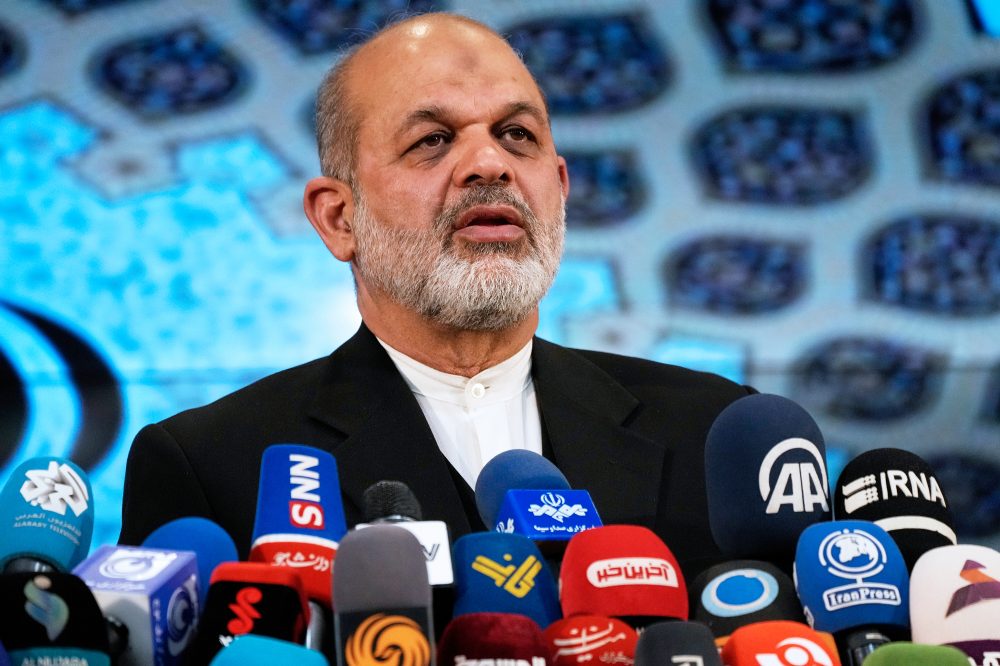

DUBAI, United Arab Emirates (AP) — A militant Iranian military commander connected to controversial operations spanning decades appears to have gained significant influence as diplomatic discussions with the United States remain uncertain.
Brig. Gen. Ahmad Vahidi, who commands Iran’s paramilitary Revolutionary Guard, has emerged as a key figure in shaping Iran’s aggressive approach to negotiations aimed at potentially ending the conflict with the United States, according to analysts. Sources suggest he belongs to a select inner circle maintaining direct communication with Iran’s Supreme Leader Ayatollah Mojtaba Khameini, who has remained out of public view after reportedly suffering injuries during the Feb. 28 Israeli attacks that resulted in his father’s death, Ayatollah Ali Khamenei.
Similar to many aspects of Iranian governance since hostilities commenced, the actual power structure for making critical decisions remains unclear. Within Iran’s religious leadership hierarchy, individuals competing for influence can rapidly gain or lose standing. Vahidi has not made any public appearances since Feb. 8, several weeks prior to the war’s outbreak.
A seasoned figure within Iran’s governing apparatus, Vahidi played a role in developing Iran’s backing of militant organizations throughout the region, faces accusations regarding his involvement in the 1994 attack on a Jewish facility in Argentina, and during 2022 directed internal security operations during a violent suppression of demonstrators.
After being promoted to Guard leadership this year following his predecessor’s death early in the conflict, he now oversees Iran’s most influential military organization, which controls ballistic missile stockpiles and operates small naval vessels that pose threats to Persian Gulf maritime traffic.
“Vahidi and members of his inner circle have likely consolidated control over not only Iran’s military response in the conflict but also Iran’s negotiations policy,” the Washington-based Institute for the Study of War said.
Iran’s military approach has focused on maintaining control over the Strait of Hormuz, preventing oil and gas shipments and creating worldwide energy shortages. Simultaneously, it has launched aggressive attacks against petroleum infrastructure, hospitality facilities and vital systems in Gulf Arab countries.
During diplomatic discussions, it has resisted U.S. requirements to relinquish its supply of highly enriched uranium, calculating that it can endure longer than the U.S. in the current confrontation and that President Donald Trump will hesitate to restart full-scale warfare that might cause additional harm to America’s Gulf partners.
This approach probably mirrors Vahidi’s aggressive methodology. “He comes from that mindset of unending revolution, unending resistance,” said Kenneth Katzman, a senior fellow at the The Soufan Group, a New York-based think tank. Vahidi believes “the U.S. needs to be challenged at every turn,” said Katzman, a senior Iran expert who advised the U.S. Congress for over 30 years.
Vahidi boasted in January that Iran’s defense power has developed to make it a “high risk for any military action by an enemy.”
Pakistan hosted talks in April between an Iranian delegation led by parliament speaker Mohammad Bagher Qalibaf and an American one headed by U.S. Vice President JD Vance. But it ended without any deal.
Qalibaf and Foreign Minister Abbas Araghchi returned home to face criticism from inside the theocracy suggesting they were too willing to make concessions. Qalibaf had to insist publicly that the talks had the support of the supreme leader.
Since then, Vahidi has become the main point of contact for those negotiating with Iran, said a regional official with direct knowledge of the mediation. The official spoke on condition of anonymity to discuss the sensitive diplomacy.
The extreme seclusion and unknown condition of the supreme leader have fueled speculation about jockeying among leaders for access to Khamenei and influence over him. In early May, President Masoud Pezeshkian, who many see as sidelined from influence by the Guard, went out of his way to say he “got to see our dear leader” and spoke to him for around two hours.
But Holly Dagres, a senior fellow at the Washington Institute for Near East Policy, said it’s likely the new supreme leader “is in lockstep with a more hard-line (Guard) — similar to his father, but in a more emboldened and uncompromising form.”
Analyst Kamran Bokhari wrote that figures like Vahidi “are not just managing war — they are actively reshaping succession, consolidating authority around a weakened supreme leader, and effectively ‘capturing’ the state through crisis governance.”
Born Ahmad Shahcheraghi in Iran’s southern city of Shiraz in 1958, Vahidi like many young men after the 1979 revolution joined the Revolutionary Guard and fought against the invasion by Iraqi leader Saddam Hussein that sparked a bloody, eight-year war.
Vahidi entered the Guard’s nascent intelligence arm and soon was overseeing operations outside Iran. He gained the favor of powerful patrons, including Akbar Hashemi Rafsanjani, a later president. Rafsanjani said in his autobiography that Vahidi was involved in the 1980s Iran-Contra scandal, in which the Reagan administration sold weapons to Tehran in an effort to free hostages held by Iranian-backed militants in Lebanon. The U.S. later used the money from those sales to fund Contra rebels in Nicaragua.
Rafsanjani later intervened to protect Vahidi when then-Supreme Leader Ayatollah Ruhollah Khomeini sought to prosecute members of the Guard who failed to stop an incursion by armed fighters from an Iranian exile group in the late 1980s during the war.
Around this time, Vahidi took over the newly formed Quds, or Jerusalem, Force. Over decades, the Quds Force helped create a network of proxy militant groups and allied governments around the Middle East. The Quds Force under Vahidi helped mastermind the 1994 bombing targeting Argentina’s largest Jewish community center, killing 85 people and wounding 300 others, prosecutors say. Iran has denied involvement.
American investigators also believe that under Vahidi, Iran organized the 1996 Khobar Towers bombing in Saudi Arabia, killing 19 U.S. service members and wounding hundreds. Tehran has denied being involved in that attack as well.
Vahidi left the Quds Force in 1998. In 2010, while he was defense minister, the United States imposed sanctions on him over alleged involvement in Iran’s nuclear program and its pursuit of weapons of mass destruction.
More recently, as interior minister, Vahidi oversaw police units involved in a bloody, monthslong crackdown on protests over the 2022 death of Mahsa Amini, who died in police custody after being arrested for not properly wearing the mandated headscarf to the liking of authorities.
An Iranian newspaper later published a classified document that showed Vahidi’s Interior Ministry ordered security agencies to monitor and photograph women not wearing the hijab, something he had denied was taking place.
At around that time, Vahidi said in public comments that calls to remove the hijab were a “colonial plan” by Iran’s enemies trying to undermine the Islamic Republic. “The hijab has been a big barrier against the progress of effete Western culture,” he said.
Vahidi’s role makes reaching an accord with Iran that much more difficult for the U.S. — as does the continued obscurity over Iran’s leadership.
Trump wants a single interlocutor in Iran for negotiations, but “the whole system has changed,” said Hamidreza Azizi, an Iran expert at the Middle East Institute.
“It is not a one-man show. Vahidi is one alongside others,” Azizi said. “Some we know and some we don’t know.”