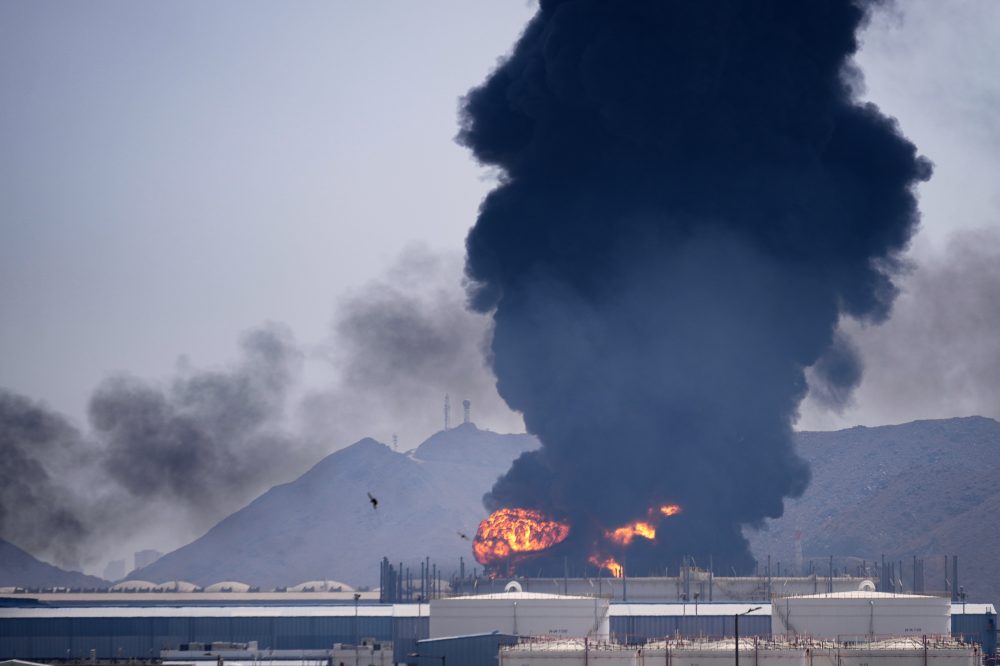

DUBAI, United Arab Emirates (AP) — After 30 days of conflict with Iran, American and Israeli forces are facing an adversary that operates more like a guerrilla movement than a traditional military power — maximizing damage with increasingly scarce resources.
Even while enduring daily bombardments from two of the globe’s most advanced air forces, Iran continues to harass neighboring Gulf states and Israel through missile and drone attacks while maintaining economic leverage over world markets, largely through intimidation tactics.
Iran’s capacity to regulate shipping — and consequently oil supplies — passing through the Strait of Hormuz represents its most significant strategic weapon. This approach mirrors strategies that Iran’s allied groups have employed for years under Tehran’s guidance as head of what it calls the “Axis of Resistance.”
At the same time, Iran’s financial system, already isolated from international markets due to longstanding sanctions, remains largely protected from the economic turmoil it’s creating elsewhere.
The blockade of the strait has triggered soaring oil costs, falling stock values, and increased prices for essential commodities, creating political pressure on President Donald Trump that may push him toward further military action.
Though Iran has achieved some success by closing the strait, domestic challenges remain that Washington and Jerusalem might leverage as the conflict continues. However, the theocratic government’s path to success through guerrilla-style methods stays relatively straightforward — simply endure.
“The Islamic Republic understands that it cannot defeat the United States militarily,” wrote Shukriya Bradost, a Mideast security analyst. “Instead, its objective is both simpler and more strategic: Survive the war long enough to claim victory.”
The Strait of Hormuz, the critical Persian Gulf passage that previously handled one-fifth of global oil and natural gas shipments, now sees minimal maritime activity. Iranian authorities permit only selected cargo to pass, setting their own terms and pricing. Despite losing most of its naval fleet, Iran maintains control over the waterway using decades-old stockpiles of missiles and drones.
Asian nations, which rely heavily on oil transported through the strait, face the most severe impact — but since oil markets operate globally, motorists across Europe and America also experience price increases. Because petroleum costs affect manufacturing and transportation of numerous products, gasoline isn’t the only commodity seeing higher prices.
This situation creates additional challenges for Trump, who already faced difficulties demonstrating to voters that he could reduce living expenses before November’s midterm elections.
Resolving the crisis presents complex options. Negotiating a ceasefire offers one possibility — Trump claims discussions are advancing, though Iran disputes this.
Should diplomacy fail, America and Israel must choose between declaring sufficient progress and withdrawing from the war — or significantly intensifying military operations to force the strait’s reopening. Trump has already deployed additional paratroopers and Marines to the region. He established a new ultimatum — postponed twice already — of 8 p.m. Eastern time on April 6 for Iran to restore strait access. He’s warned that failure to comply will trigger bombing campaigns against Iranian power facilities.
“Trump’s preference remains ‘escalate to de-escalate,’” the risk advisory Eurasia Group said in an analysis Thursday. “The U.S. is moving more ships and ground troops into the region and will be better prepared to escalate in mid-April.”
However, Iran has demonstrated remarkable endurance against the punishment it has sustained so far.
Trump stated Thursday evening that approximately 9% of Iran’s missile stockpile remains operational. Independent confirmation of this estimate proved impossible — but even if correct, Tehran retains multiple methods for causing destruction.
With its aircraft largely eliminated and air defense systems severely compromised, Iran still operates an extensive network of air and naval installations, many constructed decades earlier.
The country has also established underground facilities more recently, which combined with missile systems disguised as civilian trucks, enable concealment of launch positions until deployment. Maintaining mobile launcher movement helps protect them from aerial attacks.
This approach, called “shoot and scoot,” represents a standard practice among numerous insurgent organizations, including Yemen’s Houthi rebels. The Iran-supported group successfully interrupted international commerce in the Red Sea. Iranian-backed Shiite militias in Iraq employed comparable methods against American forces there. Both groups have persisted despite repeated targeting.
Iran’s geographical characteristics and landscape — a mountainous country roughly equivalent to Alaska in size — provide ample space and natural features for insurgent-style concealment.
Nevertheless, underlying problems persist for Iran as well.
Both American and Israeli officials have expressed hopes that Iranian citizens, who confronted their theocratic government during nationwide demonstrations in January, might overthrow their leadership.
No evidence of such an uprising has emerged — and currently, many Iranians remain in shelters avoiding airstrikes.
Iran’s population also recalls the government’s violent suppression earlier this year that resulted in thousands of deaths and tens of thousands of arrests. The Revolutionary Guard’s volunteer Basij militia, which played a crucial role in that crackdown, continues operating despite frequent targeting during the war, with social media footage showing armed members patrolling neighborhoods while broadcasting propaganda through speakers.
Indicating Iran feels pressure on its forces, Guard official Rahim Nade-Ali announced recruitment of children as young as 12 for the Basij. He characterized this as meeting public demand — but it also represents a method for replenishing ranks as checkpoints face attacks.
Uncertainty surrounds Iran’s leadership structure. Mojtaba Khamenei hasn’t appeared publicly since assuming the role of supreme leader, with American officials reporting he suffered war injuries. Guard and other military divisions seem to function without centralized command. Any ceasefire agreement that fails to satisfy Guard and hardline expectations could split the country’s political leadership.
But Trump’s military strategy might not produce intended results.
“Washington seems to believe that an overwhelming display of military power will force the Iranians to the negotiating table,” the New York-based Soufan Center said in an analysis Friday. “But … the U.S. can’t expect to gain in peace what it was not able to take in war.”