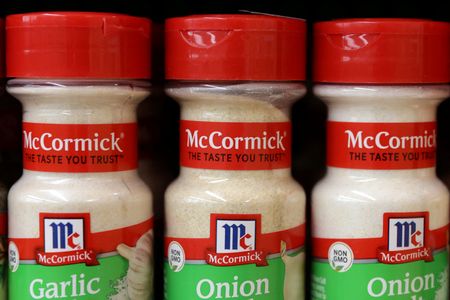

Consumer goods giant Unilever is moving forward with negotiations to merge its food division with Maryland-based McCormick & Company, according to sources close to the discussions.
The British company, known for producing Hellmann’s mayonnaise and Knorr bouillon cubes, announced last week that it had received an acquisition proposal from the spice manufacturer for its food operations.
McCormick, which produces Cholula hot sauce among other products, has acknowledged the ongoing discussions but has not revealed financial terms for what would represent the most significant restructuring in Unilever’s corporate history. The British firm currently holds a market capitalization of $131 billion.
According to individuals familiar with the negotiations who requested anonymity due to the confidential nature of the talks, the transaction is being designed to provide Unilever investors with more than half ownership of the resulting company while preventing a change of control that would create capital gains tax liabilities.
The arrangement would mark the largest transaction for CEO Fernando Fernández since he assumed leadership last year. The deal structure would require Unilever to first separate its food operations before transferring them to the Maryland-based McCormick through what’s known as a reverse Morris trust, which provides tax savings benefits.
Multiple sources indicate that negotiations are advancing rapidly.
While the exact percentage of ownership for Unilever shareholders remains undetermined, comparable consumer goods transactions have typically resulted in the selling company’s investors holding between 50% and 60% of the new combined entity.
A similar structure was used in 2021 when International Flavors & Fragrances acquired DuPont’s Nutrition & Biosciences division through a reverse Morris trust valued at $45.4 billion, with DuPont shareholders receiving 55.4% ownership of the merged company.
During the 2000s, J.M. Smucker purchased the Jif and Crisco brands, followed later by Folgers, from Procter & Gamble through all-stock reverse Morris trust transactions that provided P&G investors with approximately 53% stakes in Smucker.
Financial analysts at Barclays estimate Unilever’s food division to be worth between 28 billion and 31 billion euros (approximately $32 billion), including debt obligations. McCormick’s enterprise value stands at nearly $18 billion, which includes roughly $4 billion in net debt, according to LSEG data.
This size differential is characteristic of reverse Morris trust arrangements, where the acquiring company is substantially smaller than the seller.
Sources with knowledge of the advisory arrangements report that Unilever has engaged Goldman Sachs for the transaction, with Morgan Stanley and PwC also providing counsel on the potential business separation.
McCormick has retained Citi and Rothschild as its investment banking advisors for the deal, according to two individuals familiar with the matter.
Goldman Sachs, Morgan Stanley, and Citi have declined to provide comments on the transaction. PwC and Rothschild have not responded to requests for comment.
Industry sources reveal that McCormick has maintained interest in Unilever’s food operations for several years, attracted by the division’s international presence and potential opportunities to develop undervalued brands within the large conglomerate.
The spice company has maintained a conservative approach to mergers and acquisitions, which has positioned it to act quickly when this opportunity emerged. McCormick had previously attempted to acquire Sauer Brands, the producer of Duke’s mayonnaise, and Japanese barbecue sauce brand Bachan’s in recent years, but was outbid by competitors.
In 2017, McCormick successfully purchased Reckitt Benckiser’s food division, which included Frank’s RedHot hot sauce and French’s mustard brands.
Unilever recently completed a year-long process to separate its ice cream business, which began trading as The Magnum Ice Cream Company in December. The company maintained a 19.9% ownership stake in that business following the transaction, which also provided tax advantages including reduced taxable gains for shareholders when portions of their holdings were converted to Magnum shares.