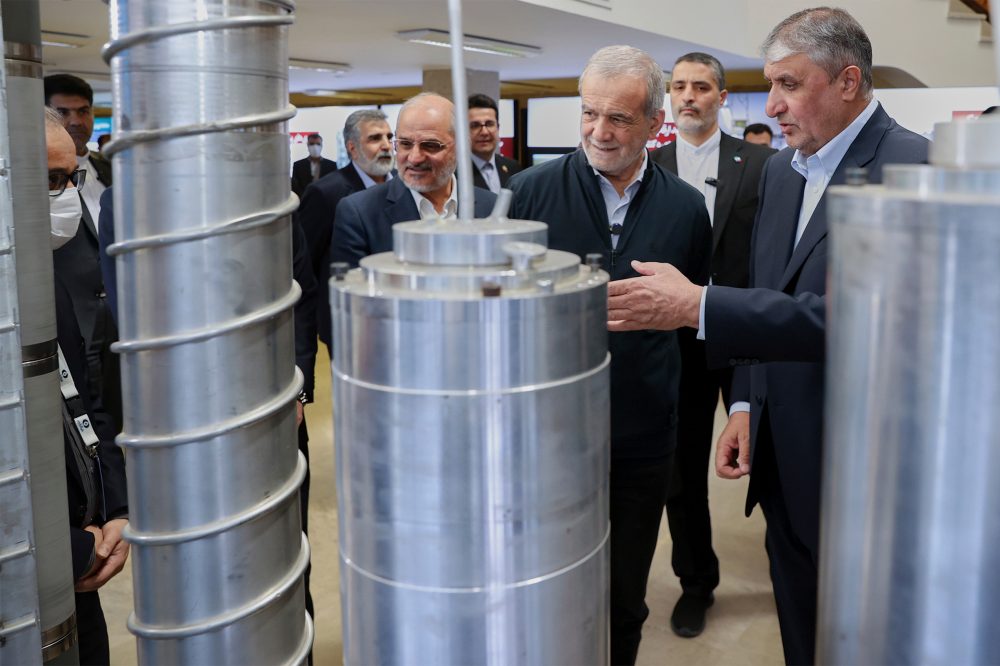

Tehran and Washington are scheduled to conduct fresh negotiations in Geneva this Thursday regarding Iran’s nuclear activities.
The diplomatic meeting occurs while the United States has positioned its most extensive collection of military aircraft and warships in the Middle East region in decades, part of President Donald Trump’s strategy to pressure Iran into an agreement following widespread domestic unrest against the country’s religious leadership.
The following chronology outlines the escalating disputes surrounding Iran’s nuclear activities:
1967 — Tehran receives the Tehran Research Reactor from the United States through the “Atoms for Peace” initiative.
1979 — Shah Mohammad Reza Pahlavi, America’s ally who was terminally ill, escapes Iran amid growing public demonstrations. Ayatollah Ruhollah Khomeini returns to Tehran, leading the Islamic Revolution to victory. Iranian students capture the U.S. Embassy in Tehran, launching a 444-day hostage situation. International pressure causes Iran’s nuclear activities to become dormant.
August 2002 — Western spy agencies and an Iranian resistance organization expose Iran’s clandestine uranium enrichment operations at Natanz.
June 2003 — The United Kingdom, France, and Germany begin nuclear discussions with Iran.
October 2003 — Tehran halts uranium enrichment activities due to international pressure.
February 2006 — Following the election of hardline leader Mahmoud Ahmadinejad, Iran declares it will resume uranium enrichment. The UK, France, and Germany abandon the stalled diplomatic efforts.
June 2009 — Iran’s controversial presidential election results in Ahmadinejad’s reelection amid fraud claims, triggering demonstrations called the Green Movement and violent government suppression.
October 2009 — During Barack Obama’s presidency, America and Iran establish a covert communication channel through Oman.
July 2012 — American and Iranian representatives conduct secret direct meetings in Oman.
July 2015 — Global powers and Iran reveal a comprehensive nuclear deal restricting Tehran’s uranium enrichment in return for sanctions relief.
May 8, 2018 — Trump withdraws America from the nuclear deal unilaterally, labeling it the “worst deal ever.” He promises to negotiate better terms addressing Iran’s missile program and regional militia support, but no such discussions occur during his initial presidency.
May 8, 2019 — Iran declares it will begin withdrawing from the agreement. Regional attacks on land and sea attributed to Tehran subsequently occur.
Jan. 3, 2020 — An American drone attack in Baghdad eliminates Gen. Qassem Soleimani, who orchestrated Tehran’s regional proxy conflicts.
Jan. 8, 2020 — Iran retaliates for Soleimani’s death by launching missiles at Iraqi military installations housing thousands of American and Iraqi personnel. Over 100 U.S. soldiers sustain traumatic brain injuries, the Pentagon reports. While preparing for potential counterstrikes, Iran’s Revolutionary Guard accidentally shoots down a Ukrainian civilian aircraft departing Tehran’s airport, reportedly confusing it with an American cruise missile. All 176 passengers and crew perish.
July 2, 2020 — An unexplained blast destroys a centrifuge manufacturing facility at Iran’s Natanz nuclear site. Tehran accuses its enemy Israel of the sabotage.
April 6, 2021 — Under President Joe Biden, Iran and America begin indirect Vienna negotiations to restore the nuclear agreement. These discussions, along with talks involving European countries, fail to produce results.
April 11, 2021 — A second assault within twelve months targets Iran’s Natanz facility, again presumably executed by Israel.
April 16, 2021 — Iran starts enriching uranium to 60% purity — its highest level ever and approaching weapons-grade concentration of 90%.
Feb. 24, 2022 — Russia begins its comprehensive Ukraine invasion. Moscow eventually depends on Iranian explosive drones and missiles in the war.
July 17, 2022 — Kamal Kharrazi, an advisor to Iran’s supreme leader, states Iran possesses the technical ability to produce nuclear weapons but hasn’t decided to do so.
Oct. 7, 2023 — Hamas fighters from Gaza attack Israel, killing approximately 1,200 people and capturing 251 hostages, initiating the most severe Israel-Hamas conflict ever. Iran, which supplies Hamas with weapons, supports the militants. Regional tensions escalate.
Nov. 19, 2023 — Yemen’s Iranian-backed Houthi rebels capture the Galaxy Leader vessel, starting months of Red Sea shipping attacks that the U.S. Navy calls its most intense combat since World War II. The tactics mirror Iran’s previous methods.
April 14, 2024 — Iran conducts an unprecedented direct assault on Israel, launching over 300 missiles and attack drones. Israel, supported by a U.S.-led coalition, intercepts most incoming projectiles.
April 19, 2024 — A suspected Israeli attack targets an air defense system near an Isfahan airport in Iran.
July 31, 2024 — Hamas leader Ismail Haniyeh is killed during a Tehran visit following reformist President Masoud Pezeshkian’s inauguration. Israel later claims responsibility.
Sept. 27, 2024 — An Israeli strike eliminates Hezbollah leader Hassan Nasrallah in Lebanon.
Oct. 1, 2024 — Iran launches its second direct Israel attack, though a U.S.-led coalition and Israel intercept most missiles.
Oct. 16, 2024 — Israel eliminates Hamas leader Yahya Sinwar in Gaza.
Oct. 26, 2024 — Israel publicly attacks Iran for the first time, targeting air defenses and missile program facilities.
Jan. 20, 2025 — Trump begins his second presidential term.
Feb. 7, 2025 — Iran’s Supreme Leader Ayatollah Ali Khamenei calls proposed U.S. talks “not intelligent, wise or honorable.”
March 7, 2025 — Trump reveals he sent Khamenei a letter proposing a new nuclear agreement with Tehran.
March 15, 2025 — Trump orders intensive airstrikes against Yemen’s Houthi rebels, the final active members of Iran’s “Axis of Resistance.”
April 7, 2025 — Trump announces direct U.S.-Iran talks will occur in Oman. Iran confirms the meeting but describes them as indirect negotiations.
April 12, 2025 — The initial U.S.-Iran talks in Oman conclude with commitments for additional meetings after U.S. Middle East envoy Steve Witkoff and Iranian Foreign Minister Abbas Araghchi “briefly spoke” directly.
April 19, 2025 — The second negotiation round between America and Iran takes place in Rome.
April 26, 2025 — Iran and America meet again in Oman for their third session, now including expert-level discussions.
May 11, 2025 — A fourth round of U.S.-Iran negotiations occurs in Oman before Trump’s Middle East visit.
May 23, 2025 — The fifth round of talks happens in Rome, with Oman reporting “some but not conclusive progress.”
June 9, 2025 — Iran indicates it will reject a U.S. nuclear program proposal.
June 12, 2025 — The International Atomic Energy Agency’s Board of Governors determines Iran violates its nuclear commitments. Iran responds by announcing construction and activation of a third uranium enrichment facility.
June 13, 2025 — Israel begins its war against Iran, attacking nuclear facilities, military sites, and government installations over 12 days.
June 22, 2025 — America joins the conflict, striking three Iranian nuclear locations.
June 23, 2025 — Iran retaliates against the U.S. attack by targeting an American military base in Qatar, causing minor damage.
June 24, 2025 — Trump declares a ceasefire in the conflict.
July 25, 2025 — Iranian and European diplomats conduct nuclear program discussions in Istanbul.
Aug. 8, 2025 — France, Germany, and the UK warn Iran in correspondence that they will restore U.N. sanctions without a “satisfactory solution” to the nuclear dispute by August 31.
Aug. 28, 2025 — The three European nations announce they have initiated the “snapback” sanctions process against Iran.
Sept. 9, 2025 — Iran and the International Atomic Energy Agency agree on potential inspection procedures, though implementation questions persist.
Sept. 19, 2025 — The U.N. Security Council refuses to prevent “snapback” sanctions on Iran.
Sept. 26, 2025 — The U.N. Security Council rejects China and Russia’s final attempt to halt the “snapback.”
Sept. 28, 2025 — The United Nations reinstates “snapback” sanctions on Iran without last-minute diplomatic intervention.
Dec. 28, 2025 — Demonstrations erupt in two major Tehran markets after the Iranian rial drops to a historic low of 1.42 million rials per U.S. dollar, increasing inflation and raising prices for food and essential goods.
Jan. 3, 2026 — Khamenei declares “rioters must be put in their place,” interpreted as authorization for security forces to more aggressively suppress demonstrations.
Jan. 8, 2026 — Following Iran’s exiled crown prince’s appeal, masses of people shout from windows and join nationwide street protests. The government blocks internet access and international phone calls to isolate the 85 million population from external influence. Security forces kill thousands and detain tens of thousands during the subsequent crackdown.
Jan. 13, 2026 — Trump announces he has canceled meetings with Iranians and pledges unspecified “help is on its way.”
Jan. 26, 2026 — The USS Abraham Lincoln aircraft carrier and three escort vessels reach the Middle East amid Trump’s attack threats.
Feb. 3, 2026 — A U.S. Navy fighter destroys an Iranian drone approaching the Lincoln in the Arabian Sea. Iranian speedboats attempt to intercept a U.S.-flagged vessel in the Strait of Hormuz.
Feb. 6, 2026 — Iran and America conduct indirect nuclear discussions in Oman, with the U.S. Central Command chief also participating.
Feb. 17, 2026 — Iran and America hold Geneva talks while Tehran announces temporarily closing the Strait of Hormuz, the narrow Persian Gulf passage through which one-fifth of global oil trade flows.
Feb. 26, 2026 — Iran and America are scheduled for another Geneva negotiation round after America assembles its largest Middle East military aircraft deployment in decades.