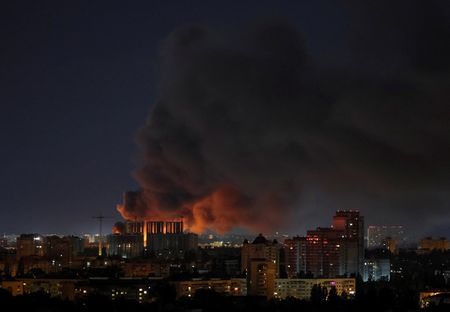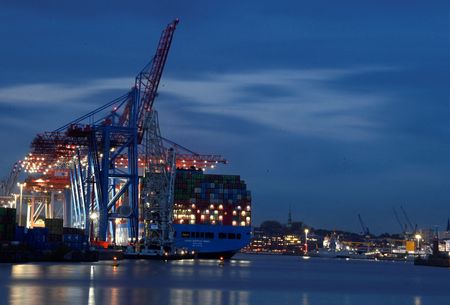

Iran’s Revolutionary Guards announced Wednesday that they carried out missile and drone attacks against U.S. military facilities in Bahrain and Kuwait, responding to a fresh round of American military strikes on Iran tied to attacks on tankers in the Strait of Hormuz.
The Islamic Revolutionary Guard Corps said the joint operation targeted key U.S. military sites, including Bandar Salman, Bahrain’s Fifth Naval District, and Ali Al Salem Air Base in Kuwait. Iran also claimed it shot down a U.S. MQ9 drone it said was attempting to interfere with the operation.
Air raid sirens blared across Bahrain and Kuwait following the strikes. Kuwait’s military confirmed its air defenses were actively responding to what it described as “hostile” missile and drone attacks.
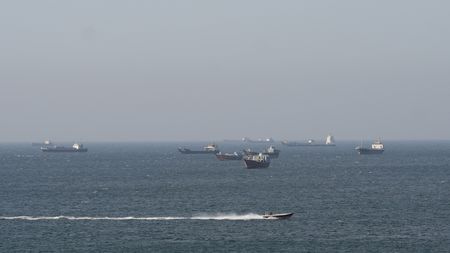
Earlier in the day, the U.S. launched its own round of military strikes against Iran and revoked a license that had permitted Iran to sell oil on international markets — a response to attacks on three tankers in the strait.
U.S. Central Command reported that more than 60 small boats belonging to Iran’s Revolutionary Guards were among the targets struck, calling the action a response to Iranian shipping attacks that violated the ceasefire agreement.
“The unwarranted aggression by Iranian forces is a clear and dangerous violation of the ceasefire and undermines freedom of navigation,” CENTCOM stated.
Iran’s top military command, Khatam al-Anbiya Central Headquarters, fired back, calling the U.S. strikes a “blatant act of aggression” and warning of a “crushing response.” The command also declared that Tehran would not tolerate American interference in control of the strait.
Iranian parliament speaker and top negotiator Mohammad Baqer Qalibaf accused Washington of breaking the ceasefire, pointing to the military strikes, renewed oil sanctions, alleged violations of Iranian adjustments in the Strait of Hormuz, and Israeli attacks against Lebanon.
“The era of bullying and extortion is over,” Qalibaf wrote on X. “We don’t fold.”
Iranian media reported explosions at Iran’s main oil hub on Kharg Island, as well as on Qeshm Island and in the southern port cities of Sirik and Bandar Abbas. Iran’s Press TV said multiple blasts were heard in southern Kharg Island, which serves as the export point for 90% of Iran’s crude oil. CENTCOM made no mention of Kharg Island in its statements.
A U.S. official told Reuters that American strikes focused on Iranian air defense systems, coastal surveillance systems, surface-to-air missiles, anti-ship cruise missiles, and drone launch sites.
No civilian deaths were reported in Iran, though several people were injured by shrapnel from what Iranian state TV described as an “enemy projectile” striking a commercial pier in Sirik. Reports also indicated strikes hit fishing piers in both Sirik and Bandar Abbas.
The escalating clashes represent the latest blow to a fragile ceasefire agreement reached last month between the U.S. and Iran, which was intended to pause a conflict that began with U.S. and Israeli strikes on Iran.
On Tuesday, Washington revoked a key concession that had allowed Iran to sell oil on global markets — a move that sent oil prices surging more than 3%. Under the interim agreement, the U.S. Treasury had issued a June 22 license permitting the sale of Iranian crude oil and petroleum products through August 21. With the license now revoked, Iran has until July 17 to wind down related transactions.
A U.S. official said negotiators were still working in good faith toward a final agreement, but analysts note that Iran’s control over the Strait of Hormuz has given Tehran significant leverage in talks, effectively allowing it to hold its ground against the world’s most powerful military.
Iran’s foreign ministry condemned the oil license revocation as a breach of the framework agreement and warned that Washington would bear responsibility for any consequences. The ministry said Iran would take whatever steps it deemed necessary to protect its interests and national security.
While Iran denied responsibility for the latest tanker attacks, Qatar blamed Iran for striking three vessels, including the large Qatari liquefied natural gas tanker Al Rekayyat, which was hit by a drone that sparked a fire in its engine room. The crew was reported safe and was being evacuated. A Saudi-flagged crude oil tanker believed to be the supertanker Wedyan was also reported damaged off Oman, though the cause was not immediately confirmed.
Iran’s foreign ministry called Qatar’s accusations puzzling, insisting Tehran was honoring its commitments. However, the ministry also warned that commercial vessels face risks when using routes not coordinated with Iran.
A second U.S. official, speaking anonymously, said early indications suggested Iran had fired on three commercial ships.
Iran’s leadership has been pushing to establish a permanent system for collecting fees from vessels passing through the strait — a move that would represent a significant shift in regional power dynamics in an area where the U.S. has long served as a security guarantor.
The latest U.S. strikes came as large crowds gathered to mourn Iran’s Supreme Leader Ayatollah Ali Khamenei in the holy city of Qom. Khamenei was killed alongside his daughter, granddaughter, son-in-law, and daughter-in-law on the first day of the conflict.
The ceasefire was designed to allow 60 days of negotiations toward a permanent deal, but indirect talks held in Qatar ended last week without any apparent progress. U.S. President Donald Trump has repeatedly threatened to resume bombing unless Iran agrees to “make a deal.” Iran’s Foreign Minister Abbas Araqchi warned that under the terms of the interim ceasefire memorandum, negotiations on a final deal would “not commence if threats continue.”