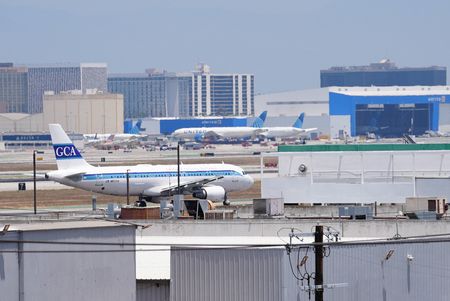

Iran’s national soccer team set foot on U.S. soil for the first time this World Cup on Sunday, arriving at Los Angeles International Airport following a brief flight from Tijuana, Mexico, where the squad had been based and received an enthusiastic farewell from supporters.
The team’s Airbus A320 touched down on runway 25L at 4:11 p.m. ET on its second landing attempt, arriving under clear skies at the airport located approximately 15 minutes from Los Angeles Stadium, the venue for Iran’s opening World Cup match against New Zealand on Monday.
Following their arrival, the players were expected to proceed to a nearby hotel, where a visible police security presence had already been established. Officers were blocking off sidewalks and stretching concertina security coils along sections of the hotel’s exterior.
Coach Amir Ghalenoei and striker Mehdi Taremi were scheduled to speak with reporters at a press conference at Los Angeles Stadium at 6:45 p.m. ET.
The Group G contest between Iran and New Zealand carries added weight given the ongoing U.S. war with Iran, creating a charged atmosphere for what will be the first-ever World Cup meeting between the two nations.
Iran had relocated its World Cup base camp from a sports complex in Arizona to Mexico late last month, a move that followed joint military strikes carried out by the U.S. and Israel against Iran beginning in late February.
While the team was in the air en route to Los Angeles, demonstrators gathered near Los Angeles Stadium calling for democratic change in Iran and condemning its government. Signs reading “No Shah — No Mullah in Iran — Regime Change by Iranians” were visible at the rally, and posters of athletes protesters said had died following arrest by the Iranian government were displayed along a busy street corner in Inglewood.
Mojgan Ramezani, 56, an Iranian American attending the protest, expressed particular anger over a January crackdown on demonstrations inside Iran, which rights organizations and activists say resulted in thousands — and possibly tens of thousands — of deaths.
“They’re holding hostage their own people,” Ramezani said.
Hassan Haddadi, 70, voiced frustration that most world governments had taken little meaningful action to support change in Iran. “We’re hoping to bring awareness to the western world, to somehow do something beyond just condemning, to bring an end to this regime,” he said.
Earlier in the day in Tijuana, crowds five people deep lined the sidewalk outside Iran’s hotel, chanting “Team Melli” — which translates from Persian as “national team” — as the players emerged and made their way to a waiting bus. Many players waved and smiled at the gathered crowd, while some delegation members recorded the moment on their phones.
One supporter held up a yellow sign with black lettering that read: “Iran, you will never walk alone. Mexico stands with you.” At one point, the crowd broke into a Spanish chant: “Iran, brother, you are Mexican now.”
A young boy, perched on someone’s shoulders, held the official Panini FIFA World Cup 2026 sticker album, opened to the page featuring the Iranian squad.
Iranian soccer federation President Mehdi Taj was also present outside the hotel as the players departed, with many supporters following the bus down the street as it pulled away.
The Iranian community in Tijuana is quite small — estimated at around 20 people — a stark contrast to Los Angeles, which is home to the largest Iranian community outside of Iran itself. Tens of thousands of Iranian Americans reside in Los Angeles, where a distinct diaspora community often referred to as “Tehrangeles” has long been established.
This World Cup marks the first time since the tournament’s founding in 1930 that a host nation has competed against a country with which it is at war.