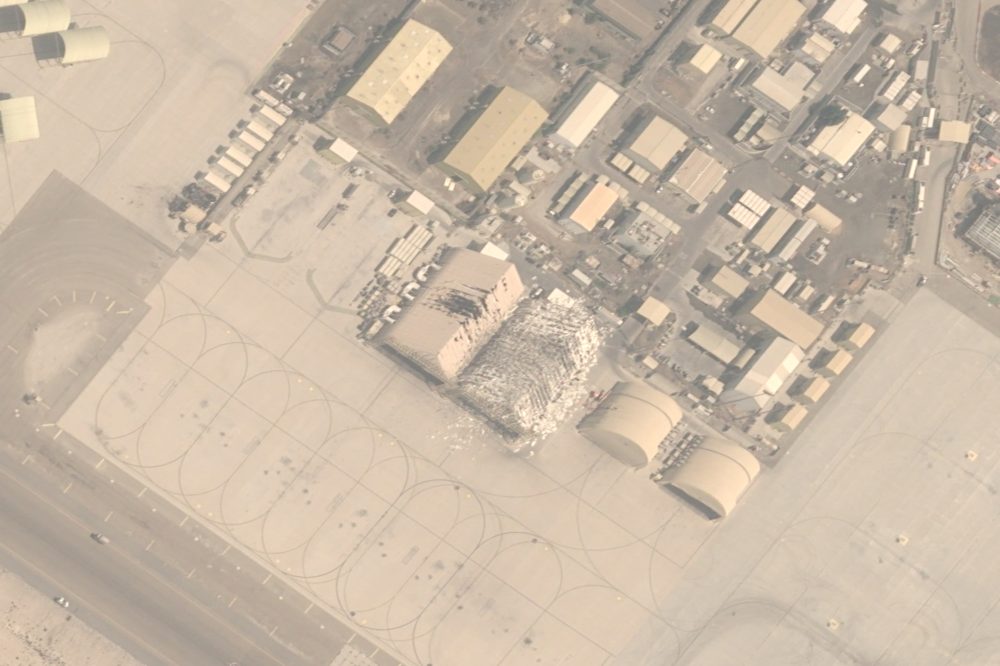

DUBAI, United Arab Emirates (AP) — Iranian military leaders issued warnings against global tourist destinations and declared continued missile production capabilities on Friday, displaying defiance as U.S.-Israeli military operations enter their third week, having eliminated numerous high-ranking Tehran officials and damaged weapons manufacturing and energy infrastructure.
The Islamic Republic launched attacks against Israeli targets and energy facilities in neighboring Gulf nations while many Muslims observed Eid al-Fitr, one of Islam’s most sacred celebrations. Iranians simultaneously celebrated Nowruz, their traditional Persian New Year, though festivities remained more restrained than usual this year.
Limited intelligence emerging from Iran makes it difficult to assess the extent of damage to the nation’s military, nuclear, or energy infrastructure since hostilities commenced February 28, or to determine current leadership structures. However, Iran has demonstrated ongoing capacity for attacks that disrupt oil distribution and impact the worldwide economy, driving up food and fuel costs well beyond Middle Eastern borders.
American and Israeli officials have presented varying justifications for the military campaign, ranging from encouraging domestic rebellion to overthrow Iranian leadership to dismantling nuclear and missile development programs. No visible signs of popular uprising have emerged, and Iran’s remaining military capabilities and potential conflict resolution remain unclear.
Iran’s senior military spokesperson issued a Friday warning that “parks, recreational areas and tourist destinations” globally would face danger for Tehran’s adversaries.
Gen. Abolfazl Shekarchi delivered these threats while Iran endures continued American and Israeli bombardment. The statement raises fresh worries that Iran might resume militant operations outside the Middle East as wartime leverage.
American and Israeli leadership claim weeks of bombardment have devastated Iran’s armed forces. Air campaigns have also eliminated the supreme leader, Supreme National Security Council chief, and numerous other high-level military and government officials.
Thursday saw Israeli Prime Minister Benjamin Netanyahu assert that Iran’s naval forces were destroyed and air capabilities severely compromised, while claiming ballistic missile manufacturing had been eliminated. Iran’s paramilitary Revolutionary Guard challenged the missile production claims Friday.
“We are producing missiles even during war conditions, which is amazing, and there is no particular problem in stockpiling,” spokesman Gen. Ali Mohammad Naeini was quoted as saying in Iran’s state-run IRAN newspaper.
Naeini stated Iran had no plans for rapid conflict resolution. “These people expect the war to continue until the enemy is completely exhausted,” he said.
Shortly following the statement’s publication, Iranian state media reported Naeini’s death in an airstrike.
The nation’s new Supreme Leader Ayatollah Mojtaba Khamenei issued an uncommon declaration, stating Iran’s adversaries must have their “security” eliminated.
Khamenei has remained unseen since replacing his father, 86-year-old Ayatollah Ali Khamenei, who died in an Israeli strike on the war’s opening day.
Iran has intensified energy facility attacks across Gulf Arab nations following Israel’s bombing of Iran’s extensive South Pars offshore natural gas installation earlier this week.
Two Iranian drone waves targeted a Kuwaiti oil refinery Friday morning, igniting fires. The Mina Al-Ahmadi facility, capable of processing approximately 730,000 daily barrels, ranks among the Middle East’s largest refineries. Thursday brought another Iranian assault on the same installation.
Bahrain reported warehouse fires from intercepted projectile debris, while Saudi Arabia confirmed destroying multiple drones aimed at its oil-producing Eastern Province.
Massive explosions echoed through Dubai as defensive systems intercepted incoming attacks over the city, where residents were celebrating Eid al-Fitr, marking Ramadan’s conclusion.
In Iran, many observed Nowruz despite Israel announcing fresh strikes and explosions heard over Tehran. The Persian New Year, coinciding with spring equinox, represents a southwestern Asian tradition spanning millennia.
Jerusalem also experienced loud explosions after Israeli military warnings about incoming Iranian missiles. Emergency responders treated two approximately 70-year-old individuals with minor injuries.
Beyond consistent Iranian strikes, Israel has repeatedly targeted Lebanon, focusing on Iran-supported Hezbollah fighters who have launched rockets and drones into Israeli territory.
Friday brought Israeli expansion into Syria, with officials citing infrastructure attacks responding to what they characterized as assaults on the Druze minority community. Syria’s state-operated SANA news service did not immediately confirm the attack.
Over 1,300 Iranian deaths have occurred during the conflict. Israeli operations in Lebanon have displaced more than one million residents, according to Lebanese authorities, who report over 1,000 fatalities. Israel claims eliminating more than 500 Hezbollah fighters.
Within Israel, Iranian missile attacks have killed 15 people. Four additional deaths occurred in the occupied West Bank from Iranian missile strikes.
At least 13 American military personnel have died.
Iranian energy infrastructure attacks throughout the Gulf, combined with shipping disruption in the Strait of Hormuz—a crucial passage for one-fifth of global oil and essential goods transport—has sparked global energy crisis concerns.
Brent crude oil, the international benchmark, has surged during fighting, reaching approximately $107 in Friday morning trading, representing over 47% increase since war began.
Rising fuel costs arrive as world leaders already struggle with elevated food prices and consumer goods. Asia faces particular hardship as most Strait of Hormuz oil and gas exports flow there.
However, price impacts spread throughout the global economy. Essential raw materials—including helium for computer chip manufacturing and sulfur for fertilizer production—face supply disruptions and potential shortages, elevating costs across entire supply chains.