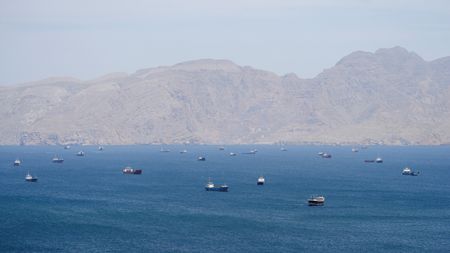

Iran has identified underwater internet cables running through the Strait of Hormuz as potential targets, sparking worries about threats to critical digital infrastructure that keeps the global internet running.
This strategic waterway, already crucial for worldwide oil transport, serves as an equally important pathway for digital communications. Multiple fiber-optic cables run along the ocean floor through the strait, linking nations from India and Southeast Asia to Europe through Gulf nations and Egypt.
These underwater cables carry approximately 99% of global internet traffic, according to the International Telecommunication Union, the UN’s digital technology agency. The cables also transport telecommunications signals and electrical power between nations, making them essential for cloud computing services and online communications worldwide.
“Damaged cables mean the internet slowing down or outages, e-commerce disruptions, delayed financial transactions … and economic fallout from all of these disruptions,” explained geopolitical and energy analyst Masha Kotkin.
Gulf nations, especially the UAE and Saudi Arabia, have poured billions into artificial intelligence and digital infrastructure as they work to reduce their dependence on oil revenues. Both countries have created national AI companies serving regional customers — all depending on these underwater cables for high-speed data transmission.
Key cable systems passing through the Strait of Hormuz include the Asia-Africa-Europe 1 (AAE-1), which links Southeast Asia to Europe through Egypt with connection points in the UAE, Oman, Qatar, and Saudi Arabia. The FALCON network connects India and Sri Lanka to Gulf states, Sudan, and Egypt. The Gulf Bridge International Cable System links all Gulf nations, including Iran. Several additional networks are currently being built, including one led by Qatar’s Ooredoo.
While submarine cable length has expanded significantly from 2014 to 2025, cable failures have held steady at approximately 150-200 incidents annually, according to the International Cable Protection Committee. Though state-sponsored sabotage remains a concern, 70-80% of cable damage results from accidental human activities, mainly fishing operations and ship anchors.
Additional threats include ocean currents, seismic activity, underwater volcanic activity, and severe storms, noted Alan Mauldin, research director at telecommunications research company TeleGeography. The industry mitigates these dangers by burying cables, adding protective armor, and choosing safer routes.
The Iran conflict, now approaching its second month, has caused unprecedented disruption to global energy supplies and regional infrastructure, including damage to Amazon Web Services data centers in Bahrain and the UAE. The submarine cables have remained undamaged thus far.
However, an indirect threat exists from damaged ships accidentally striking cables while dragging anchors.
“In a situation of active military operations, the risk of unintentional damage increases, and the longer this conflict lasts, the higher the likelihood of unintentional damage,” Kotkin stated. A comparable incident happened in 2024 when a commercial ship attacked by Iran-backed Houthis drifted in the Red Sea and cut cables with its anchor.
The extent to which cable damage might affect connectivity in Gulf countries depends heavily on individual network operators’ reliance on them and available backup options, according to TeleGeography.
Fixing damaged cables in war zones presents unique challenges beyond simply protecting them. While the actual repair work isn’t extremely complex, repair ship owners and insurance companies may hesitate due to risks from combat or mines, experts explain.
Getting permission to enter territorial waters creates another complication. “Often one of the biggest problems with doing repairs is you have to get permits into the waters where the damage is. That can take a long time sometimes and can be the biggest source (of problems),” Mauldin explained.
After conflicts end, industry operators must also re-examine the sea floor to identify safe cable locations and avoid ships or debris that may have sunk during fighting.
While potential submarine cable damage wouldn’t cause complete connectivity loss due to land-based connections, experts agree that satellite systems cannot serve as adequate replacements since they cannot manage the same traffic volume and cost significantly more.
“It’s not as though you could just switch to satellite. That’s not an alternative,” Mauldin emphasized, explaining that satellites depend on ground-based network connections and work better for mobile applications like aircraft and ships.
Low-Earth-orbit systems like Starlink represent “a boutique solution, which is not scalable to millions of users, at this time,” Kotkin added.