
DUBAI — Iran laid its slain Supreme Leader Ayatollah Ali Khamenei to rest Thursday at one of the country’s most sacred sites, as massive crowds gathered in the northeastern city of Mashhad to witness the culmination of a week-long series of funeral ceremonies stretching across two nations.
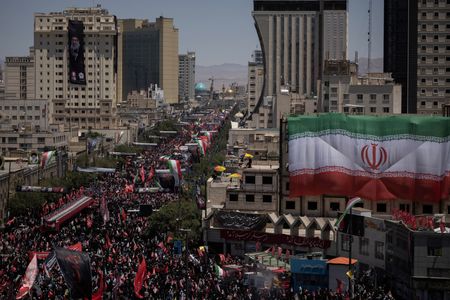
The burial took place at the Shrine of Imam Reza, where the golden dome and towering minarets caught the morning light as mourners waved Iranian flags, carried photographs of the late Khamenei, and held signs bearing revolutionary slogans.
Notably absent from the proceedings was Mojtaba Khamenei, who was named Supreme Leader by a clerical assembly in the week following his father’s death. He has not been seen publicly since the strike that killed his father on February 28 — the same attack that left him with severe injuries, including a disfigured face and badly wounded limbs. While written statements have been issued in his name, no images, video, or audio recordings of him have been released. Senior sources in Tehran say he is recovering but has not yet been well enough for public appearances, and that state security services are also working to limit his exposure out of concern for further U.S. attacks.
As crowds waited for the funeral procession in Mashhad, chants demanding vengeance against U.S. President Donald Trump rang through the streets. “I swear by the blood of the Supreme Leader, Trump, we will kill you!” demonstrators shouted, with women in the crowd holding up placards reading “Kill Trump.”
Khamenei’s remains, along with those of four family members who died alongside him, had already been transported through Tehran, the Shi’ite Muslim clerical center of Qom, and the Iraqi shrine cities of Najaf and Karbala over the course of the past week. At every stop, enormous crowds filled the streets to the sound of Shi’ite mourning chants and revolutionary calls.
The concept of martyrdom carries deep significance in Shi’ite theology, and Khamenei’s death at the hands of foreign adversaries has tapped into a powerful religious and political tradition at the core of the Islamic Republic’s identity.
The funeral marks a pivotal turning point for Iran, closing the chapter on nearly four decades under Khamenei’s leadership. His death comes months after a wave of nationwide protests fueled by public anger over an economy strangled by sanctions. Security forces crushed that unrest by killing thousands of demonstrators — a level of repression consistent with previous episodes of violence under the Islamic Republic.
Analysts suggest Iran emerged from the recent war in a strategically stronger position, with its hold over the critical Strait of Hormuz remaining intact. However, the country also sustained significant damage that has compounded existing economic difficulties.
Khamenei first took power as supreme leader in 1989, a decade after the Islamic revolution, and spent the following 37 years consolidating political, military, and economic authority within his office. That consolidation increasingly sidelined Iran’s elected president and parliament and was carried out in close partnership with the Islamic Revolutionary Guard Corps, which grew steadily more powerful throughout his tenure.
Mojtaba Khamenei’s appointment as his successor came with the backing of the Guards, who are now widely regarded as the dominant force shaping Iran’s political and strategic direction.