
Pakistani Navy search and rescue teams faced challenging ocean conditions Thursday as efforts to find the five-member crew of a downed cargo plane entered their second day, officials confirmed. Debris from the aircraft was pulled from the water Wednesday, but no crew members have been found.
The plane, which belonged to private airline K2 Airways, reported a navigation system failure before all radio and radar communication was lost late Tuesday evening, according to the Pakistan Airports Authority.
Since losing contact, ships and aircraft have been scouring an area of the Arabian Sea roughly 300 kilometers — about 180 miles — southwest of Karachi. The plane had been approaching Pakistan’s largest city on a flight originating from Sharjah in the United Arab Emirates when it disappeared from radar.
Investigators have not yet determined what caused the crash.
Two officials with knowledge of the search operation told The Associated Press that both the plane’s main fuselage and all five crew members have yet to be found. The officials requested anonymity because they were not authorized to speak publicly about the matter.
Both officials noted that choppy waters were again making the search extremely difficult.
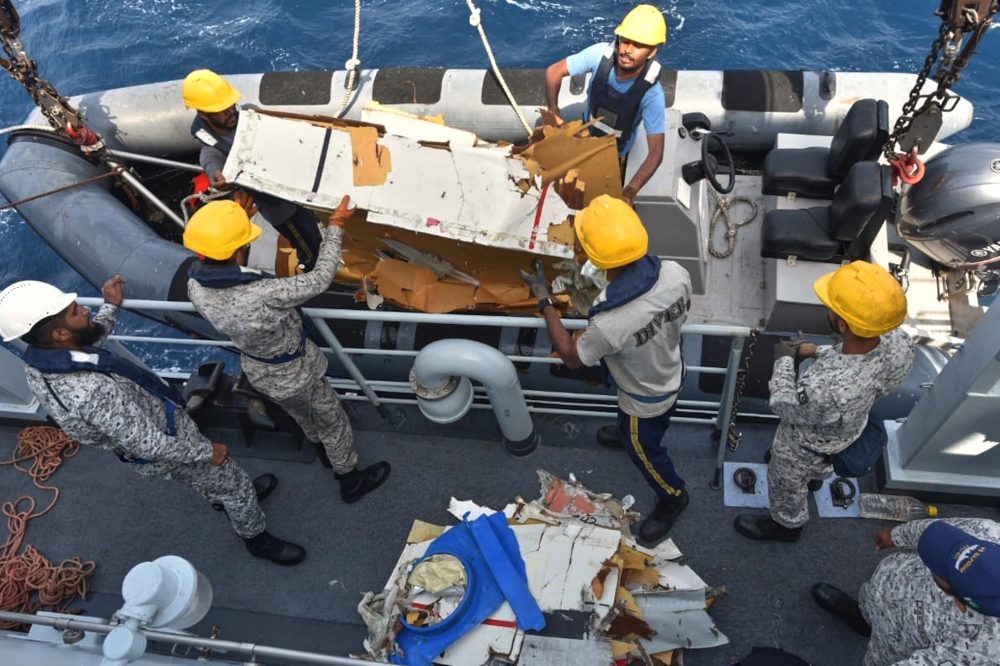
The Pakistan Airports Authority reported Wednesday that Navy vessels and the Pakistan Maritime Security Agency discovered and retrieved debris approximately 12 hours after the plane went missing. That wreckage was found about 100 kilometers — roughly 60 miles — off the coast of Ormara, a town along the Makran coastline in Pakistan’s Balochistan province.
The authority also shared photos on the social media platform X showing rescue workers pulling pieces of the plane from the water. Officials noted the debris was spread across a large area, with strong winds, heavy seas, and shifting currents scattering the wreckage and making it harder to pinpoint where the crew might be.
Retired Rear Adm. Faisal Shah warned that locating the plane’s main wreckage could take months or even years. He explained that the aircraft is believed to have gone down in water approximately 3,000 meters — nearly 9,800 feet — deep, which would require specialized underwater equipment to search.
Shah also cautioned that recovering floating debris does not pinpoint the actual crash location, since wind, waves, and ocean currents can move wreckage far from where the plane initially went down.
He drew a comparison to the prolonged search for Malaysia Airlines Flight MH370, which disappeared in 2014 and has never been definitively found despite years of international search efforts.
K2 Airways identified the five missing crew members as Capt. Muhammad Rizwan Idris, First Officer Faisal Jatoi, flight engineers Muhammad Hamid and Muhammad Arif Siddiqui, and aircraft loader Muhammad Taufiq Khan. Their families have continued to hold out hope as rescue teams press on with the search in the Arabian Sea.
Prime Minister Shehbaz Sharif has ordered authorities to deploy every available resource in the search operation and extended his condolences to the families of the missing crew members.
Radar data reviewed by the Pakistan Airports Authority showed the aircraft made a sudden change in direction and dropped rapidly in altitude before contact was lost at approximately 9:21 p.m. Tuesday, at a point about 287 kilometers — or 178 miles — west of Karachi.
Pakistan has a history of deadly aviation accidents spanning several decades. In May 2020, a Pakistan International Airlines flight carrying 99 people went down in a heavily populated area near the Karachi airport while attempting to land. Only two of the 99 people on board survived. A subsequent government investigation determined that errors made by both the flight crew and air traffic controllers were responsible for the disaster.