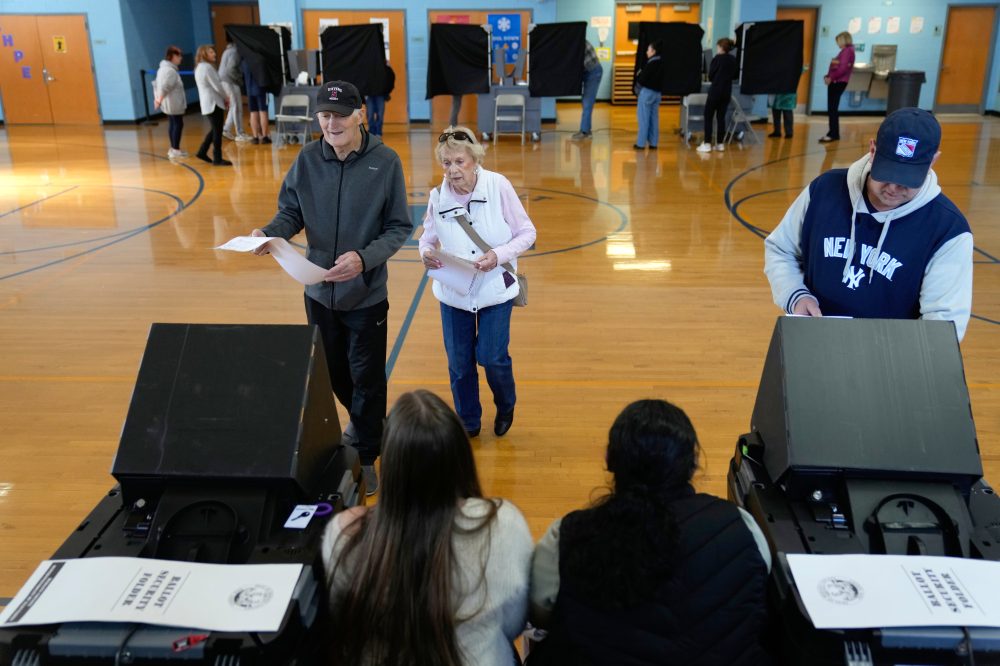

New Jersey voters will head to polling stations Tuesday to choose congressional nominees in primary elections, with particular focus on a crucial swing district that may determine which party controls the U.S. House.
The Republican Party currently maintains a slim House majority but confronts challenging midterm conditions where the party occupying the White House traditionally loses congressional seats. While Republicans might benefit from recent redistricting efforts in multiple states and a Supreme Court decision that threatens Democratic-majority Black districts in the South, securing competitive districts such as New Jersey’s 7th Congressional District remains vital to both parties’ plans for maintaining or gaining chamber control.
In the 7th District, U.S. Rep. Tom Kean Jr. seeks a third term and faces no Republican primary challenger. His father, Thomas Kean Sr., held the New Jersey governor’s office for two terms during the 1980s as a Republican.
The congressman will meet the victor of a contested Democratic primary that includes former healthcare executive Rebecca Bennett, former Small Business Administration official Michael Roth, physician Tina Shah and entrepreneur and business owner Brian Varela. Bennett has raised more money than her Democratic rivals and possessed the largest campaign war chest entering the race’s final phase.
Questions have emerged regarding Kean’s presence both on the campaign circuit and in congressional chambers. He issued a statement on April 27 explaining he was dealing with “a personal medical issue” and anticipated returning “very soon.” Through Monday, he had missed every legislative vote since March 5, accumulating more than 100 consecutive absences.
The 7th Congressional District spans northern New Jersey from Staten Island to the Pennsylvania border. Republican presidential candidate Donald Trump won the district narrowly in 2024, defeating Democratic nominee Kamala Harris by 49.6% to 48.5%.
The ballot also includes U.S. Sen. Cory Booker, who encounters no Democratic primary opposition while pursuing a third full term. Republicans vying to face him in November include physician Robert Lebovics, former Tabernacle Deputy Mayor Justin Murphy, Army veteran and former state trooper Richard Tabor and former local TV news reporter Alex Zdan.
Bergen and Middlesex counties near New York City rank among the state’s most populated areas and serve as crucial battlegrounds in both Democratic and Republican statewide primaries. Essex County, home to Newark, represents another major population hub, though its heavily Democratic makeup reduces its influence in Republican contests. Ocean, Monmouth and Morris counties typically generate the highest Republican primary vote totals statewide.
Union County delivers the largest portion of 7th Congressional District votes, with Somerset and Hunterdon counties following.
Polling locations close at 8 p.m. ET.
The Associated Press will report vote tallies and announce winners in competitive primaries for U.S. Senate and U.S. House seats.
Only registered party members can participate in their party’s primary, meaning Democrats cannot vote in Republican contests and vice versa. Independent or unaffiliated voters may join either primary, though participation automatically enrolls them in that party.
New Jersey had approximately 6.7 million registered voters as of May 1, consisting of roughly 2.5 million registered Democrats, 1.7 million registered Republicans and 2.4 million unaffiliated voters.
The 2025 gubernatorial primary drew about 841,000 Democratic votes and 466,000 Republican votes. This exceeded turnout for 2024 U.S. Senate primaries, which recorded approximately 525,000 Democratic votes and 318,000 Republican votes.
Early voting comprised about 46% of Democratic primary ballots and 31% of Republican primary ballots in the 2025 gubernatorial races.
Through Wednesday, roughly 285,000 ballots had been submitted for Tuesday’s election, with about 79% from Democrats and 20% from Republicans.
New Jersey counties generally report mail and early in-person voting results before Election Day totals. Counties usually publish all or nearly all mail and early voting numbers in their initial report before releasing any Election Day results.
During the 2025 gubernatorial primaries, the AP began reporting results at 8:03 p.m. ET, three minutes after polls closed. The final update occurred at 11:43 p.m. ET with approximately 93% of votes tallied.
The AP avoids making projections and declares winners only when determining no possible scenario exists for trailing candidates to overcome deficits. When races remain undecided, the AP continues covering significant developments like candidate concessions or victory claims while clarifying it has not declared a winner and explaining the reasoning.
New Jersey rarely conducts recounts. The state lacks automatic recount provisions, but candidates and voters may request and fund them, receiving cost refunds if outcomes change. The AP may declare winners in recount-eligible races when determining leads are too substantial for recounts or legal challenges to alter results.
Tuesday marks 154 days until the 2026 midterm elections.