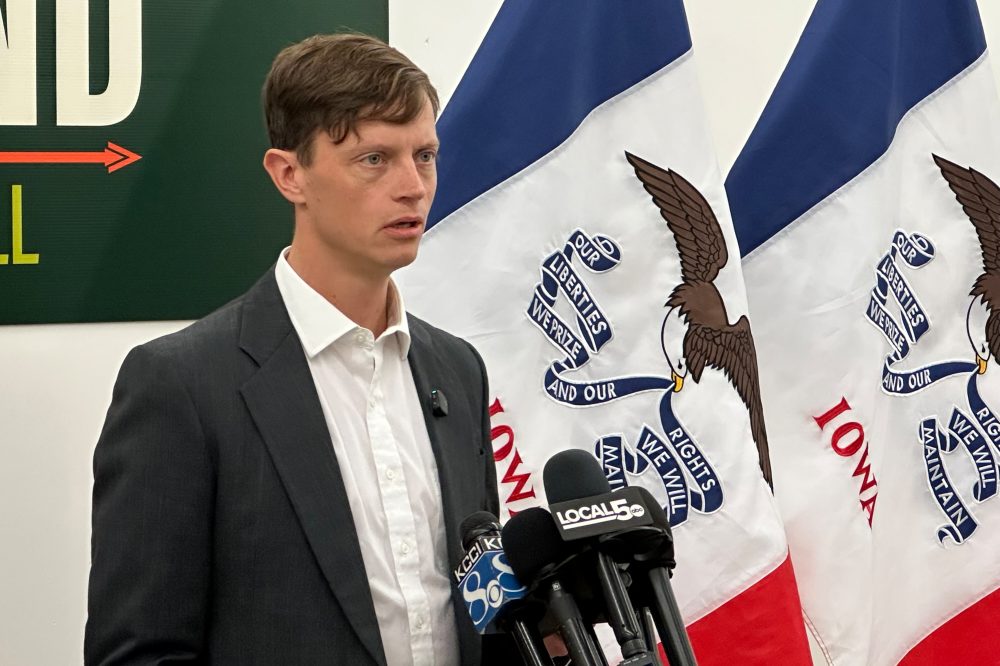

DES MOINES, Iowa — Following several election cycles of disappointing results, Iowa Democrats believe they can transform their state back into a competitive political arena.
While Donald Trump secured Iowa with a commanding double-digit victory in the most recent presidential race, increasing frustration with his administration and economic pressures from the Iran conflict may create opportunities for Democrats to achieve previously elusive victories.
Democratic organizers in Iowa are preparing to deploy 60 field coordinators by June — nearly twice the number from Trump’s first midterm cycle eight years prior. An additional 24 staff members will operate a unified campaign structure designed to assist candidates running for governor, Congress, and Senate positions.
“Iowa is still, in my view, a purple state,” state party chair Rita Hart said in an interview. “We just haven’t given them an opportunity to show that lately.”
GOP officials maintain Iowa will stay Republican, though recent White House travel schedules hint at potential concerns. Vice President JD Vance plans a Tuesday visit to campaign for Rep. Zach Nunn, whose district encompasses Des Moines, surrounding suburbs, and central rural areas. Trump similarly selected Iowa for his initial midterm campaign appearance this year.
The state faces an unusually high number of open-seat contests after Republican Gov. Kim Reynolds and Republican Sen. Joni Ernst decided against seeking reelection.
State auditor Rob Sand leads what Hart described as “the best statewide ticket we’ve had for a generation” in his gubernatorial campaign. Sand concluded last year with $13 million in campaign funds and frequently emphasizes his small-town background, Christian beliefs, and archery hunting skills, along with his rejection of partisan politics, to connect with diverse Iowa voters.
State legislators Josh Turek and Zach Wahls are competing for the Democratic Senate nomination in the June 2 primary. The party also hopes to capture three of four Republican-controlled House seats.
Democratic leaders believe an economic populist platform could gain traction in Iowa, where agricultural producers face tariff pressures and increased costs for fertilizer and fuel. Manufacturing plant closures and meatpacking facility shutdowns have eliminated hundreds of positions, while rural communities must travel greater distances for medical care as health facilities close.
This election cycle’s candidates are prepared to criticize their own party despite expecting support from national political organizations.
Turek and Wahls contend Democrats have neglected rural and small-community voters who supported Trump seeking systemic change. Turek, who identifies as a “prairie populist,” argues Congress contains too many wealthy members disconnected from paycheck-to-paycheck living. Wahls, backed by multiple labor organizations, claims political corruption favors corporate interests over working families.
Christina Bohannan, making her third attempt to defeat Republican U.S. Rep. Mariannette Miller-Meeks in southeastern Iowa, stated both major parties “have failed to really fight for working people.”
“Everybody’s talking about affordability,” she said. “I don’t want it just to become a catchphrase that people can kind of just brush aside as political rhetoric. This is real.”
Sand criticizes the broader political framework, which he claims “helps incumbents get reelected, rather than actually forcing them to solve our problems.” His recent policy platform includes term limits, prohibitions on congressional stock trading, and open primary systems.
Prior to Trump’s regional dominance, Democratic representation in Midwest and Plains state governorships and congressional delegations was common. Trump’s commitments to restore manufacturing employment and “drain the swamp” attracted voters who historically backed populist Democrats, according to Iowa Democratic strategist Jeff Link.
“Because the knee-jerk reaction to Trump is to be the opposite of Trump, we went away from economic populism to our detriment,” Link said. “By just being anti-Trump, it is being condescending towards people that chose him three times.”
Former Iowa Democratic Senator Tom Harkin believes Trump’s missteps have opened doors for political change.
“I think a lot of people wanted to get things shaken up a little bit,” he said. “But I don’t think they wanted them shaken up like this.”
Harkin suggested his party can reshape its public image.
“I think Democrats in the Midwest especially got painted with this broad brush, and we didn’t fight back well enough,” he said. “We became more defensive.”
Republican leaders contend Democratic progressive policies remain disconnected from Iowa values.
“You can’t have political born-again experiences,” said Jeff Kaufmann, chairman of the Republican Party of Iowa. He argued that messaging adjustments and distancing from national party positions cannot “erase your history in one election cycle.”
Kaufmann recognized the challenging electoral environment while asserting Iowans support Trump’s strategic vision, understanding his tariff policies aim to protect agricultural interests and Iran military action seeks to eliminate nuclear threats. However, he noted Democrats required years to lose Iowa communities that shifted from Barack Obama to Trump support.
“It’s going to take a long time for them to build it back up again,” Kaufmann said.
Democratic electoral prospects have remained dim since Obama carried Iowa in 2008 and 2012. Republicans have controlled Iowa state government completely for almost ten years, with all six federal delegation members being Republican.
Democratic voter registration trails Republican numbers by approximately 200,000 statewide, with deficits in all four congressional districts.
Iowa Democrats report 7,000 new volunteer sign-ups over the past year, with planned volunteer training programs. The party has secured eight field office leases and intends to establish seven additional locations, including blue-collar Mississippi River communities in eastern Iowa that supported Obama before switching to Trump.
“We’re investing so much in these organizers and in our county parties and supporting and training our volunteers,” Hart said. “It’s through these kinds of conversations where we build trust with voters.”
Party leadership anticipates spending levels comparable to presidential election years, reaching high seven-figure amounts. Their strategy emphasizes personal interactions over text messaging and digital advertising.
“Since the pandemic, we’ve really struggled with getting back to the basics with person-to-person communication,” Hart said, adding, “We’ve got to get back to that.”