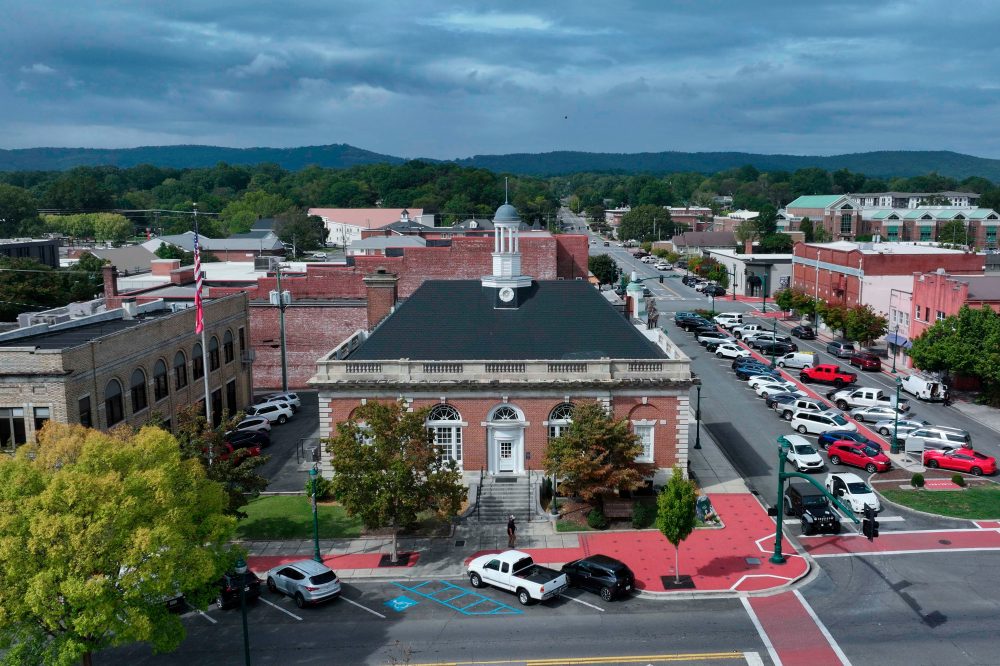

CALHOUN, Ga. — Beginning in the 1970s, textile manufacturers in northwest Georgia used chemicals called PFAS to make carpets stain-resistant. The chemicals that weren’t absorbed were discharged through the multibillion-dollar industry’s wastewater into municipal sewer systems and ultimately into area rivers.
Years later, these invisible, odorless chemicals have contaminated the entire region, including people’s bloodstreams. Researchers have issued warnings about potential health dangers to both humans and animals.
Although federal authorities haven’t established mandatory PFAS limits, states possess the power to safeguard public health and environmental quality. However, Georgia’s Environmental Protection Division failed to address the contamination problem despite being aware of it for many years, according to a joint investigation by The Atlanta Journal-Constitution, The Associated Press and FRONTLINE (PBS).
Here are the main findings from this continuing investigation into the harmful environmental impact of the South’s carpet manufacturing industry.
Residents throughout northwest Georgia know individuals suffering from health issues, including specific cancers, potentially linked to PFAS exposure. This public health emergency could have been prevented.
University of Georgia research conducted in 2008 warned both industry leaders and state officials that the local Conasauga River, which provides the area’s drinking water, contained “staggeringly high” concentrations of PFAS — short for perfluoroalkyl and polyfluoroalkyl substances, nicknamed forever chemicals due to their persistence in human bodies and their ability to remain in the environment for decades or longer. Georgia’s own laboratory results from 2012 and 2016 validated the university’s findings. Federal monitoring continued to detect PFAS in 2019, the same year major carpet producers claimed they discontinued using these chemicals.
PFAS contaminate household tap water because municipal water systems lack the sophisticated and expensive equipment needed to filter them from river water sources.
Georgia’s Environmental Protection Division never issued fish consumption warnings or water safety alerts to residents, even as scientists and federal officials expressed growing alarm about PFAS health risks. Currently, Georgia still has no PFAS regulations, unlike other states that have spent tens of millions on environmental cleanup and filed lawsuits against polluting companies to recover expenses.
Anna Truszczynski, Deputy Director of Georgia’s EPD, explained that her department relied on federal guidance and waited for researchers to develop better understanding of PFAS dangers. She noted that her agency assisted contamination-affected cities by providing laboratory testing, connecting them with potential funding opportunities, and recommending filtration systems.
“We believe that there can be a good balance between environment and economy,” Truszczynski said. “We don’t have to sacrifice one for the other.”
Jake Murphy, a spokesperson for the U.S. Environmental Protection Agency, stated in an email that federal officials are working to provide technical assistance and financial support to the affected region.
During 2008, Georgia’s EPD director held a closed-door meeting with carpet industry executives and representatives from their trade organization, the Carpet and Rug Institute, based on testimony records from company lawsuits.
Werner Braun, who served as the carpet institute’s director at that time, subsequently briefed his board about the discussion with then-Director Carol Couch, reporting that EPD “has no plans to initiate regulatory action” regarding PFAS, according to court deposition documents. Braun informed his board that Couch also suggested EPD “would probably look at the issue again in five years.”
The meeting with Couch was so successful that one carpet company executive expressed gratitude to participants for “gaining this good outcome,” the transcripts show.
When contacted for comment via text message, Couch stated that PFAS were merely an “emerging concern” during that period and EPA had not yet established drinking water standards. EPA’s initial PFAS guidance was released in 2009.
“To the Carpet and Rug Institute I offered no respite from state regulation of PFAS,” Couch wrote to the AJC and AP. She explained that the five-year timeline was standard for new water regulations and that in 2008, EPD “had neither the sufficient science, expertise nor resources to undertake action independent of USEPA.”
A carpet institute spokesperson declined to provide comments. Braun did not respond to interview requests.
The nation’s two largest carpet manufacturers, Shaw Industries and Mohawk Industries Inc., both headquartered in the area, attribute the contamination to their chemical suppliers, claiming these companies concealed PFAS dangers for years. The carpet manufacturers said they complied with regulatory guidance and emphasized that no mandatory chemical limits currently exist.
In legal documents, chemical suppliers 3M and DuPont argued that carpet companies, not chemical manufacturers, were responsible for releasing PFAS into northwest Georgia’s waterways.
All four companies declined to comment for this investigation.
When PFAS appeared in Alabama’s drinking water during 2016, local water authority officials contacted Georgia seeking explanations.
Eastern Alabama and northwest Georgia share a river network that begins in the Blue Ridge Mountains and flows through both states toward Mobile Bay. This watershed supplies the area’s carpet factories, which consume enormous quantities of water, particularly during fabric dyeing operations. It also serves as the drinking water source for hundreds of thousands of downstream residents.
Following tests that revealed PFAS concentrations above EPA’s voluntary health recommendations at that time, Alabama’s environmental authorities notified federal officials and requested Georgia’s EPD assistance in locating the contamination source.
Georgia had been aware for years that waters flowing from Dalton, the center of the state’s major carpet industry located more than 100 miles (160 kilometers) upstream, contained elevated PFAS levels.
Despite Alabama’s emergency request, Georgia’s environmental officials failed to respond appropriately, according to interviews and internal agency documents.
“EPD was very defensive,” said Jim Giattina, former director of EPA’s Water Protection Division who facilitated a conference call between both states for coordination purposes. “There was certainly no commitment on their part to do any more monitoring.”
EPD’s Truszczynski, who joined the department in 2016, said she could find no documentation of Georgia’s response.
“We’re always very happy to work with our friends in Alabama,” she said.
Alabama’s Department of Environmental Management did not respond to repeated interview and comment requests.
Across the United States, PFAS have been produced and incorporated into numerous products, including non-stick cookware, waterproof sunscreen, firefighting foam, dental floss and microwave popcorn packaging.
This widespread use has created contamination hotspots in other locations.
Several other states are implementing much more aggressive strategies than Georgia.
Wisconsin, Michigan and Maine have each allocated millions of dollars for environmental cleanup, established comprehensive testing programs and filed lawsuits to hold polluters and manufacturers responsible.
A bipartisan coalition of Wisconsin legislators approved $133 million for PFAS cleanup earlier this year. This decision concluded a lengthy effort by Jill Billings, a Democratic state assembly member. In 2019, a community in her district discovered contaminated drinking water. Residents have relied on state-provided bottled water since 2021.
Billings emphasized that state-level action becomes increasingly crucial as federal environmental regulations, including PFAS oversight, face rollbacks. While EPA has not yet implemented enforceable forever chemical limits, the agency’s proposed restrictions include the two chemicals most commonly used by carpet manufacturers. These limits are scheduled to take effect in 2031.
“I think it’s up to us to solve the problems of regular folks because the federal government seems to be struggling,” Billings said in an interview. “That’s fine. We’re ready.”