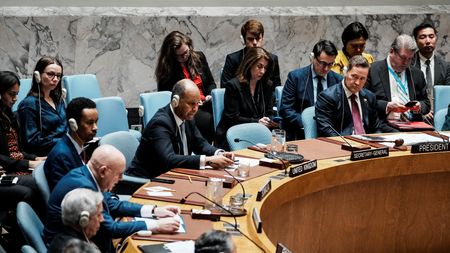

International divisions deepened Thursday as the United States and its Western partners faced off against Russia and China during a heated United Nations Security Council session focused on Iran’s nuclear activities.
During the meeting of the 15-nation council, which the U.S. currently leads, Moscow and Beijing attempted to prevent discussions regarding a committee responsible for monitoring and implementing UN sanctions against Iran. Their effort failed by a vote of 11-2 with two countries abstaining.
U.S. Ambassador to the United Nations Mike Waltz criticized Russia and China for attempting to shield Iran from scrutiny by obstructing the work of what’s known as the 1737 Committee.
“All member states of the United Nations should be implementing an arms embargo against Iran, banning the transfer and trade of missile technology, and freezing relevant financial assets,” Waltz stated.
“The U.N. provisions to be re-imposed are not arbitrary, but instead, narrowly scoped to address the threat posed by Iran’s nuclear, missile and conventional arms programs and Iran’s ongoing support for terrorism,” he added.
Waltz alleged that both nations opposed an effective sanctions committee “because they want to protect their partner, Iran, and continue to maintain defense cooperation that is now once again prohibited.”
The American envoy highlighted that the UN’s International Atomic Energy Agency recently confirmed Iran remains the sole non-nuclear weapon state globally to produce and stockpile uranium enriched to 60 percent levels, while denying IAEA inspectors access to these materials.
Russia’s UN representative Vasily Nebenzya countered that the United States and allies had “whipped up hysteria surrounding supposed plans Iran had to get a nuclear weapon” without IAEA verification.
“This was done in order to undertake yet another military venture against Tehran and to ensure great escalation of the situation in the Middle East and beyond,” he declared.
China’s delegate Fu Cong labeled Washington the “instigator” of the Iranian nuclear crisis, saying it had “resorted to blatant use of force against Iran during the negotiation process, which rendered the diplomatic efforts futile.”
President Donald Trump has pointed to Iran’s nuclear development as grounds for military action against the country. He claimed this month that Iran was just two weeks away from obtaining nuclear weapons before U.S. forces targeted three major nuclear facilities in June, though intelligence sources reportedly question this assessment.
Both Britain and France supported reinstating Iranian sanctions during the Security Council session, citing Tehran’s failure to address nuclear program concerns. France noted the IAEA could no longer verify the peaceful nature of Iran’s nuclear activities and stated Tehran possessed enough nuclear material for ten weapons.