
A major international summit between India and the African Union has been called off due to a rapidly spreading Ebola outbreak in Congo that health officials say is spiraling out of control.
India’s Ministry of External Affairs announced Thursday that the India-Africa Forum Summit, originally set for next week in the capital, has been postponed because of the “evolving health situation in parts of Africa.”
The cancellation comes as medical teams and humanitarian organizations in eastern Congo report they are overwhelmed by a deadly Ebola outbreak that appears to be expanding faster than authorities can contain it.
“The situation is worrying because this is gaining momentum,” Hama Amado, the field coordinator in the region for Alima, an aid organization, told reporters. “This is spreading in many areas. So everyone must mobilize.”
Amado emphasized the severity of the crisis, stating: “We are still far from saying that the situation is under control.”
The postponement was announced jointly, with officials citing “the importance of ensuring the full participation and engagement of African leaders and stakeholders, and mindful of the emerging public health situation on the continent.” India expressed solidarity with Africa and pledged support for continent-led health response efforts.
Medical personnel and relief organizations in eastern Congo say they urgently require additional equipment and personnel to combat the uncommon Ebola outbreak, while armed militant groups continue to pose security threats in a region already struggling with mass displacement and humanitarian emergencies.
This particular outbreak involves the Bundibugyo strain of Ebola, for which no vaccination or treatment currently exists. The virus went undetected for weeks after the initial known fatality while health authorities tested for a different, more prevalent form of Ebola and received negative results.
Medical teams and aid workers are now attempting to catch up with an outbreak that specialists believe is significantly larger than official numbers indicate. Current reports show 139 suspected fatalities and nearly 600 suspected infections.
The World Health Organization, which has assessed the global risk as low, has stated that “patient zero” remains unidentified.
Despite nearly 20 tons of emergency supplies being flown to the outbreak’s epicenter, physicians using expired protective masks were caring for suspected Ebola patients in regular hospital wards due to insufficient isolation facilities.
Quick identification of the virus is crucial for patient survival, but the area’s already fragile healthcare infrastructure and monitoring capabilities have been further damaged by reductions in international funding, according to experts. More than 920,000 people have been internally displaced in the province that has become the outbreak’s center, according to United Nations data.
“Communities in eastern DRC are already facing immense pressure from conflict, displacement, and a collapsing health system,” said Dr. Lievin Bangali, Senior Health Coordinator for the International Rescue Committee in the region. “Years of underfunding, compounded by recent cuts to front line health and outbreak preparedness programming, have weakened the ability to detect and respond to outbreaks quickly.”
The organization reported it was forced to halt surveillance operations in three of five areas in the province during the past year due to funding shortages.
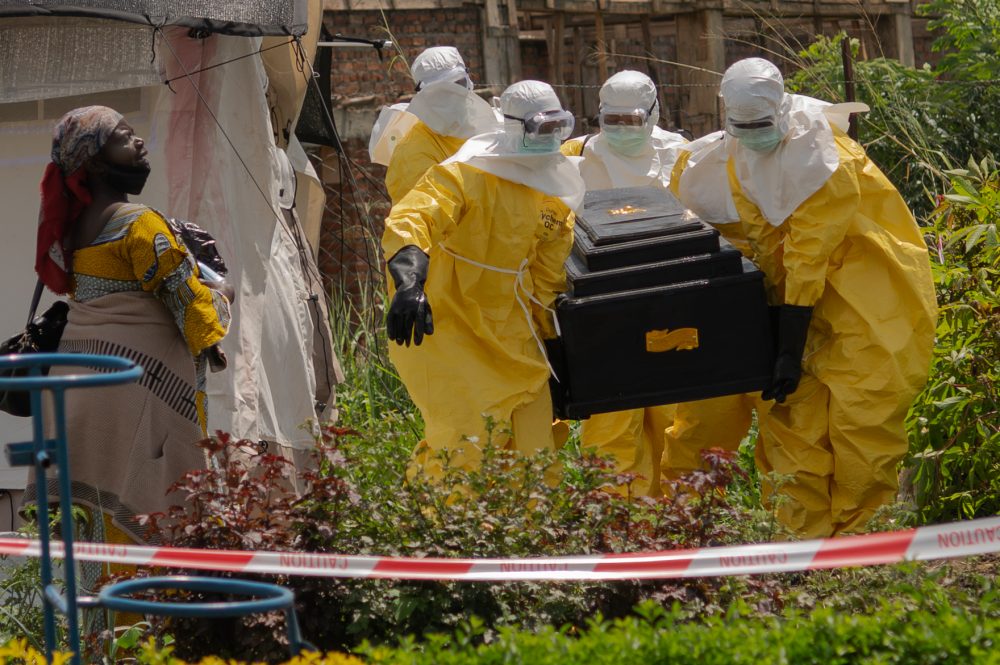
At a medical facility in Rwampara, healthcare personnel in protective equipment managed the remains of suspected Ebola victims. Family members, who traditionally wash deceased relatives’ bodies themselves, observed as workers sanitized the corpses and placed them in caskets for transport to secure burial locations. Some family members broke down in tears.
Relatives described how the illness struck without warning, with rapid decline after symptoms were initially mistaken for other diseases like malaria.
“He told me his heart was hurting,” said Botwine Swanze, whose son died from the disease. “Then he started crying because of the pain. Then he started bleeding and vomiting a lot.”
The Ebola virus spreads rapidly and transmits through human populations via contact with bodily fluids including vomit, blood or semen. Signs include fever, vomiting, diarrhea, muscle aches and sometimes internal and external bleeding.
Educational institutions and religious centers continue operating normally in the affected city. Some local residents have begun wearing protective masks, which are becoming increasingly scarce.
“It’s truly sad and painful because we’ve already been through a security crisis, and now Ebola is here too,” said Justin Ndasi, a local resident.
Anxiety is mounting at medical facilities throughout the region. A team from Doctors Without Borders discovered suspected cases over the weekend at the city’s main hospital but could not locate any available isolation ward in the vicinity, according to Trish Newport, an emergency program manager, who posted on social media.
“Every health facility they called said, ‘We’re full of suspect cases. We don’t have any space.’ This gives you a vision of how crazy it is right now,” she explained.
At another hospital elsewhere in the province, suspected Ebola patients were housed in the same ward as other injured or sick individuals.
In the town where the first known victim’s body was transported, the nearby international border remains open and gold mining operations continue, said Chérubin Kuku Ndilawa, a civil society leader, illustrating the challenges of virus containment.
“There’s no panic. People continue with their normal lives, but they’re also starting to spread the word,” Ndilawa observed, noting the absence of public handwashing facilities.
The situation was markedly different at the local general hospital, where Dr. Didier Pay reported treating approximately 30 Ebola patients, and a student from the area’s medical technology institute died on Wednesday.
“The patients are scattered here and there in rather unusual conditions,” Dr. Richard Lokudu, the hospital’s medical director, explained. “We hope for the proper triage and isolation facilities to be installed today, and if that doesn’t happen, we will be completely overwhelmed.”
The facility is understaffed and personnel lack training to handle suspected cases, he noted. If confirmed infections increase, “we have no protection.”
The World Health Organization has classified the outbreak as a public health emergency of international concern. The organization’s Director-General Tedros Adhanom Ghebreyesus stated Tuesday he was “deeply concerned about the scale and speed of the epidemic,” while the organization’s regional chief predicted the outbreak could continue for at least two months.
Research into the outbreak’s origin continues, but “given the scale, we are thinking that it has started probably a couple of months ago,” said Anaïs Legand, a viral hemorrhagic fevers specialist at the organization.
Thus far, 51 infections have been verified in the country’s northern provinces, plus two cases in neighboring Uganda, Dr. Adhanom Ghebreyesus reported Wednesday. However, “the scale of the epidemic is much larger,” he acknowledged.
The London-based research center estimates that cases have been significantly undercounted and that actual numbers could already surpass 1,000. “The true magnitude remains uncertain,” researchers stated.
The region has long experienced attacks from various armed groups, and this ongoing instability now further hampers crisis response efforts. Local officials reported that militants associated with a terrorist organization killed at least 17 people Tuesday in a village in the affected province.
Fighters with the Allied Democratic Forces, which maintains connections to the terrorist group, killed civilians using machetes and firearms, destroyed homes and businesses, and took several people hostage. Civil society organizations warned that other villages in the area face similar attack threats.
The exact number of these fighters in the country remains unclear, but they maintain a substantial presence in the region and regularly target civilians. Another active armed group in the area consists of a loose association of militia groups primarily from a local ethnic farming community.