
NEW DELHI — A youth-driven protest movement in India announced it would press forward with demonstrations on Tuesday, one day after violent confrontations shook the heart of New Delhi and sent roughly 180 people to hospitals.
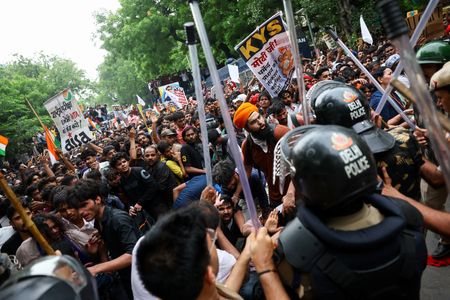
Thousands of demonstrators from Delhi and surrounding cities descended on the capital Monday, marching toward parliament in a show of force that has grown into the most serious political challenge Prime Minister Narendra Modi has faced during his third term in office.
The movement, organized by a group calling itself the Cockroach Janta Party, has attracted millions of young, Generation Z Indians. At its core, the protesters are demanding that Education Minister Dharmendra Pradhan step down following the leak of national medical school entrance exam papers in May — a scandal that affected more than 2 million students and forced many to retake the test. Some students took their own lives in the aftermath of the leak.
The group argues the exam scandal is a symptom of widespread corruption embedded in India’s education system.
Monday’s clashes between protesters and security forces resulted in nearly 180 injuries. Delhi Police reported that more than 118 of those hurt were law enforcement and security personnel, while 60 were protesters. Most of the injured were treated and released from nearby public hospitals after receiving first aid. Police also detained 70 protesters and said legal proceedings would follow.
By early Tuesday morning, roughly 150 to 200 demonstrators had gathered at Jantar Mantar, a well-known protest site in central Delhi, chanting amid light rain. Security forces remained on high alert, with paramilitary units patrolling the area and barricades creating traffic slowdowns throughout parts of the city.
“The protest against the Education Minister continues at Jantar Mantar,” the CJP movement stated in a post on X.
CJP founder Abhijeet Dipke also took to X to apologize to supporters, particularly young women who he said were struck by male police officers during the clashes. “We could have done better. I could have done better to protect you from the inhumane actions of the Delhi Police,” Dipke wrote.
The movement gained momentum after activist Sonam Wangchuk threw his support behind the cause and launched a hunger strike on June 28. Authorities forcibly removed Wangchuk to a hospital on Saturday.
One protester, Sahil Singh, who traveled from the northern state of Uttar Pradesh, described the treatment demonstrators received. “They beat us black and blue and they damaged our protest site,” Singh told Reuters. “We want accountability to be set with Pradhan’s resignation.”
On Monday, Health Minister J.P. Nadda met with two CJP leaders and requested time to bring their demands before the government for discussion.
The protesters’ list of demands includes the release of Wangchuk, Pradhan’s resignation, and financial compensation of 10 million rupees — roughly $104,000 — for the families of each student who died by suicide following the exam leak. Local media reported that approximately a dozen students took their own lives after the scandal broke.
Dipke and his supporters launched a sit-in last month focused on ousting Pradhan. On Monday, several opposition leaders and social media personalities joined the demonstration. Opposition party members condemned the government’s use of force against the largely young crowd, while leaders aligned with Modi’s party suggested the violence appeared to be coordinated.
The CJP’s rapid rise in public support reflects broader frustrations among India’s youth, including a lack of job opportunities and what protesters describe as recurring exam corruption.
Political analysts cautioned that even if negotiations bring the current demonstrations to a close, the deeper dissatisfaction among young Indians could continue to pose a serious threat to Modi’s government.
“This is an issue which affects everyone … any crackdown against the overwhelmingly peaceful protesters, as the government is wont to do, will only serve to fuel anger,” said Pearl Pandya, a senior analyst for Asia Pacific at conflict monitoring research group ACLED.