
STOCKHOLM — Sweden’s far-right Sweden Democrats believe they’ve earned their place at the governing table. After spending four years propping up a minority centre-right government and driving sweeping policy changes — particularly on immigration — the party is now demanding full membership in the next coalition cabinet.
It’s a bold move that could backfire at the ballot box. The September election may prove the demand is more than voters are willing to accept, and the situation puts Prime Minister Ulf Kristersson in a difficult position. Kristersson, who once told a Holocaust survivor he would never work alongside the Sweden Democrats, has since declared those so-called “red lines” no longer exist.
Sweden, long regarded as a pillar of European socialism, has experienced a dramatic shift to the right in both policy and public sentiment in recent years. Immigration has been at the center of that change — a particularly charged topic in a nation where one in five residents was born outside the country.
The transformation has been dramatic: the number of asylum seekers last year was down 97% compared to the peak a decade ago. What was once one of Europe’s most open immigration systems has become one of its toughest. New arrivals now face restrictions on employment, requirements to pass language and cultural tests, and reduced access to welfare benefits. Those who break the law can be quickly removed from the country, and others are offered financial incentives to leave on their own.
The Sweden Democrats were the driving force behind all of these changes. Over the past four years, the party provided 73 votes in the 349-seat Riksdag — Sweden’s parliament — to keep the centre-right government afloat, without being formal coalition members.
Now, party leader Jimmie Akesson says that arrangement is over. He wants his party inside the coalition, running the most powerful ministries if the right-wing bloc wins the upcoming election.
“It’s been a clear demand from us ahead of this election. Either we are in government or we are in opposition,” Akesson told Reuters. “We have shown that we can cooperate, it has gone better than most people expected.”
Akesson said his party expects to control at least three major cabinet posts after the election — likely justice, defence, foreign affairs, or finance. “I think that is reasonable if you look at the balance of power within our bloc,” he said. He added that he would allow Kristersson to remain as prime minister, joking: “I can do without travelling around the world and shaking hands.”
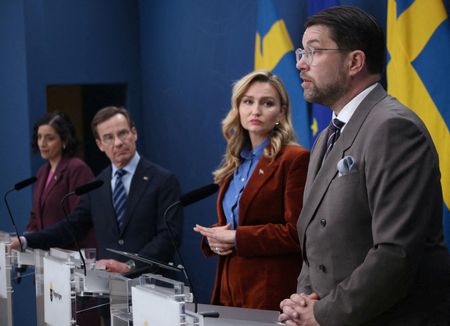
The Sweden Democrats were once shunned by every major Swedish political party, including Kristersson’s own centre-right Moderates. That changed in April when Kristersson appeared alongside Akesson at a joint press conference and officially dropped the long-standing taboo. “We have done away with red lines that can limit our cooperation and want to form a stable majority government after the election,” Kristersson announced. “That’s a strength for Sweden.”
Voters, however, don’t appear convinced. A major poll conducted in June showed the governing bloc — including the Sweden Democrats — with just 42.6% support, while the loosely united centre-left opposition, led by the Social Democrats, stood at 55.2%.
Jonas Hinnfors, a political science professor at Gothenburg University, described the prime minister’s dilemma plainly: “Kristersson is caught between a rock and a hard place. He can’t form a government without the Sweden Democrats, but they might also scare off too many voters.”
Hinnfors called Kristersson’s public embrace of the Sweden Democrats “a monumental journey” for the far-right party. “They weren’t just a small party, they were also a taboo party, a pariah party that no one wanted to touch with pliers,” he said.
The party’s origins are difficult to ignore. The Sweden Democrats acknowledge that some founding members in the 1980s had ties to neo-Nazism and white supremacy, though the party says those individuals have long since been removed.
Akesson, 47, joined the party in the 1990s and has led it since 2005, relentlessly pushing for mainstream acceptance. He plays keyboards in a Viking rock band and tends to project an easygoing image — typically appearing in a suit without a tie.
The Sweden Democrats’ rise has forced other parties to reconsider their stances, particularly on immigration and crime. Back in 2015, when more than a million asylum seekers entered Europe — most fleeing Syria — Sweden accepted more refugees per capita than any other EU country. Then-Prime Minister Stefan Lofven, a Social Democrat, declared that his Europe “didn’t build walls.”
Now, with immigration numbers already sharply reduced, the Sweden Democrats have shifted their focus to demanding that Sweden’s existing foreign-born population adopt Swedish values, language, and customs. The party advocates banning traditional Islamic dress for women, demolishing mosques that promote radical Islam, increasing deportations, and raising financial incentives for immigrants who choose to leave.
“We want the complete abolition of multiculturalism,” said Mattias Karlsson, widely regarded as the party’s leading ideologist.
While the Sweden Democrats’ poll numbers have remained relatively stable — hovering around one-fifth of the electorate — the deal to bring them into a future government has damaged other parties in the coalition. The Liberals, who currently hold 16 seats in parliament, have seen prominent members resign and party support fall below the 4% threshold required to win seats.
Liberal lawmaker Malin Sjoberg Hogrell, who stepped down from her party’s governing board and announced she would not seek re-election, was blunt: “The Sweden Democrats’ values are as far from mine as possible. To be in government with them is unthinkable.”
Opposition leaders argue that Kristersson’s arrangement with the Sweden Democrats has left voters with a clear choice: support the left if you want to keep the far right out of power.
Social Democrat leader Magdalena Andersson did not hold back at a recent news conference. “Kristersson would be the weakest prime minister in Sweden’s history,” she said. “That government would only last until the day Jimmie Akesson decides it’s time for him to become prime minister.”