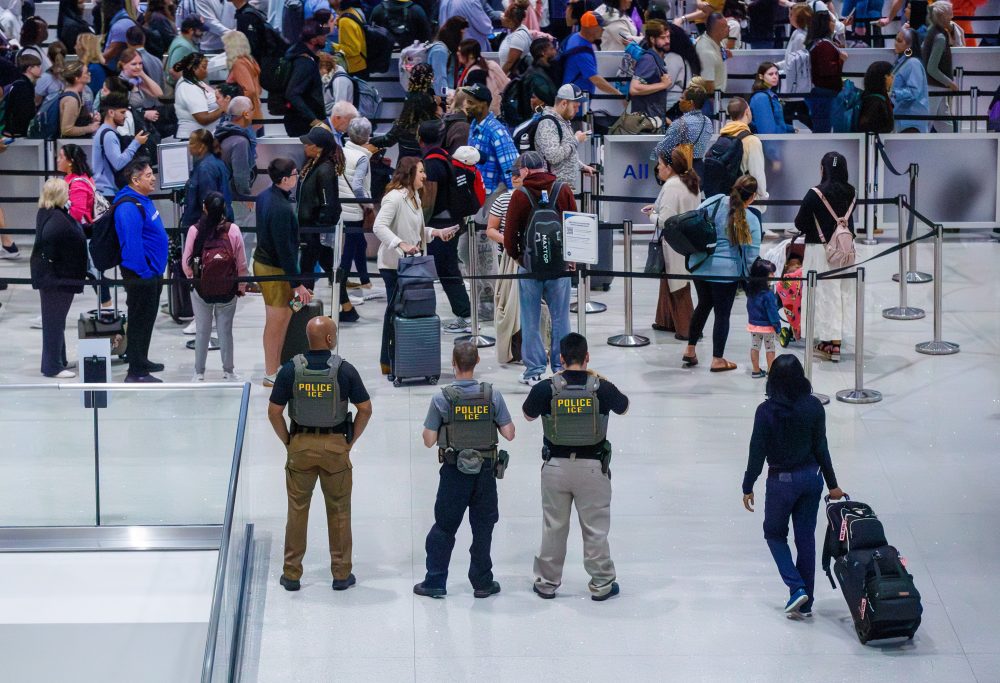

WASHINGTON — Federal immigration agents have been positioned at airports nationwide in an effort to address extensive security line delays resulting from staffing challenges during the partial government shutdown.
However, Immigration and Customs Enforcement personnel lack specialized aviation security training, and their prominent involvement in President Donald Trump’s controversial immigration policies has sparked debate about their effectiveness in reducing passenger wait times and potential impact on traveler relations.
Officials have provided limited information about the specific duties these immigration agents will perform. Trump has characterized airports as “fertile territory” for immigration operations, though he emphasized that ICE’s primary purpose there is to provide assistance.
On Monday, ICE personnel were observed positioned near security checkpoints and passenger lines, but they were not conducting passenger screenings. Extended wait times persisted at several airports.
Industry experts indicate there are significant limitations to ICE’s potential contributions.
Using ICE agents as replacements for Transportation Security Administration personnel represents a flawed approach to an increasingly critical travel crisis, according to Keith Jeffries, former TSA security chief at Los Angeles International Airport.
“Can they do some of the duties? Perhaps,” stated Jeffries, currently serving as vice president at K2 Security Screening, a company that provides airport equipment installation.
“There is just zero chance for them to be operating X-rays, conducting bag checks and pat-downs,” Jeffries explained, noting that TSA personnel undergo extensive classroom instruction in security protocols, followed by “weeks or months” of hands-on training.
Tom Homan, Trump’s border enforcement leader, indicated Sunday that immigration officers might manage exit lanes, which could allow some TSA staff to focus on security operations.
Travel industry blogger Zach Griff, who writes “From the Tray Table,” expressed cautious optimism about utilizing ICE personnel to support TSA operations while emphasizing that their deployment doesn’t represent a comprehensive solution to airport challenges.
Similar to Jeffries’ assessment, Griff highlighted the complexity of incorporating ICE agents or other personnel into baggage screening operations, which constitute TSA agents’ primary responsibility.
“That is a specialized training process that the TSA goes through with all of its agents. That’s not something that they can just kind of spin up,” Griff explained.
ICE personnel undergo their own specialized preparation that bears little resemblance to airport security procedures.
The agency encompasses Homeland Security Investigations agents and deportation officers within Enforcement and Removal Operations. Both groups receive fundamental instruction in firearms and vehicle operation, but deportation officers concentrate on immigration regulations, while HSI agents undergo extended training for complex criminal investigations, with some operating in airport environments.
ICE agents and their methods, including intensive arrest operations and expanded detention authority, have faced intense criticism since the Trump administration initiated immigration enforcement campaigns across multiple cities last year.
Immigration officers could assist with managing crowds in the massive security lines that have recently extended throughout airport terminals and beyond building entrances, Jeffries suggested.
However, ICE’s deployment could attract demonstrators who have previously disrupted their enforcement activities, potentially diverting additional airport security resources from passenger processing, Jeffries observed. Notably, Lauren Bis from the Department of Homeland Security declined Sunday to identify which airports would receive ICE officers, citing security considerations.
Introducing armed ICE agents into airports during a period of heightened immigration enforcement tensions may create discomfort among many travelers, Griff noted.
“There are going to be people who are going to be uncomfortable seeing ICE agents at the airport,” Griff stated.
Trump suggested Monday that immigration arrests might occur at airports, describing them as “fertile territory” for ICE operations. However, he added, “that’s not why they’re there, they’re really there to help.”
Trump also addressed a key issue in the congressional funding dispute — protective face coverings worn by ICE officers. In a Monday social media message, Trump expressed support for officers wearing masks when apprehending “hardened criminals,” but requested “NO MASKS” when assisting with airport operations.
Face coverings used by ICE officers have become a contentious point in immigration discussions. Opponents argue that masks enable ICE agents to avoid responsibility for potential rights violations. ICE leadership maintains they’re essential for protecting officers from personal information exposure.
Democrats have demanded that ICE officers be prohibited from wearing masks as a condition for agreeing to fund the Department of Homeland Security, which would restore TSA worker compensation.
Democratic leaders have expressed concerns about deploying ICE to airports.
“Everywhere ICE goes, trouble follows,” said Senate Minority Leader Chuck Schumer, D-N.Y. “We’ve seen that, and it is highly likely the airports will be no exception. No one trusts that ICE is going to make things better.”
Jeffries, the former Los Angeles Airport TSA security director, emphasized that resolving the congressional deadlock and fully funding DHS represents the only viable long-term solution.
“There is no substitute — and I don’t even think ICE would disagree with that,” he concluded.