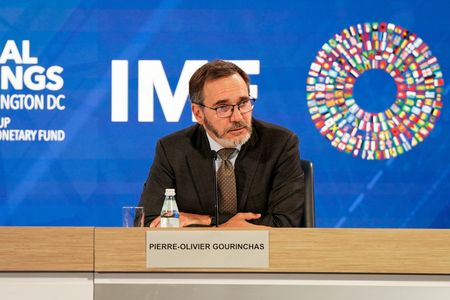

The International Monetary Fund’s chief economist has given his stamp of approval to Federal Reserve Chair Kevin Warsh’s decision to pull back on forward rate guidance, describing the move as “entirely appropriate” — though he cautioned that central banks will always need to offer some degree of long-term direction for financial markets.
Pierre-Olivier Gourinchas, who is stepping away from his role next week to return to academia, said that strong forward guidance has earned “really bad press” because it locks central banks into future actions regardless of how economic conditions change.
“That is something that is not tenable, of course,” Gourinchas said in an interview, explaining that rigid commitments proved particularly damaging when U.S. inflation spiked in 2021 and 2022 but the Fed was slow to respond because it had previously pledged to hold rates steady.
“So I think moving away from these strong forms of forward guidance is entirely appropriate. Saying there is no forward guidance, I don’t think that is actually the case ever. You do it explicitly, or implicitly, the market is going to form a view,” he said.
Warsh, who took the helm of the Fed last month, has launched a sweeping review aimed at reshaping how the central bank operates and communicates with the public. During his first policy meeting as chair, he guided a unanimous agreement around a simplified policy statement that removed any near-term guidance on potential rate actions.
Gourinchas’ remarks represent the first public comments from a senior IMF official regarding the Fed’s new communication strategy. They come after years in which the global lending institution urged central banks to be open about their monetary policy intentions in order to keep inflation expectations stable.
Gourinchas said the IMF has observed other central banks moving in a similar direction, though many continue to operate under inflation-targeting frameworks designed to manage inflation over a one-to-two-year horizon.
“You need to provide some amount of guidance, so that the market will form some views about what the long-term rates are going to be, and that actually is what’s going to have an influence on the conditions,” he said.
He added that even without explicit statements, central banks would step in to correct market expectations if they drifted too far off course. “If that view somehow is not the one that you want to communicate, central banks will communicate differently, and they will try to guide where they want it to be,” Gourinchas said.
He also pointed out that markets, businesses, and banks are constantly seeking signals to guide investment decisions, set mortgage rates, and plan ahead — a demand that extends well beyond the scheduled meetings of the Federal Open Market Committee, where interest rates are formally set.