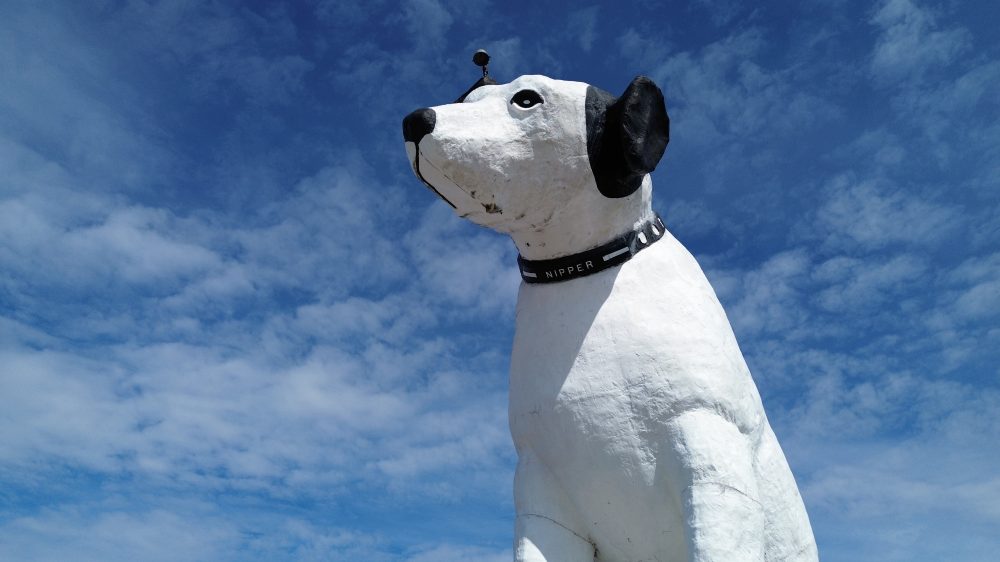

ALBANY, N.Y. — A towering canine figure that has become synonymous with Albany’s identity faces an uncertain destiny.
For nearly seventy years, the massive 28-foot white terrier known as Nipper has perched atop a warehouse building, his black ears and tilted head recreating the iconic RCA advertisement showing a dog listening to a phonograph. The composite statue, built over a steel framework, has evolved into much more than corporate advertising.
Local residents have embraced the statue as a cherished landmark along the Hudson River. Families driving past regularly show their children the distinctive figure, and Nipper’s likeness decorates everything from keychains to sweatshirts throughout the area.
“When I think of Nipper, I think of Albany. When I think of Albany, I think of Nipper,” said Cody Hitt, who was out with friends recently at a bar right by the statue.
However, that community affection now mixes with growing worry about the statue’s fate. Following extended legal battles, the empty four-story structure supporting Nipper recently received a red warning sign with white markings — an official alert advising emergency personnel to exercise extreme caution before entering.
“It’s definitely not a good thing for Nipper. He is attached to that building, so if something happens to it, it’s going to be kind of hard to take him off,” said Cara Macri, director of preservation services for the Historic Albany Foundation.
The original Nipper was a real dog from late 1800s England who got his moniker from his habit of nipping at people’s legs. After the pet’s death, Francis Barraud, the brother of Nipper’s owner, created the famous painting “His Master’s Voice,” depicting the curious dog listening to sounds from a phonograph.
The Gramophone Company purchased rights to the artwork in 1899, and it was later registered for American use. RCA obtained the “His Master’s Voice” trademark in 1929.
Albany’s version of Nipper was installed by crane in the late 1950s to mark the site of an RCA appliance distribution center.
While other Nipper replicas were created during the brand’s peak years — including a 14-foot version from 1958 now housed at Baltimore’s Maryland Center for History and Culture alongside an oversized phonograph — Albany’s version stands tallest.
The statue commands attention in a skyline otherwise dominated by the modernist state government buildings near the Capitol, including a 44-story tower and an egg-shaped theater.
At downtown’s Fort Orange General Store, merchandise featuring the famous dog consistently ranks among top sellers, appearing on everything from socks to shot glasses.
“He is kind of like our unofficial mascot here at Fort Orange, as well as the city of Albany,” said Cubello, who was wearing a Nipper hoodie.
While Nipper himself remains in excellent condition after decades of weather exposure, the structure beneath him tells a different story. The building has remained vacant for more than ten years, with peeling paint visible across its front facade.
Development plans announced a decade ago to convert the purchased building into residential units and commercial space never materialized. Foreclosure proceedings have continued for years, with city records showing an attorney serving as receiver for the property.
Legal representatives involved in the ongoing litigation did not return requests for comment.
The Historic Albany Foundation added the building to its endangered properties list in 2024. The city posted the red warning placard at the entrance in March, prompting Times-Union columnist Chris Churchill to write an urgent piece titled: “Nipper has our love, but needs more protection.”
Mayor Dorcey Applyrs’ administration reports efforts are underway to designate Nipper as an official city historic landmark, which would provide protection for both the statue and building against harmful modifications. Additionally, a state panel recently nominated the warehouse district containing Nipper’s building for inclusion on state and national historic registries, potentially making the property eligible for preservation tax incentives.
Relocating Nipper from his longtime perch is not under serious consideration, given the logistical complexity and high costs involved.
After all, finding a new location for a roughly four-ton statue presents significant challenges.
“There’s a whole redevelopment downtown. You could put him there. You could put him on the riverfront,” Macri said. “But he’s a big dog.”